

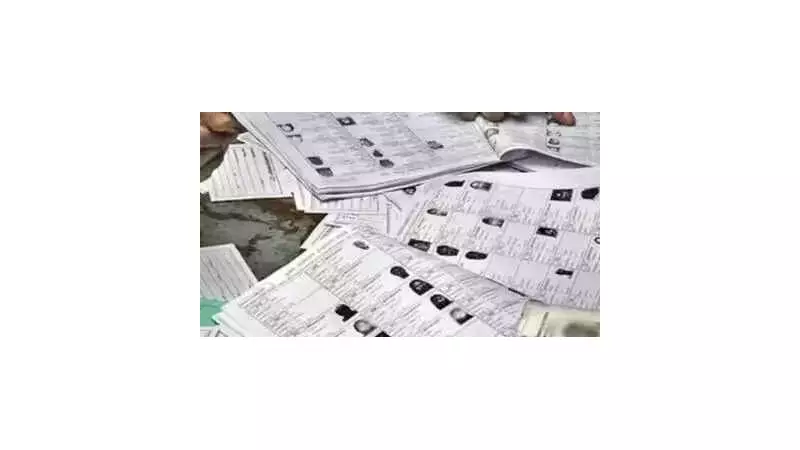
The recent special electoral roll revision camp in Chennai witnessed an overwhelming public response, with authorities receiving a staggering number of applications for voter inclusion and deletion. The two-day drive has significantly shaped the ongoing summary revision of the electoral roll, a critical process ahead of future elections.
Massive Surge in Voter Inclusion Applications
During the special camp held on Saturday and Sunday, the electoral machinery received more than 5.43 lakh (543,000) Form 6 applications. These forms are used by citizens seeking to include their names in the electoral rolls. This influx over the weekend has pushed the total number of such inclusion requests under the ongoing Summary Revision (SIR) to a remarkable 7.28 lakh (728,000).
Breaking down the weekend's data, officials recorded 2,56,793 applications on Saturday, followed by an even higher 2,86,362 on Sunday. This indicates a strong public interest in securing voting rights. The revision exercise, which provides this window for claims and objections, will continue until January 18 next year.

Deletion Requests and Ongoing Verification
Parallel to the inclusion requests, the process for cleaning the voter list also saw activity. In the last two days, 7,684 Form 7 applications were submitted by individuals seeking the deletion of names from the rolls. This brings the total number of such exclusion requests to 9,410.
In a significant parallel exercise, the Election Commission of India (ECI) has commenced issuing notices to a vast pool of 12,43,363 (over 1.24 million) electors. These notices are targeted at voters whose details require confirmation or whose records need correction and verification. TN chief electoral officer Archana Patnaik stated that upon receiving these notices, electors must submit relevant documents as prescribed by the ECI during hearings conducted by the Assistant Electoral Registration Officer or Electoral Registration Officer.
Understanding the Forms and Process
Archana Patnaik clarified the purpose of the various forms available to citizens during this period. Form 6, along with a declaration form, is for electors whose names are missing from the draft roll and for newly eligible voters. Form 7 is to be used for requesting deletion of a name or raising an objection against an existing entry.
She further added that Form 8 is the designated application for electors who have shifted residence, need corrections in existing entries, require a replacement of their Electors Photo Identity Card (EPIC), or for marking people with disabilities in the records.
Major Clean-Up and Final Publication Date
The scale of the ongoing electoral roll revision is underscored by the draft roll published on December 19. According to that draft, a massive 97.37 lakh (9.737 million) voters were deleted from the previous list. The grounds for deletion included being untraceable, deceased, having permanently shifted, or having multiple entries in different constituencies.
This extensive clean-up operation reduced the total electorate in the revision area from 6.41 crore to 5.43 crore. A detailed breakdown of the deleted voters shows that 66.44 lakh were categorised as permanently shifted or absentees, 26.94 lakh were deceased, and 3.98 lakh were removed for being enrolled in more than one constituency.
The entire process is moving towards a crucial deadline. The final publication of the revised electoral roll is scheduled for February 17, 2026. This will be the definitive list that will be used for forthcoming electoral events, making the current claims and objections period vital for every eligible citizen to ensure their franchise.






