

The Legal Framework Behind EVM Candidate Placement
The precise positioning of a candidate's name, electoral symbol, and photograph on the Electronic Voting Machine (EVM) is not a random occurrence. It is governed by a meticulous process established under the Representation of the People Act, 1951, the Conduct of Election Rules, 1961, and the Election Commission of India's own procedural manual. This system ensures uniformity and fairness across all constituencies during elections.
The Three-Tier Grouping System for Candidates
Candidates are systematically organized into three distinct blocks on the EVM ballot unit. The first block is exclusively reserved for candidates representing recognised national and state political parties. Following this, the second block accommodates candidates from registered but unrecognised political parties. The final group is composed entirely of independent candidates who are not affiliated with any party.
Within each of these three groups, the returning officer arranges the candidate names strictly in alphabetical order according to the Tamil language. Sequential numbers are then assigned based on this alphabetical arrangement. It is important to note that professional titles such as "Dr" or "Prof" are completely disregarded during this sorting process. Similarly, the political stature or public prominence of a candidate holds no weight in determining their position on the ballot.

This structured approach means that if there are, for example, eight candidates in the first block of recognised parties, the very first candidate from a registered-unrecognised party will automatically receive candidate number 9 on the EVM.
Real-World Examples from Tamil Nadu Constituencies
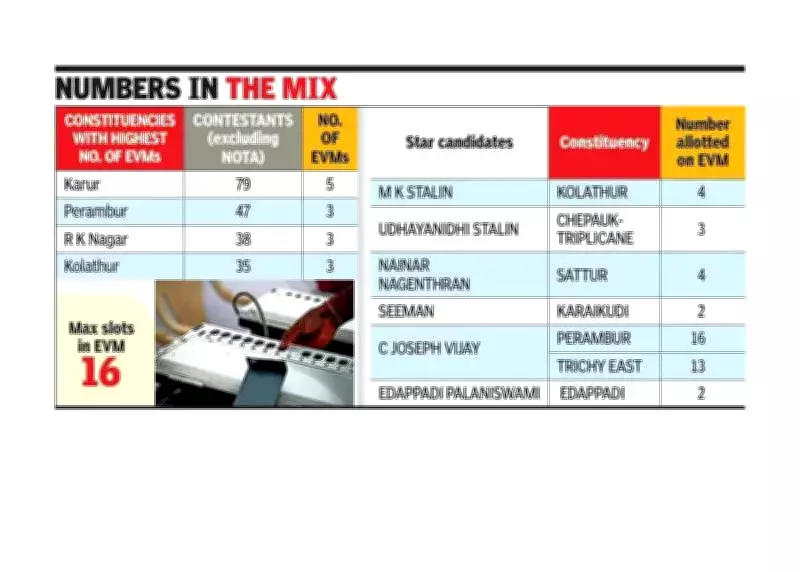
This procedural system explains specific candidate placements in the ongoing Tamil Nadu elections. Chief Minister M K Stalin appears as candidate number 4 in the Kolathur constituency. Meanwhile, his son and deputy, Udhayanidhi Stalin, is listed as number 3 in the Chepauk constituency. Consequently, Stalin's name will be displayed fourth on the first of the three ballot units deployed in Kolathur. Udhayanidhi's name will appear third on the first of the two interconnected ballot units in his constituency.
In Kolathur, three rival candidates—AIADMK's P Santhana Krishnan, BSP's Subashini, and NTK's Soundara Pandian Luder Seth—are positioned ahead of Chief Minister Stalin. This occurs because their names, in Tamil alphabetical order, precede "Stalin." The linguistic reason is that the "Sta" in Stalin does not correspond to a native Tamil consonant cluster, which pushes his name further down the list.
A similar scenario applies to TVK leader and popular actor Joseph Vijay, contesting from Perambur. The "Jo" in Joseph is not a native Tamil consonant cluster. As a result, he is placed at position 16, which is the final slot in the second group of unrecognised party candidates. This makes him the last name on the first of the three EVM units in Perambur. His ballot position in the Trichy (East) constituency is number 13.
The Strategic Impact of Ballot Position on Voter Psychology
Election experts and political analysts emphasize that a candidate's position on the EVM can function as a subtle, yet powerful, campaign tool in itself. A name listed at the very top of the ballot enjoys prime visibility. This prime spot can capture the attention of voters who are in a hurry or remain undecided, as they may cease scanning the list once they encounter a familiar name, face, or party symbol.
Conversely, the final slot on a ballot unit can also be advantageous due to its distinct placement. However, lesser-known candidates positioned in the middle of a long list—or those appearing on a second or third ballot unit—face a significant challenge. They risk being overlooked in a visual blur of similar-looking names, photographs, and electoral symbols, potentially reducing their visibility to voters.
Technical Constraints and Maximum Candidate Capacity
Each individual EVM ballot unit has a technical limitation: it can accommodate a maximum of only 16 candidates. Once the number of contestants in a constituency exceeds this limit, a second ballot unit is physically connected or "bolted on" to the first. The candidate sequence then continues uninterrupted across the linked units.

According to returning officers, the EVM system is theoretically capable of supporting up to 24 interconnected ballot units. For the current Tamil Nadu elections, the maximum required will be five units. The Karur constituency, with a staggering 80 candidates—the highest in the state—will utilize five ballot units. Constituencies such as Perambur, Dr Radhakrishnan Nagar, and Kolathur will each require three interconnected units. In these multi-unit setups, the NOTA (None of the Above) option is systematically placed in the final row of the very last machine in the sequence.





