

With just ten days remaining for the Special Intensive Revision (SIR) exercise, booth-level officers (BLOs) in Gautam Budh Nagar (Noida) and Ghaziabad are engaged in a final push to locate a massive number of missing voters. The administrations are focusing on tracing citizens who have remained untraceable since the revision process began on November 4.
Scale of the Challenge: Lakhs of Voters Untraceable
The numbers reveal a significant task ahead. In Gautam Budh Nagar district, a staggering 4.85 lakh voters out of a total 18.68 lakh are currently classified as untraceable or missing. This constitutes nearly 26% of the electorate. In neighbouring Ghaziabad, the situation is similarly challenging, with over 7.73 lakh of the total 28 lakh voters—more than 27.6%—at risk of being removed from the rolls.
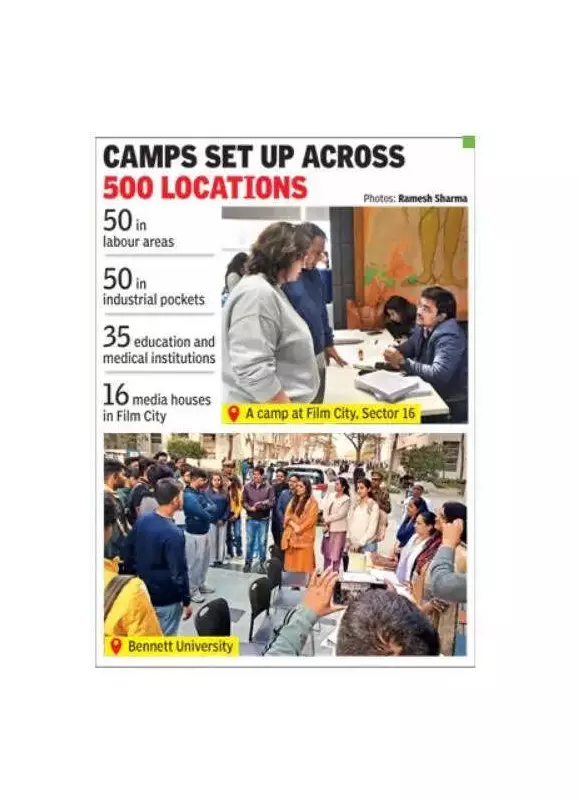
To address this, the administrations have launched large-scale voter verification camps. On Monday and Tuesday, more than 500 locations across offices, universities, factories, and institutions are hosting these camps. The timing, strategically set between noon and 2 PM, allows working professionals to utilise their lunch breaks to submit or collect enumeration forms, as well as Forms 6 and 8, without leaving their workplaces.

Targeted Outreach Across Sectors
The outreach is comprehensive. Camps have been set up at around 50 locations in labour areas and another 50 in industrial pockets. Furthermore, 35 educational and medical institutions are facilitating updates for students and staff. Even media hubs, including 16 media houses in Film City, have been covered to ensure no segment of the population is missed.
As of Monday afternoon, data shows progress. In GB Nagar, 66% of enumeration forms have been returned and digitised by BLOs. However, 1.5 lakh voters (8.06%) are confirmed for deletion from the electoral roll. These fall into categories such as absent, shifted, dead, refused to sign, or are duplicate entries. The breakdown is as follows:
- Absent: 18,680 (1%)
- Shifted: 92,466 (4.9%)
- Duplicate: 15,878 (0.8%)
- Dead: 16,065 (0.8%)
- Refused to Sign: 7,472 (0.4%)
Administration's Strategy and Directives
District Magistrate Medha Roopam personally reviewed the process at several locations on Monday. She directed BLOs to carefully segregate records, particularly of students who graduated and moved away, while ensuring that first-time voters submitting Form 6 are added without delay.
"Most college students registered from campus booths have already shifted out, which is why a large number are being dropped from the list," Roopam told TOI. "However, at the same time, new voters continue to be added as Forms 6 are being collected from first-timers and these names will reflect in the final roll published after the SIR exercise in February." She emphasised that with one extra week, the goal is to ensure not a single eligible voter is left out.
Ghaziabad's Cross-Verification Process
In Ghaziabad, District Magistrate Ravindra Mander outlined a cautious approach. The list of voters marked under the ASD (Absent, Shifted, Dead, Duplicate, Refused to sign) category has been shared with political parties' booth-level agents (BLAs) for cross-verification before final deletion on December 11.
"We have shared the lists with all political parties' BLAs so that they can cross-verify this so that there are no claims once the draft electoral roll is published on December 16," Mander stated. Here, the ASD category includes 3.9 lakh absent voters, 2.9 lakh shifted voters, 52,000 dead voters, 18,000 duplicate voters, and 18,000 who refused to sign.
Mander noted that 50% of enumeration forms have been digitised in Ghaziabad so far, and over 70% of the SIR work is complete. The administration is now focused on tracing the remaining 23% or 6.40 lakh voters who are still untraceable or whose forms are pending.
As the clock ticks down, the concerted efforts in these key National Capital Region (NCR) districts underscore the critical push to finalise an accurate and inclusive electoral roll for the upcoming elections.






