

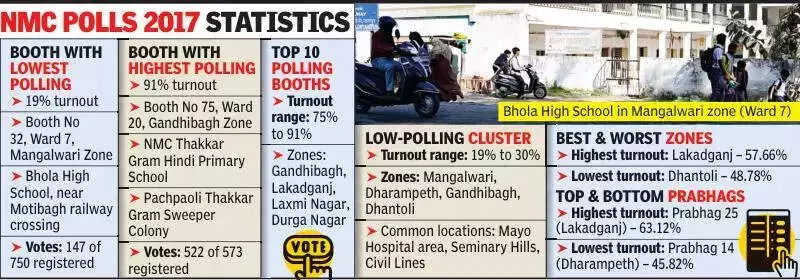
The 2017 Nagpur Municipal Corporation (NMC) elections painted a starkly contrasting picture of urban democracy, where intense political engagement in some pockets existed alongside near-complete voter disengagement in others. This divide was most glaringly visible at the booth level, with one polling station recording the city's lowest turnout and another its highest, setting the extremes of civic participation.
The Extremes: Apathy vs. Enthusiasm
The symbol of voter indifference was Polling Booth No. 32 at Bhola School, located near the Motibagh railway crossing in Mangalwari zone's Ward 7. Here, only 147 out of 750 registered voters cast their ballots, resulting in a dismal 19% turnout, the lowest recorded across Nagpur. This booth has since come to represent the deep electoral fault lines within the city.
At the opposite end of the spectrum was Polling Booth No. 75 at the NMC Thakkar Gram Hindi Primary School in the Pachpaoli Thakkar Gram Sweeper Colony, under Ward 20 of Gandhibagh zone. This location showcased remarkable democratic participation, with 522 of 573 voters exercising their franchise, achieving an impressive 91% turnout, the city's highest. A nearby booth in the same locality, Booth No. 76, also logged a strong 83% polling, indicating sustained local engagement.

Zone-Wide Patterns and Performers
The analysis of booth-wise data from 2017 reveals clear patterns. Areas with strong community ties, like railway colonies and established residential belts, consistently outperformed. For instance, booths at GP Kove Vidya Mandir in Lakadganj's Ward 24 registered turnouts of 89% and 78%. Lokanchi School in Siraspeth (Ward 18, Gandhibagh) posted 86%. Overall, the top 10 polling booths, located in Gandhibagh, Lakadganj, Durga Nagar, and Laxminagar zones, recorded turnout figures ranging from 75% to 91%.
Conversely, the list of low-turnout booths was dominated by areas in Mangalwari, Dharampeth, Gandhibagh, and Laxmi Nagar zones. These were typically institutional or rental-heavy neighborhoods around Mayo Hospital, Seminary Hills, Civil Lines, Ravi Nagar, and Dhantoli, where turnout largely hovered between a poor 23% and 29%, despite having large voter bases.
Prabhag-Level Insights and Nagpur's Overall Picture
The booth-level extremes were mirrored in the prabhag-wise (ward committee) voting patterns. At a macro level, Nagpur witnessed middling overall turnout. Lakadganj emerged as the best-performing zone with 57.66% polling, driven by Prabhag 25's city-high of 63.12%. It was followed by Satranjipura (56.97%), Nehru Nagar (56.10%), and Gandhibagh zones (54.89%), pointing to stronger engagement in traditional residential areas.
On the other hand, Dhantoli zone recorded the lowest cumulative turnout at 48.78%, weighed down by weak participation in Prabhags 16 and 35, both failing to cross the 48% mark. Sharp contrasts were evident even within the same zone. In Laxmi Nagar, turnout ranged from 48.13% in Prabhag 36 to 60.55% in Prabhag 38. Dharampeth zone was dragged down by Prabhag 14's poor 45.82% polling.
The data underscores a crucial reality for future civic polls: Nagpur's core democratic challenge is not a lack of voters but the severe unevenness of their participation. While some booths and prabhags demonstrate what focused community outreach and mobilization can achieve, the haunting 19% turnout at Bhola School, Motibagh, remains a sobering reminder of the significant urban electorate that continues to disengage from the ballot box.






