

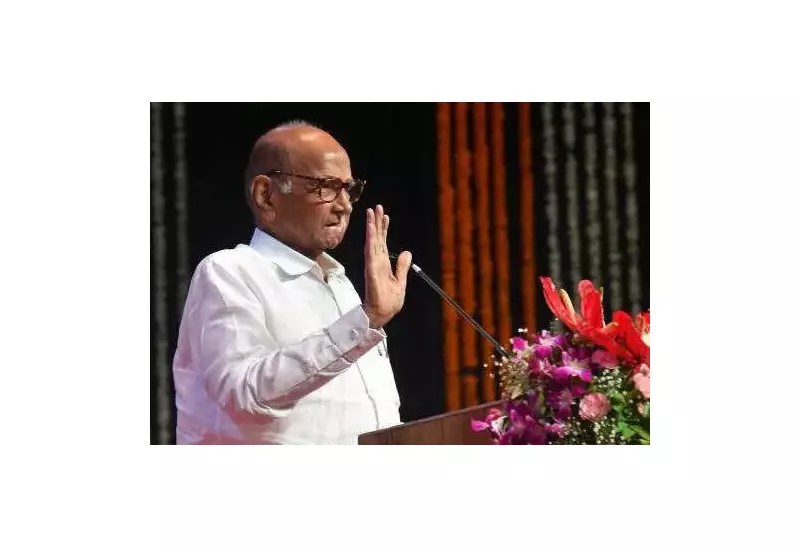
In a significant political development just ahead of the crucial Brihanmumbai Municipal Corporation (BMC) elections, the Nationalist Congress Party led by Sharad Pawar, or NCP (SP), has been dealt a severe blow. The party's Mumbai unit witnessed a major exodus on Monday, with its city president and several poll aspirants switching allegiance to rival camps.
Key Defections Rock NCP (SP) Mumbai Unit
The most prominent defection was that of Rakhi Jadhav, the president of the NCP's Mumbai unit, who joined the Bharatiya Janata Party (BJP). Alongside her, several other election hopefuls, including Nitin Deshmukh and former corporator Dhananjay Pisal, crossed over to the rival faction led by Deputy Chief Minister Ajit Pawar. Pisal, who previously served as the NCP group leader in the BMC, will now contest from ward number 111 on an Ajit Pawar-led NCP ticket.
Jadhav, a three-time corporator, cited dissatisfaction with the response from the NCP (SP) leadership as her reason for joining the BJP. "BJP is working for Mumbai, and I took this decision to work in my constituency," she stated. "I did not get the expected response from NCP (SP), and we could not do justice to the party workers."

Failed Alliances and Leadership Vacuum
Political observers point to a series of strategic failures that have pushed the NCP (SP) to the brink of disintegration in India's financial capital. The party's state president, Shashikant Shinde, and senior leader Jayant Patil, failed to stitch together a viable alliance with their Maha Vikas Aghadi (MVA) partners—the Shiv Sena (UBT) and the Congress—despite holding several rounds of talks.
Furthermore, the two senior leaders were unable to provide clear direction to the party cadre and local leaders, leaving them in a lurch and forcing them to seek alternative political options. "There is a total collapse of the NCP (SP) party machinery in Mumbai. This was purely because of poor handling of affairs," a political observer remarked.
Strategic Missteps and Organizational Collapse
The observer further elaborated that the party's refusal to finalize an alliance with either side proved disastrous. "They should have allied with Ajit Pawar's NCP like they are doing in Pune and Pimpri-Chinchwad. But by not finalising an alliance with either side, they ended up destroying whatever little party organisation was there," the observer said. "They lost good candidates to BJP, which is a setback. It seems that NCP (SP) gave up BMC altogether. Surprisingly, Ajit Pawar's NCP did better."
In a last-minute move, the NCP (SP) released its first list of seven candidates for the BMC polls on Monday. The list includes names like Ajit Raorane (ward 43), Sanjay Kamnle (ward 140), Manju Jaiswal (ward 112), and Ganesh Shinde (ward 48). This comes after the undivided NCP had secured eight corporators in the 2017 BMC elections, with party supremo Sharad Pawar historically commanding a strong base in several wards.
The alliance negotiations were particularly messy. For over a week, the NCP (SP) held parallel talks with both the Sena (UBT) and the Congress, but neither yielded a concrete result. The party initially demanded 50 seats from the Congress after efforts to reach a deal with the Sena (UBT)-MNS combine fell through. Congress functionaries claimed they offered around two dozen seats, considering the NCP (SP)'s limited presence in certain areas.
On December 26, Jayant Patil met Sena (UBT) president Uddhav Thackeray at Matoshree. Sena (UBT) MP Sanjay Raut later commented, "There is no need to announce that the NCP (SP) is with us...We left most of the seats that they wanted. That means an alliance was formed. Some of the seats they wanted went to the MNS, so we told them to discuss it with Raj Thackeray. We ended this issue from our side."
The defections and failed alliances represent a critical weakening of the Sharad Pawar-led faction's position in Mumbai's civic politics, handing a significant advantage to both the BJP and the Ajit Pawar-led NCP as the city prepares for the high-stakes BMC elections.






