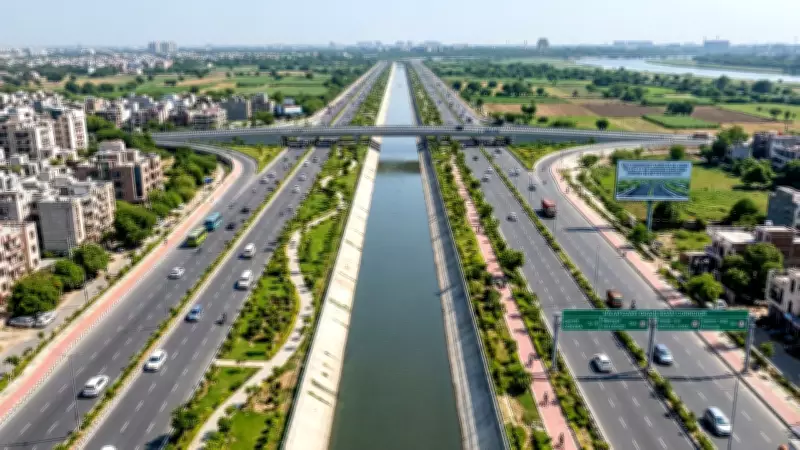
Delhi Government Greenlights Major 61-Km Road Corridor Project
In a significant move to enhance urban mobility, the Delhi government has officially approved a substantial infrastructure project valued at Rs 454 crore. This initiative focuses on developing an extensive 61-kilometer road corridor along both sides of the Najafgarh drain, designed to alleviate persistent traffic congestion and boost intra-city connectivity across various urban and rural areas of the national capital.
Project Timeline and Phased Construction Approach
The ambitious corridor is slated for completion by November 2027, with a structured timeline to ensure efficient execution. Construction will proceed in carefully planned phases, commencing with tendering processes starting in April and physical work kicking off in May. This systematic approach aims to facilitate the orderly development of a two-lane road alongside the drain, complemented by essential associated infrastructure.
Detailed Layout and Strategic Connectivity
The project encompasses a total length of 60.7 kilometers along the Najafgarh drain, featuring specific segments to maximize utility. This includes a 5.9-kilometer stretch on the left bank from Jhatikra Bridge to Chhawla Bridge, along with 27.4 kilometers of roads on both sides from Chhawla to Basaidarapur. Strategically, the corridor will intersect and link with major arterial routes such as the Outer Ring Road, Inner Ring Road, Shivaji Marg, Pankha Road, UER-II, and Najafgarh Road, providing direct access to critical hubs like IGI Airport and the Dwarka Expressway to enhance travel efficiency.

Comprehensive Urban and Rural Benefits
This infrastructure development promises to deliver widespread benefits, improving access for residents in key localities including Uttam Nagar, Vikaspuri, Najafgarh, Dwarka, Paschim Vihar, Rajouri Garden, and numerous surrounding villages. Villages adjacent to the Dwarka Expressway will particularly gain from enhanced connectivity to vital city routes and infrastructure, fostering better integration and mobility.
Advanced Road Design and Amenities
The corridor will feature a 7-meter-wide design, incorporating dedicated tracks for walking, jogging, and cycling to promote sustainable transportation. Additional amenities will include extensive landscaping, tree plantation, modern street lighting, clear signage, and new bridges. To address environmental concerns, the project includes robust drainage systems and boundary walls to prevent waterlogging and protect government land along the drain.
Implementation Framework and Approvals
The project has already secured necessary technical and flood control committee sanctions, with administrative approvals anticipated imminently. Following this, tendering will be finalized and construction initiated, ensuring a methodical and efficient execution process that prioritizes the safety and well-being of both urban and rural communities in the surrounding areas.