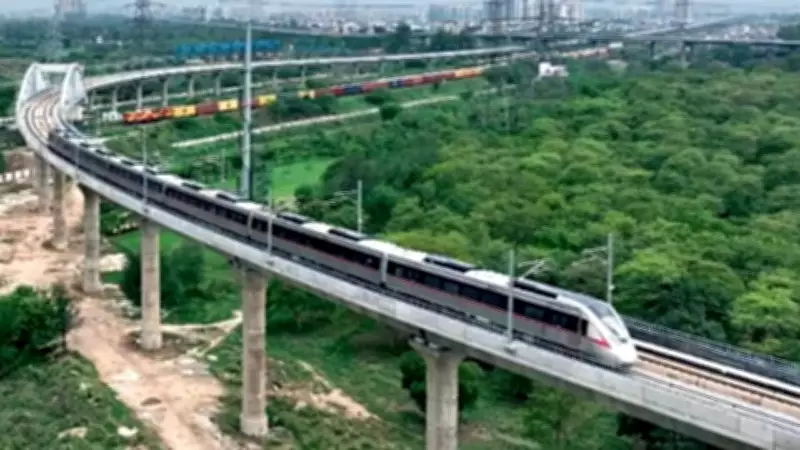
Haryana Greenlights Gurgaon-Faridabad-Noida Namo Bharat Corridor with Integrated Transport Hubs
In a significant move to bolster urban transportation, the Haryana government has officially cleared the alignment for the Gurgaon–Faridabad–Noida Namo Bharat corridor. This ambitious project, proposed by the National Capital Region Transport Corporation (NCRTC), includes the establishment of six metro stations and two integrated RRTS-cum-metro hubs within Gurgaon, aiming to streamline both intercity and intracity travel.
Government Approval and Strategic Planning
Chief Minister Nayab Singh Saini announced the approval during a session in the Haryana Assembly on Wednesday, describing it as "an important step in the direction of urban transport." The decision follows a high-level meeting chaired by Saini on Tuesday, where NCRTC officials presented a comprehensive plan to operate Namo Bharat and metro services on the same alignment within the city. This integrated approach is designed to optimize infrastructure and improve connectivity across the region.
Station Details and Operational Model
Under the approved plan, IFFCO Chowk and Sector 61 will serve as integrated RRTS-cum-metro hubs, facilitating seamless transfers between high-speed regional rail and local metro services. Additionally, six metro-only stations will be constructed at:

- Sector 29
- Millennium City Centre
- Sector 52
- Wazirabad
- Sector 57
- Sector 58/61
These stations are specifically intended to support daily intracity travel, catering to the commuting needs of residents within Gurgaon. An NCRTC official explained that this model allows high-speed RRTS trains to handle intercity movement efficiently, while metro services focus on shorter trips within the city, utilizing the same corridor to avoid duplication of infrastructure.
Corridor Specifications and Environmental Considerations
The proposed corridor spans a total length of 64 kilometers, with 52 kilometers located in Haryana, covering key areas in Gurgaon and Faridabad. The route will commence at IFFCO Chowk and proceed towards Gwalpahari via Sector 29, Millennium City Centre, and sectors 52, 57, and 61 along the Golf Course Road Extension. NCRTC officials emphasized that the alignment was carefully planned to serve existing and upcoming residential and commercial sectors while avoiding ecologically sensitive zones, such as the Tau Devi Lal Biodiversity Park.
Integration with Existing and Future Networks
For enhanced connectivity, the alignment is designed to integrate with multiple transport systems:
- Delhi Metro's Yellow Line at Millennium City Centre
- Rapid Metro at Sector 61, which may require an extension of approximately 1 kilometer
- The proposed metro corridor between Sector 56 and Pachgaon
This integration is expected to provide long-term connectivity between Indira Gandhi International Airport and the upcoming Noida International Airport in Jewar, significantly boosting regional mobility. The project is estimated to cost around Rs 15,000 crore, with a detailed project report (DPR) set to be prepared soon.
Addressing Congestion and Alternative Proposals
Union Minister Rao Inderjit Singh had previously raised concerns about potential congestion at IFFCO Chowk, noting that the location will already host an RRTS station under the Delhi–Gurgaon–Bawal corridor and an operational Yellow Line metro station. In response, Gurgaon Metro Rail Limited (GMRL) proposed an alternative plan, suggesting that the Gurgaon–Faridabad–Noida Namo Bharat corridor be built underground in the city rather than elevated. GMRL recommended starting the underground stretch from Rajiv Chowk instead of IFFCO Chowk, arguing that Rajiv Chowk serves denser residential and commercial areas in Old Gurgaon, which could generate higher all-day ridership and better integrate with the planned Delhi–Gurgaon–Manesar–Bawal RRTS corridor.

Faridabad Section and Broader Impacts
In Faridabad, an integrated section of approximately 16 kilometers from Sainik Colony to Badshapur has been approved. This stretch will cover key areas including NIT, Bata Chowk, Sectors 12 to 15, and parts of New Faridabad, connecting with Delhi Metro's Violet Line. The Faridabad area will feature two integrated RRTS-cum-metro stations and eight metro-only stations, further enhancing local connectivity.
Vision for Sustainable Urban Growth
Chief Minister Saini highlighted that the corridor will offer seamless and high-speed travel to lakhs of commuters, reduce traffic congestion, and contribute positively to environmental sustainability. He also emphasized that the project will open new avenues for investment, employment generation, and balanced urban growth in Haryana. With the rising population and increasing traffic pressure in cities like Gurugram and Faridabad, the project is being meticulously designed to meet future mobility demands. Saini assured that, through close coordination between the central and state governments, the administration is committed to ensuring timely execution of this transformative infrastructure initiative.