

Nagpur Municipal Corporation Faces Severe Audit Crisis with Six-Year Backlog
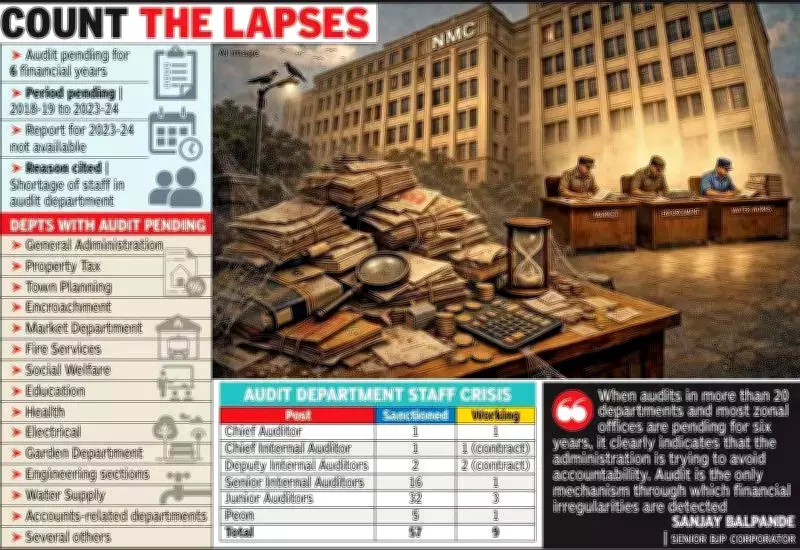
Financial oversight within the Nagpur Municipal Corporation (NMC) has effectively collapsed, as audits in the majority of its 22 departments remain pending for an alarming six consecutive financial years, spanning from 2018-19 to 2023-24. This extensive delay raises profound questions about the monitoring of expenditure and revenue during a period rife with allegations of irregularities.
Critical Audit Failures and Departmental Neglect
Official records reveal that for the financial year 2022-23, audits were completed in only three departments: market, enforcement, and water works. This minimal compliance underscores a systemic failure in financial scrutiny. The communication issued by the NMC audit department confirms that audits across key departments—including property tax, general administration, town planning, health, education, electrical, garden, social welfare, and fire services—are still pending from 2018-19 to 2023-24.
Even the crucial accounts and finance department has not finalized its audit for this entire period, with officials admitting that the process from 2018-19 to 2023-24 is still underway. This backlog coincides with the administrator's rule in the civic body from March 2022 to January 2026, a time when there were no elected representatives in the corporation.

Political Allegations and Irregularities
During this period, former corporators and political leaders repeatedly accused the administration of serious irregularities. Allegations include awarding works to contractors who quoted up to 40% below estimates, only to later inflate project costs by adding extra items. Other claims involve questionable decisions in garden and sports departments, as well as irregularities in DPDC-funded works.
The documents were accessed by senior BJP corporator and lawyer Sanjay Balpande, who asserts that the prolonged delay in auditing key departments points to a deliberate attempt to shield these irregularities. "If financial scrutiny had been conducted on time, several controversial decisions taken between 2018-19 and 2023-24 would have been exposed much earlier," Balpande stated.
Zonal Audit Woes and Staffing Crisis
The situation at the zonal level is equally dire. Out of 10 zones in Nagpur, audits in six zonal offices—Hanuman Nagar, Nehru Nagar, Gandhibagh, Satranjipura, Lakadganj, and Laxmi Nagar—are still under process. While the accounts department claims that audits for four to five zones from 2018-19 to 2023-24 have been completed, the final consolidated audit reports have not been issued due to the overall incomplete audit process.
For instance, the Laxmi Nagar zone audit was reportedly delayed due to elections, though officials now claim completion for 2022-23 and 2023-24. Four other zonal offices—Dharampeth, Dhantoli, Ashi Nagar, and Mangalwari—have only completed audits for one financial year, 2022-23, leaving a significant backlog.
Compounding the issue is a severe staffing crisis in the audit department, with only nine employees working against 57 sanctioned posts. Balpande argues that these vacancies have persisted for years without serious efforts to fill them, suggesting that the delay may have been convenient for the administration to avoid accountability.
Implications for Civic Governance and Political Fallout
Balpande emphasized that this delay cannot be dismissed as a routine administrative lapse. "When audits in more than 20 departments and most zonal offices are pending for six years, it clearly indicates that the administration is trying to avoid accountability. Audit is the only mechanism through which financial irregularities are detected," he said.
With civic finances already under pressure and multiple departments facing allegations of irregularities, these revelations are poised to intensify political confrontation in the general body. The administration will likely face mounting pressure to explain why financial scrutiny was ignored for such an extended period, potentially leading to calls for reforms and increased transparency in Nagpur's municipal governance.






