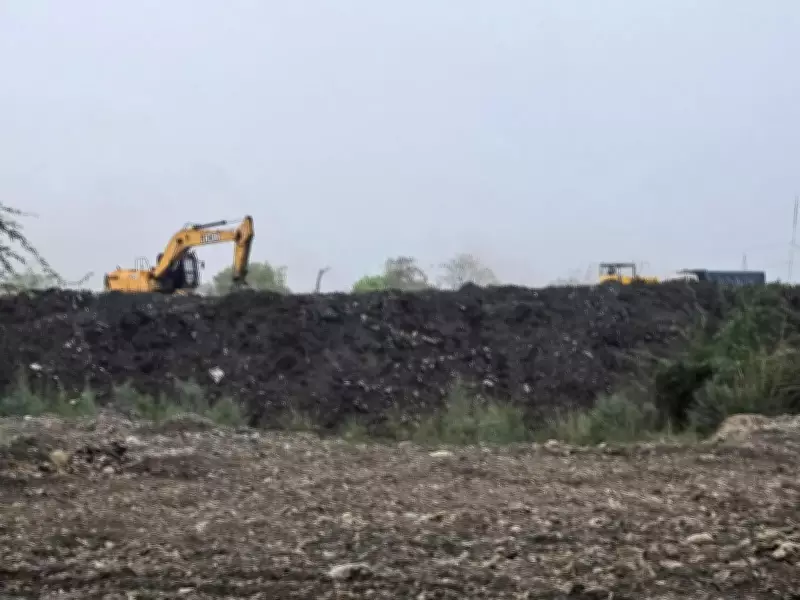
New Delhi: The Municipal Corporation of Delhi (MCD) is planning to extend the deadline for flattening the Okhla landfill for the fifth time since 2022, setting October 2026 as the new target. Nearly 15 lakh tonnes of legacy waste still remain at the dumpsite.
Repeated Delays and Challenges
The original deadline of December 2023 was pushed to May 2024, then to December 2025, and later to July 2026 due to capacity constraints and delays in remediation work. With the monsoon expected to hit the city by the end of June, corporation officials stated that biomining operations are likely to slow down as processing wet waste becomes difficult, making complete clearance before July 31 nearly impossible.
“Also, diverting all machinery there is not feasible as there’s not enough space to install them,” an official said.

Current Status of Delhi’s Landfills
Okhla is among Delhi’s three major legacy dumpsites currently undergoing biomining and land reclamation. The MCD’s deadlines for flattening the Bhalswa and Ghazipur landfills continue to be December 2026 and December 2027, respectively.
Mayor Pravesh Wahi said, “We are working hard to ensure all three landfills are cleared within the stipulated time. But July and August bring monsoon rain, which is expected to push back work by two to three months. We have directed officials to work with full force to eliminate these mountains of garbage. Senior officials are expected to visit the sites soon.”
With the current processing rate at Okhla being around 10,000 metric tonnes (MT) per day, sources indicated it will be difficult to clear the remaining waste within the next 74 days (from May 19 to July 31).
Environmental Concerns and Criticism
The repeated extensions have drawn criticism from environmental groups and residents living near the landfill, who have long complained about pollution, health hazards, and safety risks.
According to MCD data, the total leftover legacy waste at the three landfills currently stands at around 105 lakh MT, comprising 69.2 lakh MT at Ghazipur, 21.1 lakh MT at Bhalswa, and 14.8 lakh MT at Okhla.
While remediation progress has varied across these sites, 4,000 to 5,000 MT of fresh waste continues to be dumped daily, further complicating the flattening process. Besides municipal waste, silt from drains and ash generated from waste-to-energy plants are also being dumped at these landfills.
Government Initiatives and Proposals
To accelerate remediation work, the MCD has approached the central government to include all three landfill sites under the Dumpsite Remediation Accelerator Programme (DRAP), a year-long fast-track initiative launched by the Ministry of Housing and Urban Affairs under Swachh Bharat Mission–Urban 2.0 for scientific clearance of legacy waste at 214 high-impact dumpsites across the country.
“While the Centre has considered Bhalswa dumpsite under DRAP, MCD has submitted proposals for Okhla and Ghazipur for consideration under the programme,” sources said.
Of the three sites, progress at Bhalswa has been relatively better, while slow remediation at Ghazipur continues to remain a major concern, officials said. The Ghazipur landfill, which once rose to nearly 65 metres — only eight metres shorter than Qutab Minar — had prompted intervention by the National Green Tribunal, following which biomining operations were launched in 2020.
Future Plans for Waste Processing
To prevent future dumping at Bhalswa, the MCD has proposed five new waste-processing facilities, including one at each of the landfills, another at the Singhola silt dumping ground, and the fifth near the Integrated Freight Complex in Ghazipur. Officials said the tendering process for these projects is currently underway, though it may still take months before they become fully operational.