Pune Traffic Gridlock: Defunct Signals Trigger Three-Hour Commuting Nightmare
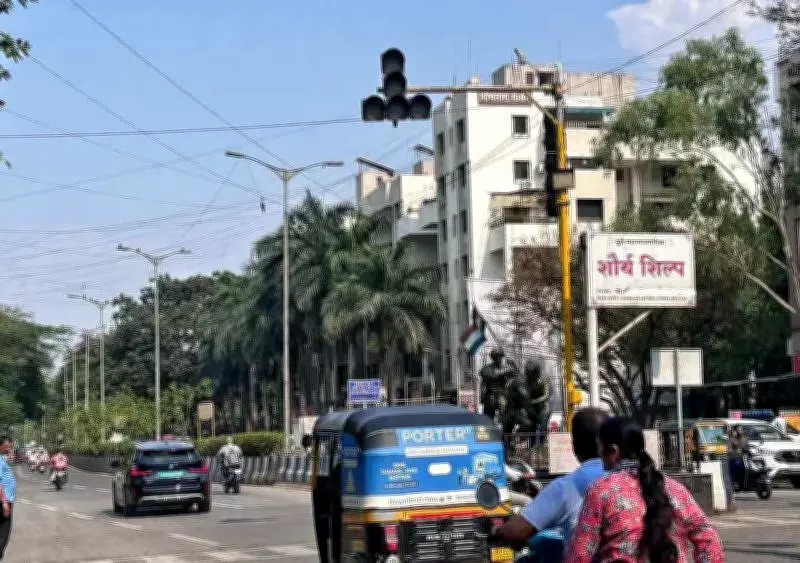
What should have been a routine evening commute transformed into a gruelling three-hour ordeal for Pulgate resident Anand More on Monday. As sporadic rain and hail battered Pune, massive traffic snarls erupted across the city, primarily triggered by a persistent and familiar culprit: completely malfunctioning traffic signals at several critical junctions.
Commuters' Frustration Peaks in Chaotic Conditions
Anand More, returning home from his workplace on Ghole Road, described how the lack of functional signals turned minor delays into total chaos. "The signals at Rani Laxmibai Chowk and the Juna Bazaar roundabout were completely dark. It took me nearly an hour and a half just to cross these two points because vehicles were converging from all directions without any regulation," he recounted. He noted that similar paralyzing gridlock prevailed at Babasaheb Ambedkar Chowk and MG Road.
Wanowrie resident Shaheen Qadir Shaikh echoed this deep frustration. "Traffic police were present at Juna Bazaar trying to manage the flow, but the volume was simply too high. With motorists breaking rules left and right, the situation quickly became unmanageable," she stated. "Defunct signals have become a recurring nightmare. It raises serious questions about the authorities' maintenance schedule and their commitment to public safety."

Official Promises Unfulfilled as Infrastructure Lags
Despite firm assurances made by the Pune traffic police over seven months ago to equip all signals with reliable power backups and draft a detailed project report (DPR) for comprehensive system upgrades, the ground reality remains starkly unchanged. Additional Commissioner of Police Manoj Patil acknowledged that the crucial upgrade process is significantly lagging.
"The DPR for traffic signal development is still pending. Currently, Pune has 281 operational traffic signals, of which a staggering 156 lack any power backup," Patil revealed. He added that the department's long-term aim is to increase the total number of signals to 450 to meet future urban demands, but provided no concrete timeline for the current crisis resolution.
Public Trust Erodes Amid Recurring Failures
Many daily commuters have completely lost faith in these official timelines and promises. "Authorities made these exact same promises last year. If nothing has moved in months, how can citizens trust these new claims?" questioned Suresh Krishnan, a frustrated resident from Kothrud.
Officials privately admitted that signals without power backup fail instantly during common electricity outages, leading to immediate and severe bottlenecks. A traffic constable, speaking on the condition of anonymity, pointed to a critical breakdown in motorist discipline during these failures. "Once the lights go out, many motorists treat it as a free-for-all. Even with police presence, the sheer volume of rule-breaking at major junctions quickly spirals into complete gridlock, especially during adverse weather," the constable explained.
Expert Warnings Highlight Safety and Systemic Issues
Currently, Pune has 302 traffic signals in total, with 281 operational. This includes 125 signals managed under the adaptive traffic management system (ATMS). Traffic and urban experts have termed the recurring signal failures "alarming and unacceptable."
Ranjit Gadgil of the NGO Parisar highlighted the grave safety implications beyond mere inconvenience. "Functional signals are not just for vehicular flow; they are absolutely essential for pedestrian safety, especially at busy intersections. Leaving signals non-operational during peak hours or bad weather is a major public safety risk that must be addressed on the highest priority," he emphasized.
Urban transport expert Pranjali Deshpande added that the core issue is one of administrative willpower and prioritization rather than technological complexity. "These are basic, fundamental infrastructure systems. They can be fixed relatively easily if the authorities genuinely prioritise citizen welfare and urban mobility. The continued delays reflect a systemic failure in governance and maintenance accountability," she concluded.