Uttarakhand's Urban Traffic Crisis: From Seasonal Snarls to Year-Round Gridlock
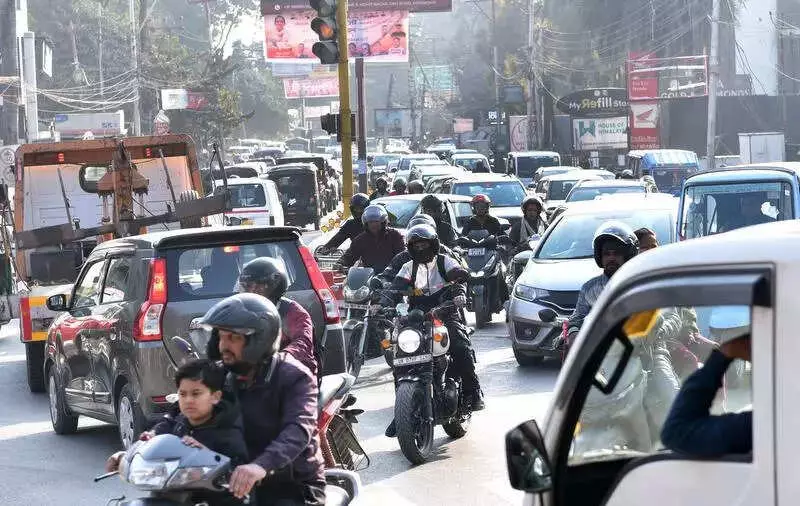
What began as seasonal traffic snarls limited to holiday rushes in Uttarakhand's picturesque hill towns has transformed into a persistent, year-round ordeal across the Himalayan state's urban centers. Daily gridlocks have become an unfortunate routine in major cities including Dehradun, Haldwani, Haridwar, Nainital and the Terai belt of Udham Singh Nagar. This escalating crisis affects not only the daily lives of residents but also poses a significant threat to tourism—the very backbone of Uttarakhand's economy.
Tourism Takes a Hit Amid Worsening Congestion
This winter witnessed a noticeable dip in tourist footfall in popular destinations like Mussoorie and Nainital, with hoteliers directly attributing the decline to poor traffic management. "Potential visitors think twice before planning trips when they hear about hours-long traffic jams," revealed a hotelier from Nainital, highlighting how congestion is deterring tourism. The situation is particularly dire on routes to significant pilgrimage sites like the Neem Karoli Baba shrine, a crucial link between Nainital and other Kumaon districts, where snail-paced traffic has become a regular sight.
Rishikesh and Beyond: Pressure Points Across the State
Rishikesh perhaps faces the most severe congestion, especially during the annual Char Dham yatra when lakhs of pilgrims and adventure sport enthusiasts converge on the town, often resulting in traffic standstills lasting several hours. Roads leading to other sought-after destinations, including the ski resort of Auli, face similar relentless pressure, indicating a statewide pattern of infrastructure strain.

Dehradun's Commuting Nightmare
In the state capital, Dehradun, peak hours have turned ordinary commutes into grueling endurance tests. Critical stretches such as the Clock Tower–Karanpur–Prem Nagar–Chakrata Road corridor and the ISBT–Saharanpur–Clock Tower route frequently grind to a complete halt. Congestion reaches critical levels at the Rispana Bridge, a vital gateway connecting to Haridwar, Rishikesh and other Garhwal regions. Similarly, the route from Survey Chowk to Raipur Road via Choona Bhatta offers no respite to beleaguered commuters.
Root Causes: A Perfect Storm of Urban Challenges
Officials point to a confluence of factors driving the worsening situation: a sharp, unrelenting rise in vehicle numbers, inherently narrow roads with limited scope for widening, a severe shortage of adequate parking spaces, and haphazard, unplanned urban expansion. While authorities claim that measures are being formulated, concrete timelines and effective, lasting solutions remain frustratingly elusive for the public.
Public Resignation and Activist Alarm
Residents have developed a grim acceptance of daily delays. "Traffic jams in Dehradun don't surprise anyone anymore. We are mentally prepared to get stuck at certain predictable points," shared Nitin Chauhan, an insurance agent from Patel Nagar, capturing the public's weary resignation.
Social activist Anoop Nautiyal has termed the situation a 'major crisis.' He asserts, "Traffic has become problem number one for Dehradun. Roads like Chakrata Road and Rajpur Road have limited space and cannot be widened endlessly. When you factor in encroachments and unauthorized parking, and consider that new projects like expressways might bring even more vehicles, we are steering toward complete chaos."
Nautiyal criticizes what he sees as a structural governance failure. "The state is unable to resolve pre-existing issues, yet it continues to invite more vehicles onto the roads. This is not a minor inconvenience but a deepening crisis that cannot be addressed solely through policing measures like issuing challans or implementing temporary diversions." He also raised pointed questions about infrastructure planning in Mussoorie, querying the logic of proposing concrete-heavy projects for a town with officially recognized parking for only about 1,240 vehicles.

Infrastructure Woes and Policing Criticisms
Dehradun residents frequently blame uncoordinated infrastructure projects for exacerbating road chaos. "Rajpur Road has become a nightmare due to ongoing work by UPCL and Jal Sansthan. This pattern of patchwork fixes during VIP movements, followed by renewed chaos, repeats across the city," lamented a regular commuter.
Manual traffic policing methods have also drawn significant criticism. Ramana Kumar of the Dehradun Citizens' Forum explained, "Even at functional signals, traffic cops manually direct vehicles without using timers. By the time one road is cleared, traffic has already backed up on the other three approaches of the junction." He advocates for a shift in strategy: "The personnel deployed for manual direction could be better utilized for strict enforcement of traffic rules. Penalize violations like signal jumping consistently. Eventually, this will foster a behavioral shift among drivers in Dehradun."
Official Response: Acknowledging Infrastructure Limits
Inspector General (Traffic) Narayan Singh Napalchyal acknowledged the police department's efforts in managing traffic, particularly in Dehradun. However, he emphasized the core constraint: "The fundamental issue is the limited road infrastructure against a backdrop of rapidly rising vehicle numbers. Police can manage traffic to a certain extent, but without substantive infrastructure upgrades, the problem will persist."
Napalchyal added that comprehensive traffic management plans have been prepared for major cities like Dehradun, Haridwar, and Nainital, as well as for key tourist hubs including Rishikesh and Mussoorie. "We are focusing on known bottlenecks such as Jogiwala, Rispana Square, and ISBT, and are coordinating with other departments to ease congestion at the earliest possible," he stated. Despite these plans, the search for a definitive, long-term solution to Uttarakhand's traffic nightmare continues, with residents and the tourism industry bearing the brunt of the daily gridlock.