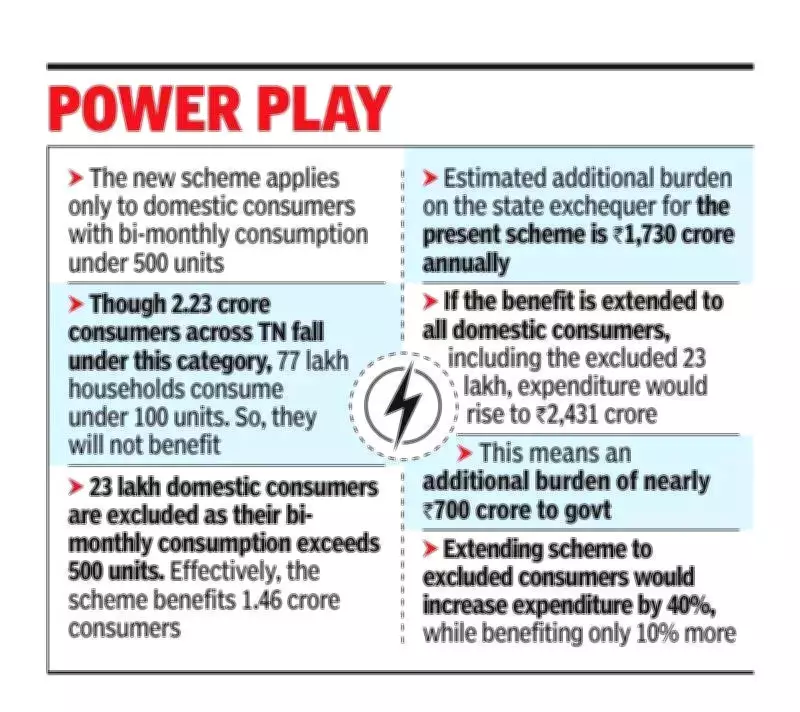
Chennai: Chief Minister C Joseph Vijay's maiden order fulfilling Tamilaga Vettri Kazhagam's (TVK) poll promise of free electricity up to 200 units has drawn mixed reactions and raised questions.
Party Cadres Hail Announcement, Critics Question Limitations
While party cadres hail the announcement—made soon after Vijay took oath as chief minister, followed by the immediate issuance of a government order—as an achievement, critics questioned why the benefit was restricted to households whose bi-monthly power consumption does not exceed 500 units.
Financial Implications and Beneficiary Data
Only about 23 lakh consumers fall in the 500-plus unit category, among the state's 2.23 crore domestic power consumers. Officials estimate that extending the benefit to these consumers would increase the burden to 2,431 crore—nearly 700 crore more. In effect, the government would incur 40% additional expenditure for just 10% more consumers.

TNPDCL Officials Explain Rationale
Tamil Nadu Power Distribution Corporation Ltd (TNPDCL) officials said the scheme was restricted to households with bi-monthly consumption below 500 units as they are considered economically weaker sections compared to higher-consuming households. Officials also pointed out that TVK's poll manifesto had carefully stated that the 200-unit free power promise would apply only to "eligible" consumers. "Households with air-conditioners generally consume more than 500 units in a bi-monthly cycle. Hence, the 200-unit free power benefit was restricted to consumers below the 500-unit mark," an official said.
Subsidy Structure and Cost Savings
Officials further noted that the promise became financially viable because the second slab of 100 units was already partially subsidized for consumers under the 500-unit category. While the base tariff is 4.95 per unit, the first 100 units are already free for all domestic consumers irrespective of consumption. The second 100 units was subsidized by 50% for consumers within the 500-unit slab. "The previous government also absorbed subsequent annual tariff hikes, so consumers effectively paid only 235 for the second 100 units. Now, that amount too has been completely waived," the official added. If the state were to absorb the tariff of 200 units for all domestic consumers, it should spend 495 every two months for the remaining 23 lakh consumers, which works out to 700 crore per year. Officials said higher-consuming households are generally financially better off and often have appliances such as air conditioners, leading to higher power usage. The government, therefore, limited the scheme to those consuming below 500 units.