

Bombay High Court Clarifies Legal Threshold for Abetment of Suicide in Marital Cases
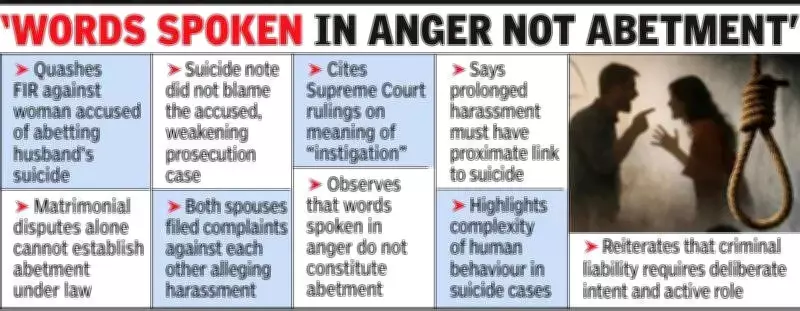
The Nagpur bench of the Bombay High Court has delivered a significant judgment clarifying the legal standards for abetment of suicide in marital contexts. In a ruling last week, the court held that a woman cannot be held criminally liable for her husband's suicide solely on account of ordinary marital discord.
Court Quashes FIR and Proceedings Against Wife
Justice Urmila Joshi Phalke quashed an FIR and all subsequent legal proceedings against a woman who had been accused of abetting her husband's suicide. The court emphasized that typical marital conflicts do not meet the stringent legal threshold required to establish criminal abetment under Indian law.
"Suicide cannot be attributed to any of the spouses, merely because there is a matrimonial dispute," the court observed in its detailed judgment. The bench noted that while such discord may cause "frustration" between partners, this alone does not establish the criminal intent necessary for abetment charges.

Background of the 2019 Amravati Case
The case originated from a tragic 2019 incident in Amravati, where a man died by suicide after allegedly jumping in front of a moving train. Following the incident, the deceased's father filed a complaint accusing the wife of harassment, leading to charges under provisions related to abetment of suicide.
Upon examining the case records, the court discovered that both husband and wife had filed mutual complaints against each other prior to the suicide. These complaints alleged:
- Ill-treatment and strained relations
- Suspicions regarding character
- General marital discord due to differences of opinion
The court characterized the nature of the dispute as "matrimonial in nature" resulting from fundamental disagreements between the couple.
Suicide Note Analysis and Legal Interpretation
A critical piece of evidence was the suicide note recovered from the deceased. While the note mentioned that the man felt under "torture," it explicitly stated that "nobody is responsible for the said suicide." The court found this declaration significantly weakened the prosecution's claim of abetment.
Justice Phalke elaborated on the legal definition of "instigation" required for abetment convictions, explaining it necessitates active conduct such as:
- Goading or urging forward
- Provoking or inciting
- Encouraging the commission of an act
The judgment emphasized that conviction under abetment laws requires establishing a proximate and direct link between the accused's actions and the suicide.
Court's Reasoning on Harassment and Intent
The bench made several crucial observations regarding the interpretation of harassment in abetment cases:
"Merely because the victim was continuously harassed cannot by itself result in finding a positive instigation," the court stated, adding that "nobody knows what goes on in the mind of the victim."
The judgment further clarified that words uttered in fits of anger during marital disputes would not be sufficient to constitute abetment. The court also noted the absence of any evidence showing the deceased had "no other option" but to take his own life.
Final Ruling and Legal Implications
After thorough examination, the High Court concluded that the prosecution had failed to demonstrate any "direct or indirect acts which would constitute incitement" to suicide. Finding that the essential legal ingredients of abetment were not met, the court quashed all proceedings against the woman.
This landmark judgment provides important clarification on the application of abetment laws in marital contexts, establishing that ordinary relationship conflicts without demonstrable criminal intent cannot form the basis for suicide abetment charges.






