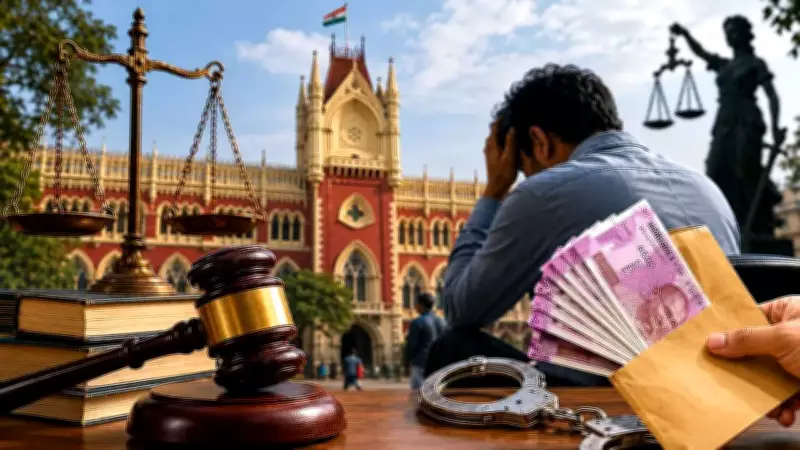
The Calcutta High Court on May 22 directed the West Bengal government to pay Rs 10 lakh in compensation to a Serampore college professor who was sentenced to 20 years in prison for the rape of a minor but had to serve over four years due to what the court described as "systematic failures" by the special public prosecutor Joydeep Mukherjee and investigating officer SI Nibedita Koley.
High Court Quashes Conviction
The 20-year sentence was quashed by the Calcutta High Court, which questioned whether the professor, an academician and NGO founder for child welfare, received a fair trial. The bench expressed "disappointment" at the trial court's verdict.
The court added that the compensation amount could be recovered from the two officers. Regarding Joydeep Mukherjee, who served as the Special Public Prosecutor in the case and also represented the professor's wife in a separate 498A case, the High Court deemed this a "professional misconduct." It directed the Bar Council chairman to initiate disciplinary proceedings against Mukherjee and notify the Director of the Directorate of Prosecution.

Prosecutor's Conflict of Interest
During the trial, the professor had repeatedly requested a change of the special public prosecutor due to his prior involvement. The prosecution's "star witnesses" were the professor's estranged wife and son. The High Court noted that Mukherjee prosecuted the professor with "malice and vindictiveness."
Investigating Officer's Lapses
Regarding the investigating officer, the Calcutta High Court directed the Director General of Police of West Bengal to initiate disciplinary proceedings against SI Nibedita Koley for "total ignorance of basic investigative protocols," which led to the professor's conviction on July 9, 2024, by a Serampore court for offenses including rape by a trusted person and aggravated sexual assault of a minor.
The case originated from a complaint filed on March 23, 2022, at the Serampore women police station, alleging that the complainant's 16-year-old sister was sent to live with the professor by her father in Mumbai and was physically violated multiple times. The allegations included confinement, rape, and administration of pills to the minor.
Lacunae in Investigation
The division bench pointed out various lacunae in the investigation, including the investigating officer's reliance solely on the accused's wife and son as witnesses while failing to record statements from neighbors, the society gate register, and others. Additionally, the vaginal swab was not sent for forensic analysis, and items were seized from the accused's house without his presence, creating further doubts.
The court also noted discrepancies in the victim's testimony. Furthermore, the medical report showed no signs of rape injuries. The ongoing 498A case filed by the wife against the accused, with her lawyer serving as the special public prosecutor, placed the accused at a disadvantage.
"As the victim's testimony is full of anomalies and the only supporting evidence comes from 'star witnesses' (the accused's estranged wife and son) with a documented vendetta (the 498A case), the foundational facts themselves are shaky. A presumption cannot be used to fill a gap left by unreliable or coached evidence. Moreover, the fact that the appellant is a professor suggests that the collateral damage to his reputation and career is irreversible," the High Court held.
Recommendations on Victim Compensation
The division bench of Justice Arijit Banerjee and Justice Apurba Sinha further proposed a staged disbursement of victim compensation to curtail the "temptation" of filing false rape cases. The bench suggested an initial disbursement of 25% of the compensation amount, with the remaining 75% to be released after conviction.
The principal secretary of the judicial department was requested to advise government departments, and the secretary of the West Bengal State Legal Services Authority (SLSA) was directed to review these recommendations.

"While the Victim Compensation Scheme is a noble instrument for rehabilitation, the Court observes a concerning trend where the prospect of financial gain incentivizes unscrupulous individuals to lodge false complaints. To balance the necessity of victim support with the protection of innocent citizens, a more rigorous disbursement structure is required," the bench held.