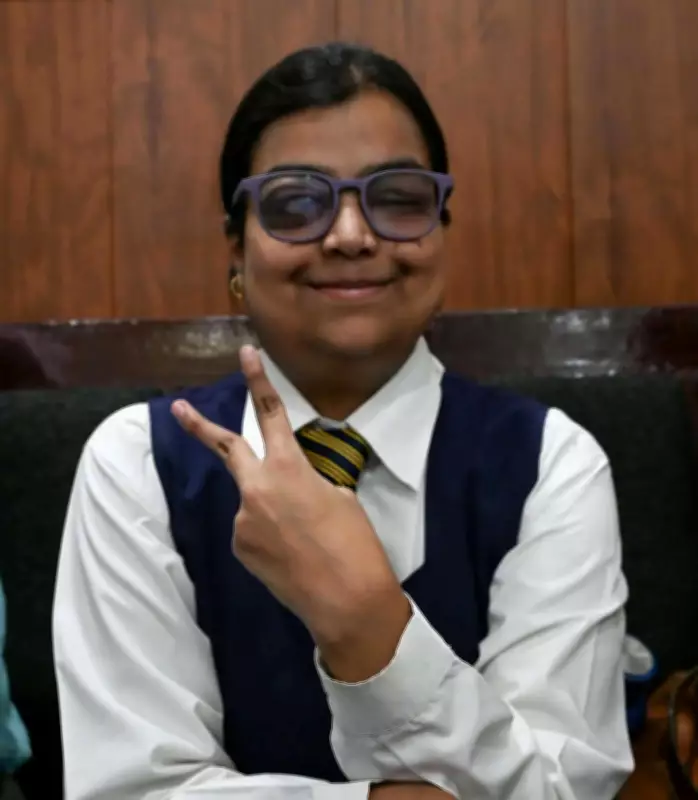
Lucknow: Sarah Moin, widely recognized as the 'Helen Keller of Lucknow,' has emerged as a beacon of determination and academic excellence. She achieved an outstanding 95% in her ICSE examinations and an even more impressive 98.75% in her ISC examinations. Despite her remarkable academic achievements, the future of Sarah, who aspires to pursue a Bachelor of Arts (Honours) in English literature at the higher education level, remains uncertain.
Uncertainty Due to Lack of CUET Provisions
The primary reason for this uncertainty is the absence of a provision within the Common University Entrance Test (CUET) framework. CUET serves as the gateway for admission to central universities and several state universities. According to her father, Moin Ahmad Idrisi, the test currently lacks the necessary facilities required for candidates who are both deaf and blind to appear for the examination.
Sarah's father, who is himself battling blood cancer, stated, "I have written to the CUET authorities, the Department of Empowerment of Persons with Disabilities, and the Chief Commissioner for Persons with Disabilities, requesting a special provision for Sarah. The case is scheduled to be heard online on Thursday."

Assistive Tools Used in Board Exams
He explained that during the Council for the Indian School Certificate Examinations (CISCE) board examinations, Sarah was permitted to use assistive tools such as a laptop equipped with MS Word and an Orbit Reader. This device converts text into braille, enabling her to write independently. "We are only asking for a similar system to be implemented in the CUET," he added. The current CUET format already includes provisions for providing scribes to blind candidates, and hearing-impaired candidates are allowed to attempt the exam independently.
Educational Experts Highlight Systemic Gap
Educationist and General Secretary of the Rehabilitation Society of Visually Impaired, Rakesh Jain, commented, "Sarah's case has brought attention to a critical gap in India's inclusive education system. While policies exist, implementation for rare disability categories remains incomplete."
Another educationist, Amrita Dass, emphasized, "Since the CISCE allowed her to appear independently using an Orbit Reader and compatible technology, it is imperative that the National Testing Agency (NTA) urgently introduces similar provisions within the CUET system for visual-hearing impaired candidates."
Social activist Sunil Mangal expressed disappointment that such talent is being held back due to a lack of clear provisions in the guidelines. "Sarah should be given the opportunity as her marks speak for her. It is concerning that there are still loopholes in our education system. The CUET should consider her case and approve it," said educationist Professor Nishi Pandey.
About the Author
Anjanaya Singh, associated with TOI for the past two years, is a Media and Communication graduate from Manipal Institute of Communication. He primarily covers the education beat and also crafts special stories on civic and cultural affairs, capturing the city's pulse with clarity and impact. In his free time, he enjoys watching sports.