

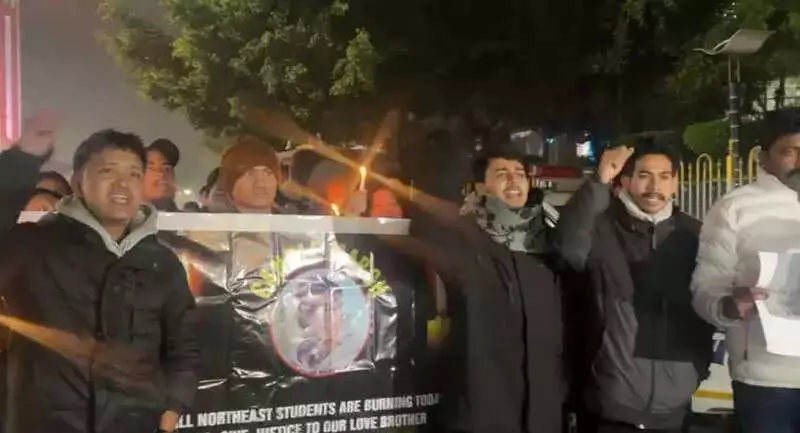
A brutal murder that could have shattered a community's sense of security has instead galvanized it into a powerful movement for justice. The alleged stabbing of 24-year-old MBA student Anjel Chakma from Tripura on December 9 in Dehradun's Selaqui area has not driven students from India's Northeast away from the city. Instead, it has forged an unyielding resolve among them to stay, protest, and demand accountability.
A Community Stands Its Ground
In the three weeks following the tragic incident, where Chakma was killed during a confrontation with a group of local youths, fear has not emptied the hostels and paying guest accommodations. Contrary to expectations, not a single student from the Northeast region has returned home out of fear. The community, numbering close to 3,000 students enrolled across Dehradun's colleges, has chosen to stand firm. Drawn to the city for its professional courses and affordability, the largest groups hail from Arunachal Pradesh and Nagaland, with around 250 from Tripura.
Led by Rishikesh Baruah, president of the Northeast Students Association in Dehradun, the protests have grown more organized. Students are now regularly on the streets, holding candles and banners, giving media interviews, and pushing for more than just arrests. They are demanding structural sensitivity and institutional accountability. "No one left the city after the incident. We decided we won't go home," Baruah stated firmly. "We are more united now. We will stay in Dehradun and demand justice for Anjel."

The Pursuit of Justice and a Fugitive
The community has vowed to intensify its peaceful demonstrations until police apprehend the lone accused who remains at large. Yagya Awasthi is suspected to be hiding near the Nepal border. Police have already arrested five others, including two juveniles, in connection with the killing. Inspector Bhaskar Sah, the investigation officer with the special investigation team (SIT) handling the case, assured that all-out efforts are underway. "Our teams are putting in all-out efforts to track him down. We're treating this case with complete seriousness," Sah said.
Quiet Changes and Solidarity in Daily Life
Away from the public demonstrations, the emotional aftermath has prompted subtle but significant shifts in daily life. Anxious phone calls from worried families have become routine. Students have adopted informal safety protocols, becoming more cautious and avoiding solitary movement at night. "We've started being more cautious. We don't step out alone at night. If we are summoned to a police station, someone always comes along," shared a 19-year-old student from Nagaland, who requested anonymity.
Perhaps the most profound change is the conscious clustering for comfort and security. Students are increasingly choosing to live together in the same rooms or apartments where possible. This proximity provides a crucial support system. "It helps. We're together, we talk, and it's easier to cope with what happened," the student added. "We don't want a repeat of such a tragedy."
The murder of Anjel Chakma has undeniably fractured Dehradun's image as a safe educational hub. Yet, from this fracture, a stronger, more united, and determined community has emerged, refusing to be silenced until justice is served.






