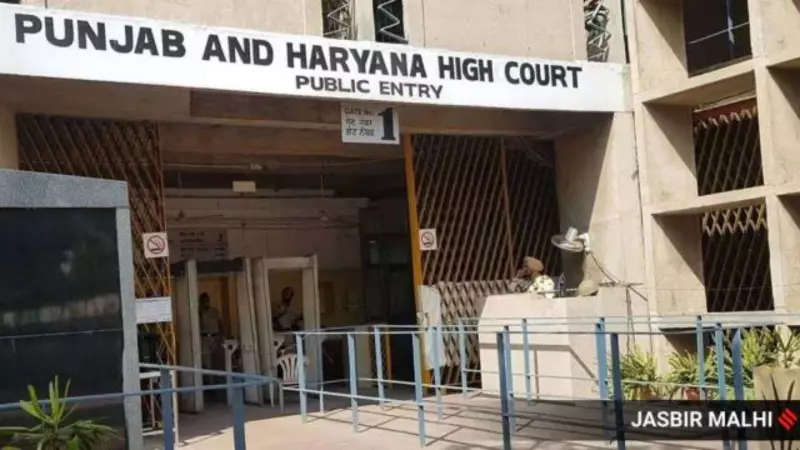
In a significant ruling that underscores the rights of long-serving casual employees, the Punjab and Haryana High Court has strongly reprimanded the Haryana government for engaging in "unfair labour practice." The court has directed the state to regularise a group of daily wage workers from the Forest Department who have served for over a quarter of a century, granting them full retirement benefits with interest.
A Sharp Rebuke for the State
Justice Sandeep Moudgil, presiding over the case, delivered a stinging critique of the state's conduct on Wednesday. The judge held that denying regularisation and retirement dues to workers who had devoted decades of their lives to government service was "wholly insensitive and unbecoming of a welfare State." The court was adjudicating a batch of 18 interconnected writ petitions, with the lead petitioner being Phoolwati, a Group-D daily wage labourer who began her service as a mali/labourer on June 10, 1988, in the Saraswati Forest Range, Kaithal.
The court noted that despite working satisfactorily for over 25 years without any adverse record, Phoolwati and others like her were never issued a formal appointment letter and were kept on the muster roll. Shockingly, Phoolwati was verbally terminated on December 26, 2016. The court observed that the state was "shrugging off its responsibility" after having utilised the petitioners' labour for decades.

Court Directs Regularisation Under 1996 Policy
In his order dated December 31, Justice Moudgil set aside the state's speaking order from October 1, 2024, which had denied the workers' regularisation. The court directed that the petitioners be regularised under the state's 1996 regularisation policy "from the due date" with all consequential benefits. This landmark decision includes:
- Full regularisation of service.
- Payment of all retirement dues.
- Arrears of pay with 6% interest per annum from the date they became due.
The judgment clarified that it would govern all connected matters with similar facts, effectively extending relief to all 18 petitioners and potentially setting a precedent for other similarly placed employees in Haryana.
Rejecting the State's Arguments
The Haryana government had attempted to block regularisation by citing the Supreme Court's Uma Devi judgment and by retrospectively claiming the work was seasonal. The High Court firmly rejected these arguments. It held that the Labour Court's earlier award—which had ordered Phoolwati's reinstatement with continuity of service—had already established her right to be treated as being in uninterrupted service since 1988.
The court stated that unlawful termination is "nothing short of an unjust expropriation of the workman’s right to labour and his rightful livelihood." It further invoked the doctrine of accrued rights, ruling that once an employee fulfills all conditions of a policy while it is in force, "the benefit is no longer contingent but becomes a vested entitlement." This entitlement cannot be defeated by the state's subsequent withdrawal or inaction.
Justice Moudgil also dismissed the state's claim that the petitioners were "back-door entrants," invoking the Model Employer Doctrine. He emphasised that their length of service—exceeding 25 years—was proof of a regular need for their work.
Wider Implications and Timelines
The court found clear discrimination, violating Articles 14 and 16 of the Constitution, as several other employees performing identical duties, some even junior to the petitioners, had been regularised under the same 1996 policy. The policy mandated regularisation for daily-rated Group-D employees with three years of service as of January 31, 1996, who had worked at least 240 days each year—conditions the petitioners fully satisfied.
The state has been given a strict deadline of four weeks to complete the regularisation process and disburse all dues with interest, ensuring the petitioners "are not further made to suffer for no fault of their own." This ruling is expected to have significant ramifications for hundreds of long-term daily wage workers across various departments in Haryana, affirming their right to job security and dignity after years of service.