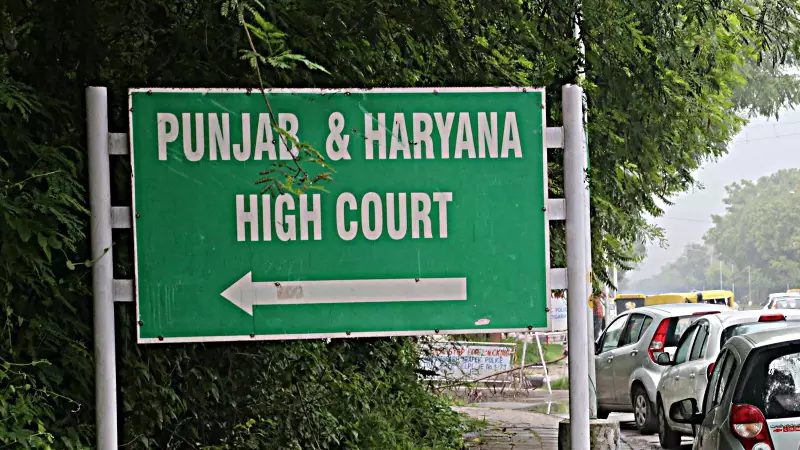
Punjab High Court Upholds ITI Mandate for PSTCL Lineman Jobs, Rejects Engineering Graduates' Plea
In a significant ruling that reinforces employer autonomy in recruitment, the Punjab and Haryana High Court has dismissed a batch of writ petitions challenging Punjab State Transmission Corporation Limited's (PSTCL) requirement of ITI certification for certain technical positions. The court's decision, delivered by Justice Harpreet Singh Brar, emphasizes that employers are best positioned to determine suitable eligibility criteria for specific posts.
Court Upholds PSTCL's Recruitment Advertisement
The controversy centered around PSTCL's recruitment advertisement, CRA-11/2021 dated May 18, 2021, which sought to fill 350 assistant lineman and 150 assistant sub-station attendant positions. The advertisement clearly stipulated that candidates must possess Punjabi at the matriculation level along with a full-time, regular ITI certificate in either the electrician or wireman trade from a recognized institution.
Engineering graduates who held degrees or diplomas in electrical engineering filed petitions seeking to quash the advertisement to the extent that it barred them from applying. They argued that their higher qualifications in the same field should be considered sufficient and that the online application portal rejected their forms as it only provided an option for the two-year ITI course.
Legal Arguments and Constitutional Questions
Appearing for the petitioners, counsel contended that excluding engineering graduates was arbitrary and violated Articles 14 and 16 of the Constitution, which guarantee equality before law and equality of opportunity in public employment. They relied on several Supreme Court and High Court judgments to support their claim that higher qualifications should not be excluded when minimum requirements are met.
PSTCL, however, maintained its position that an employer is entitled to prescribe eligibility conditions based on the nature of duties involved. The corporation's counsel argued that the recruitment advertisement did not provide for any equivalence between ITI certification and engineering degrees, and that courts could not read such equivalence into the terms of recruitment.
Court's Reasoning and Final Verdict
Justice Brar, in his ruling, noted that the very nomenclature of ITI certification versus diploma or degree courses in electrical engineering indicates distinct syllabi and training focuses. He emphasized that ITI courses are specifically designed to impart hands-on skills directly relevant to the posts in question, whereas engineering programs may have broader theoretical components.
The court firmly stated that "it is settled law that the employer is always the best judge to assess suitability of a candidate and lay down eligibility criteria for a particular post." Justice Brar added that when an advertisement is clear and within the legal framework, the court cannot step into the shoes of the employer or a domain expert to declare equivalence between different qualifications.
The ruling concluded that the condition requiring an ITI certificate for appointment as an assistant lineman or assistant sub-station attendant did not infringe upon the constitutional rights of the petitioners. Consequently, all petitions were dismissed, upholding PSTCL's recruitment criteria as valid and legally sound.
Broader Implications for Recruitment Practices
This judgment has several important implications:
- It reinforces the principle that employers have the discretion to set job-specific qualifications based on practical requirements.
- It clarifies that higher academic qualifications do not automatically guarantee eligibility for positions requiring specialized vocational training.
- It establishes that courts will generally not interfere with recruitment criteria unless there is clear statutory violation or arbitrariness.
- It highlights the continuing relevance and importance of ITI certifications in technical and vocational employment sectors.
The petitioners were represented by senior advocates D S Patwalia and Vikas Chatrath, among others. The ruling serves as a precedent for similar cases where educational qualifications and job requirements intersect, particularly in public sector recruitment.