Iran Unleashes Retaliatory Strikes Following Supreme Leader's Death in US-Israel Operation
In a dramatic escalation of Middle East tensions, Iran has launched extensive missile and drone attacks against United States military installations and Israeli targets. This aggressive retaliation comes directly after the confirmed killing of Iran's Supreme Leader, Ayatollah Ali Khamenei, during a coordinated US-Israel military operation codenamed Operation Epic Fury.
Operation Epic Fury Targets Iranian Leadership
The US-led military action, authorized by President Donald Trump, achieved its primary objective with strikes early Sunday in Tehran that resulted in the death of Ayatollah Ali Khamenei. Former President Trump declared on Truth Social, "Khamenei, one of the most evil people in History, is dead." The operation reportedly also claimed the lives of Khamenei's daughter and grandchild during attacks on multiple key locations within the Iranian capital.
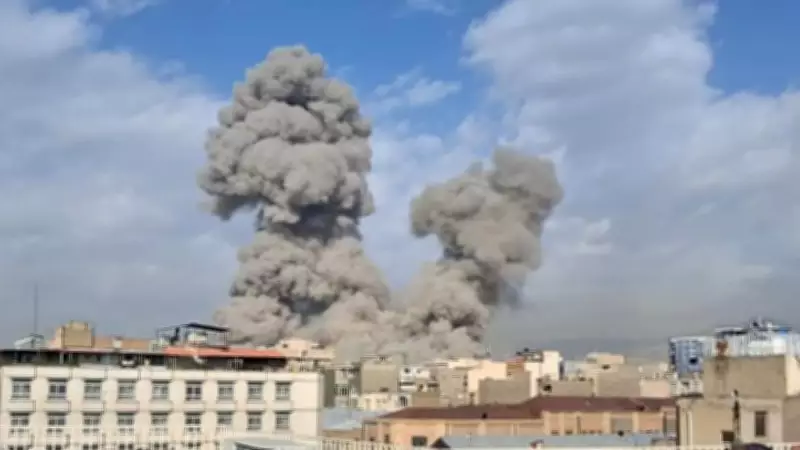
Israel, under Prime Minister Benjamin Netanyahu, participated in these strikes through Operation Lion's Roar, specifically targeting Iran's ballistic missile and air defense systems. Iranian state media reported several loud explosions reverberating through Tehran as these coordinated attacks unfolded.

Iran's Immediate Military Response
The Islamic Revolutionary Guard Corps (IRGC) swiftly executed what it described as the "sixth wave of attacks" in retaliation. According to Iranian military reports:
- Four ballistic missiles and twelve drones struck the American naval base in Kuwait's Abdullah Mubarak area, destroying all infrastructure and causing significant American casualties
- The MST-class combat support ship, which carries fuel for US vessels in the Indian Ocean, was hit by Iranian Qadr 380 missiles
- Twenty-seven US bases across the region were targeted alongside Israel's Tel Nof Airbase and military command headquarters in Tel Aviv
The IRGC issued a stern warning, stating it would "implement a different and harsh step of revenge, with successive, regrettable slaps" against the perpetrators.
Regional Impact and Civilian Toll
The conflict has created widespread disruption across the Middle East:
- Explosions were reported in major Gulf cities including Dubai, Doha, and Manama, with Iran targeting high-profile locations like Dubai International Airport and the Burj Al Arab
- Bahrain's Interior Ministry confirmed a drone strike hit Bahrain International Airport, causing material damage
- In Iraq, Iran targeted a US base in Erbil, the capital of the Kurdistan region
- Air raid sirens sounded across central Israel and parts of the occupied West Bank as the Israeli military responded to incoming Iranian missile fire
The civilian toll has been significant, with Iranian prosecutor Ebrahim Taheri reporting 148 killed and 95 wounded after a US-Israeli strike hit a girls' school in Minab county in southern Iran.
Leadership Vacuum and Political Fallout
With Khamenei's death creating a leadership vacuum, Iran has established a constitutional council to govern the nation temporarily. This body includes President Masoud Pezeshkian, judiciary chief Gholamhossein Mohseni Ejei, and a member of the Guardian Council selected by the Expediency Council. Under Iranian law, the Assembly of Experts must appoint a new supreme leader "as soon as possible."
President Pezeshkian denounced Khamenei's killing as "a great crime" and promised a forceful response, declaring: "This great crime will never remain unanswered and will turn a new page in the history of the Islamic world and Shiism. The pure blood of this high-ranking leader will flow like a roaring spring and will eradicate American-Zionist oppression and crime." Iran has announced seven days of public holidays in addition to the traditional 40-day mourning period.
International Reactions and Travel Chaos
The global response to the escalating conflict has been cautious and divided:

- The UN Security Council held an emergency meeting to address the crisis
- Many countries abstained from commenting directly on US-Israeli strikes but condemned Iran's retaliation
- Australia and Canada expressed support for the United States, while Russia and China criticized the strikes
- The 22-nation Arab League called Iran's attacks "a blatant violation of the sovereignty of countries that advocate for peace and strive for stability"
- Morocco, Jordan, Syria, and the UAE specifically condemned Iranian strikes on US bases in Kuwait, Bahrain, Qatar, and the Emirates
The conflict has created unprecedented travel disruption across the region:
- Emirates suspended all flights to and from Dubai
- Qatar's airport closed until at least Monday morning
- Israeli airspace remains completely shut
- In Bali, more than 1,600 passengers were stranded after Middle East-bound flights were cancelled
The Ministry of External Affairs in India issued an advisory for foreign nationals who have had to change travel plans due to the escalating security situation in West Asia, urging affected individuals to contact their nearest Foreigners Regional Registration Office (FRRO) for assistance with visa extensions or to regularize their stay.
Security Alerts and Continuing Tensions
Security concerns have spread beyond the immediate conflict zone:
- Protesters in Baghdad attempted to approach the heavily fortified Green Zone housing Iraqi government buildings and the US Embassy
- The US Embassy in Jordan urged Americans to remain indoors, citing reports of missiles, drones, or rockets in Jordanian airspace
- US Central Command confirmed American forces were engaged in military operations during the first 24 hours of Operation Epic Fury, with Admiral Brad Cooper stating, "The President ordered bold action"
President Trump issued a stark warning to Iran on Sunday after Tehran signaled it might launch heavy attacks in response to recent US-led strikes, writing on Truth Social: "Iran just stated that they are going to hit very hard today, harder than they have ever hit before. THEY BETTER NOT DO THAT, HOWEVER, BECAUSE IF THEY DO, WE WILL HIT THEM WITH A FORCE THAT HAS NEVER BEEN SEEN BEFORE!"
The death of Khamenei, who had no designated successor, has created significant uncertainty in Iran and raised legitimate fears of a wider regional conflict. Despite the violence, some international leaders have urged a resumption of dialogue to avoid further escalation as tensions continue to mount across the Middle East.