

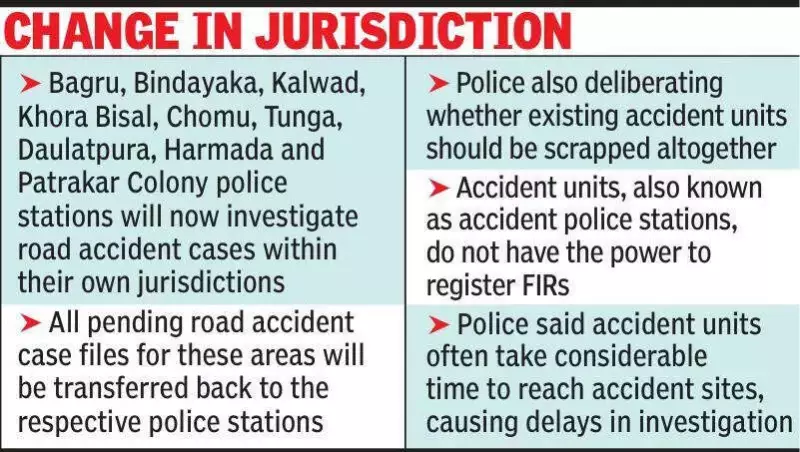
In a significant administrative shift aimed at improving efficiency, the Jaipur city police have removed nine police stations located on the city's outskirts from the jurisdiction of specialized Road Accident Investigation Units. The decision, mandated by Police Commissioner Sachin Mittal, is a direct response to persistent delays in officers reaching accident sites, which has caused hardship to victims.
Decentralizing Accident Investigations
The order, issued on December 12, directly impacts the police stations of Bagru, Bindayaka, Kalwad, Khora Bisal, Chomu, Tunga, Daulatpura, Harmada, and Patrakar Colony. Henceforth, these stations will independently investigate all road accident cases occurring within their own geographical limits. Previously, such cases were handled by dedicated accident police stations, which are centralized units.
Commissioner Sachin Mittal cited the considerable distance between these outer police stations and the accident investigation units as the primary reason for the change. This geographical gap often led to crucial time lags before law enforcement could arrive at the scene of a crash.

Addressing Victim Hardship and Pending Cases
"This often causes serious inconvenience and hardship to victims," Mittal noted in the official order. Faster arrival at the accident spot is critical for providing immediate assistance, managing traffic, collecting evidence, and initiating timely legal procedures.
As part of this transition, all pending road accident case files linked to these nine police stations will be transferred back to them. The respective stations will now be fully responsible for the complete investigation and subsequent legal action on these pending matters.
A Move for Swift Justice and Efficiency
This restructuring is expected to streamline the process of road accident investigation in Jaipur's peripheral areas. By empowering local police stations to handle cases in their jurisdiction, the police force aims to eliminate the relay of information and travel time associated with centralized units. The move underscores a victim-centric approach, prioritizing quicker response times which can be vital for emergency medical response and insurance claim processes.
The success of this new system will likely be monitored closely, as it represents a practical solution to a logistical challenge faced by many expanding urban police departments.






