

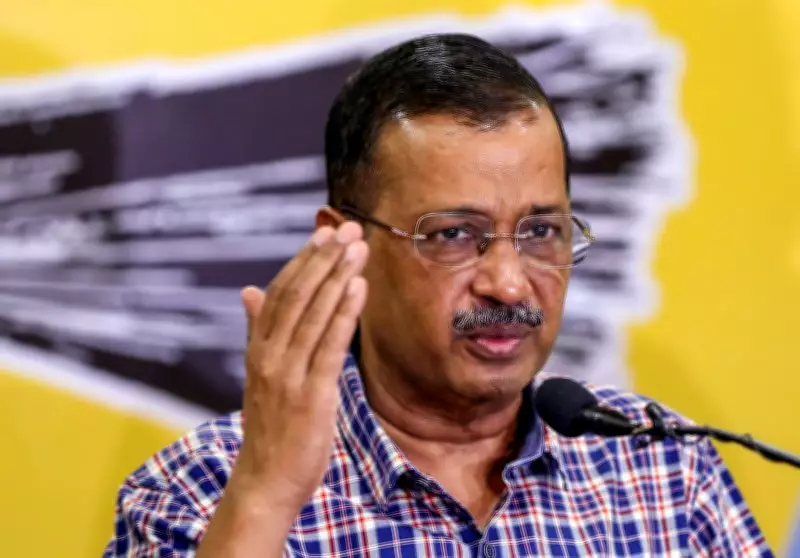
Kejriwal Escalates Legal Battle to Supreme Court After Delhi HC Chief Justice Denies Transfer Request
In a significant legal development, Aam Aadmi Party (AAP) national convener and former Delhi Chief Minister Arvind Kejriwal has approached the Supreme Court of India, seeking the transfer of the Central Bureau of Investigation's (CBI) appeal against his discharge in the Delhi excise policy case. This move comes shortly after Chief Justice Devendra Kumar Upadhyaya of the Delhi High Court rejected Kejriwal's plea to shift the case from the bench of Justice Swarana Kanta Sharma to another judge.
Challenges to High Court Summons and Separate Petitions
Kejriwal, along with former Deputy Chief Minister Manish Sisodia, has also challenged the Delhi High Court's summons in the apex court. Sisodia has filed a separate petition questioning the summons issued against him in the same case. The matter is anticipated to be listed for hearing on Monday, marking a critical juncture in this high-profile legal saga.
Background of the Transfer Rejection
The rejection of the transfer request was communicated via a letter dated March 13 from the High Court's Registrar General to eight applicants, including Kejriwal. The letter quoted Chief Justice Upadhyaya, stating that the petition had been assigned to Justice Sharma as per the existing roster. "The petition is assigned to the Hon'ble judge as per the current roster. Any call of recusal has to be taken by the Hon'ble judge. I, however, do not find any reason to transfer the petition by passing an order on the administrative side," the communication read.

In a prior letter dated March 11, Kejriwal had expressed concerns that if the case continued before Justice Sharma, the proceedings "may not receive a hearing marked by impartiality and neutrality." This apprehension forms the basis of his Supreme Court appeal.
Recent Judicial Proceedings and Kejriwal's Arguments
The legal tussle intensified after a trial court on February 27 discharged Kejriwal and 22 other accused in the excise policy case. The CBI subsequently challenged this order before the Delhi High Court, where Justice Sharma is presiding. On March 9, Justice Sharma issued a notice on the CBI's plea and stayed the trial court's direction seeking departmental proceedings against the investigating officer. The judge also recorded a prima facie view that certain observations in the trial court's order appeared erroneous.
In the same order, the High Court directed the trial court to defer proceedings under the Prevention of Money Laundering Act (PMLA), which are based on the CBI's FIR. Kejriwal, in his representation, argued that the March 9 order did not provide reasons explaining what "perversity" justified an ex parte restraint order. He contended that interim interference with a discharge order is an extraordinary measure, typically reserved for rare circumstances demonstrating clear illegality or perversity.
Furthermore, Kejriwal highlighted that the High Court directed the deferral of PMLA proceedings even though the Enforcement Directorate was not a party to the case. He asserted that granting such consequential relief at the threshold stage, without specific pleading or hearing the discharged accused, reinforced his apprehension that the revision petition might not be considered with the required judicial detachment.
Implications and Next Steps
This escalation to the Supreme Court underscores the contentious nature of the Delhi excise policy case, which has drawn significant political and legal attention. With the matter likely to be heard on Monday, all eyes are on the apex court's response to Kejriwal's transfer plea and the broader implications for judicial proceedings in high-stakes corruption cases. The outcome could set precedents for how such transfer requests are handled in the Indian legal system, impacting future cases involving public figures and investigative agencies.






