Surrendered Maoist Leader Reveals How Operation Kagar Crushed Outfit's Core Capacity
In a significant revelation, surrendered senior Maoist leader Tipiri Thirupathi, widely known as Devji, has provided Telangana police with a detailed account of how the insurgent group's final attempts to survive Operation Kagar collapsed under the combined strain of military setbacks and political disarray. According to police sources, Devji stated that sustained security pressure systematically broke the organization's core operational capacity, while internal divisions critically slowed decision-making at pivotal moments.
Military Structure Dismantled Under Pressure
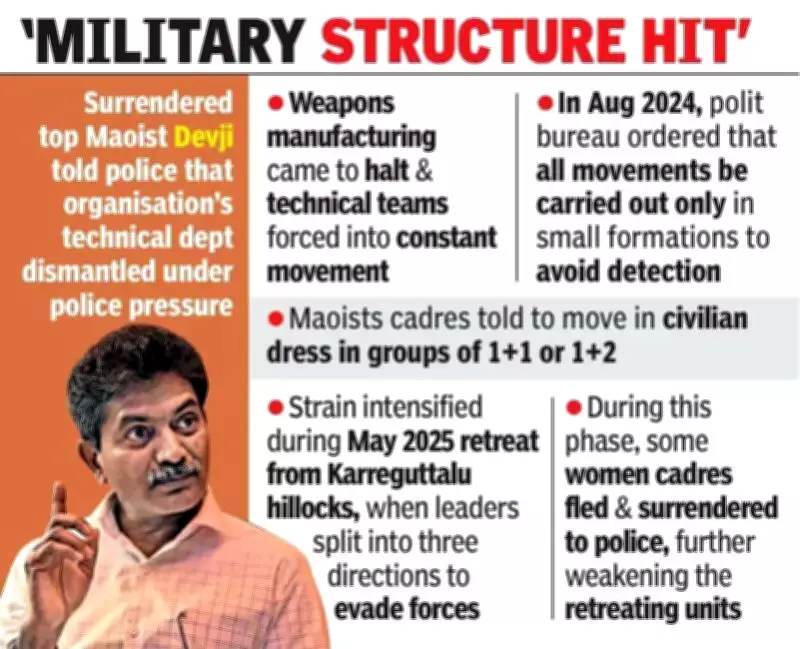
Devji informed investigators that the relentless pressure on the ground forced the Maoist leadership to implement drastic survival measures. The organization's technical department was completely dismantled under police pressure, leading to a complete halt in arms manufacturing. Technical teams were forced into constant movement to evade detection.
In August 2024, the polit bureau issued orders that all movements must be conducted only in small formations to avoid detection by security forces. Cadres received specific instructions to move in civilian dress in minimal groups of 1+1 or 1+2 configurations. This fragmentation severely limited operational capabilities and coordination between units.

Critical Retreat Exposed Organizational Weaknesses
The strain intensified dramatically during the May 2025 retreat from the Karreguttalu hillocks, when leaders split into three separate directions to evade central security forces. During this chaotic phase, some women cadres fled and surrendered to police, further weakening the already vulnerable retreating units.
According to police sources, Devji described severe communication failures during the subsequent retreat toward the National Park area. Teams faced significant delays in receiving leaders due to complete breakdowns in communication systems, affecting coordination at a time when the leadership was already under immense pressure.
While camped in the National Park, the leadership learned of the death of general secretary Nambala Keshava Rao alias Basvaraj. Attempts to regroup were followed by further devastating losses, including top Maoists Sudhakar and Mylarapu Adellu in exchanges of fire with security forces.
The account suggests that once the retreat phase began, the movement was completely unable to maintain cohesion between teams, leaders, and fighters. What should have been an organized withdrawal degenerated into a series of uncoordinated moves under relentless pressure from security forces.
Internal Divisions Compound Military Setbacks
Devji revealed to police that military setbacks were severely compounded by deep internal divisions within the Maoist leadership. He specifically referred to persistent friction between leaders from Chhattisgarh and those from Telangana or the Andhra-Odisha Border region.
Some Chhattisgarh leaders reportedly resented the movement of Telangana and AOB cadres and, at times, refused them shelter and support. This regional rivalry created additional vulnerabilities within an already strained organization.
Morale within the party had declined sharply due to ideological differences and disputes among central committee members. Simultaneously, decision-making processes slowed to a crawl amid fundamental disagreements over survival strategy.
While one faction favored dumping weapons and blending into village populations, another insisted that arms must be retained for self-defense purposes. This strategic paralysis left cadres confused and vulnerable at critical moments.
Political and Economic Disarray
The lack of clarity extended to the political line as well. Devji stated there was no consensus on how to respond to the failure of mass movements, declining student recruitment, and a situation where more people were being drawn toward government reforms and development initiatives.
According to police sources, the polit bureau in 2024 issued a circular directing that elderly and ailing cadres be moved to safe locations or encouraged to surrender to police if secure shelter could not be arranged. This represented a significant shift in policy toward vulnerable members.

Economically, the party adopted a policy to retain funds for a maximum of three years, primarily in the form of gold coins, to preserve what remained of their financial resources. This conservative approach reflected the organization's diminished operational capacity and uncertain future.
Devji further revealed that a 2018 central committee decision to withdraw forces from Chhattisgarh to other regions was never fully implemented. This failure left cadres exposed to the full force of Operation Kagar, contributing significantly to the organization's collapse.
The comprehensive account provided by Devji paints a picture of an insurgency that lost its operational coherence under sustained pressure, while internal divisions prevented effective adaptation to changing circumstances. The combination of military pressure and organizational dysfunction proved fatal to the Maoist movement's survival efforts in the region.