

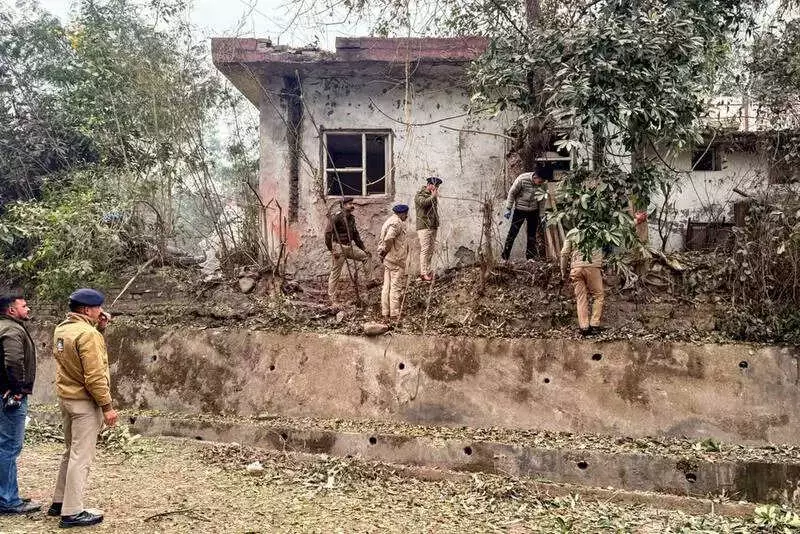
Security agencies in North India are investigating a suspected terror link to a recent explosion in Himachal Pradesh, with Punjab Police pointing fingers at Pakistan's Inter-Services Intelligence (ISI). The blast, which occurred in the Nalagarh area, has been claimed by militant groups citing the region's drug trade as their motive.
Blast Details and Responsibility Claims
On Thursday, a purported joint press note from the banned Babbar Khalsa International (BKI) and the Punjab Sovereignty Alliance (PSA) surfaced, claiming responsibility for the IED blast at a police station in Nalagarh. The note stated the attack was executed by their "brave soldiers," specifically naming Gopi Nawanshehria and Kabal Singh as the planners.
The groups justified the act by alleging that synthetic drugs manufactured in the pharmaceutical hub of the Baddi-Nalagarh region in Himachal Pradesh were being sent to Punjab. "Despite the police administration being aware of this, no action was taken, and the youth were being killed by drugs, and that is why we had to give an answer," the note read. It issued a stark warning, threatening to plant IEDs on police vehicles and headquarters if no action is taken against the drug trade.

Police Investigation Points to Foreign Conspiracy
A senior Punjab Police officer, speaking to the Times of India, presented a contrasting narrative. The officer dismissed the ideological reasons cited in the press note as a "farce." Instead, the investigation suggests the hand of external elements aiming to destabilize a strategically sensitive region.
"It seems to be the handiwork of those elements who carried out blasts in Punjab. It is all being done at the behest of the ISI in an attempt to destabilise the region north-west of Delhi and south of Jammu & Kashmir," the officer stated. The police theory posits that gullible youth are hired by foreign-based handlers to execute such blasts for money, devoid of any real ideology.
Punjab Police have contacted their counterparts in Himachal Pradesh to gather crucial evidence, including photographs and CCTV footage from the explosion site. The focus is on establishing concrete links to the earlier series of blasts targeting police establishments in Punjab since November 2024, for which US-based Gopi Nawanshehria had claimed responsibility.
Strategic Implications and Regional Security
The location of the incident adds a critical dimension to the investigation. Nalagarh lies in a zone described by authorities as strategically located northwest of Delhi and to the south of the Union Territory of Jammu & Kashmir. This places it in a sensitive corridor where maintaining stability is paramount for national security.
The dual narrative—a claim of domestic grievance over drugs by militant groups versus the police's assertion of a foreign-sponsored terror plot—highlights the complex security challenges in the region. The incident has prompted heightened coordination between the police forces of Punjab and Himachal Pradesh to prevent any further attempts to disrupt peace.
Authorities are treating the claims and the investigation with utmost seriousness, aiming to unravel the network behind the blast and preempt any future threats as warned in the purported press note.






