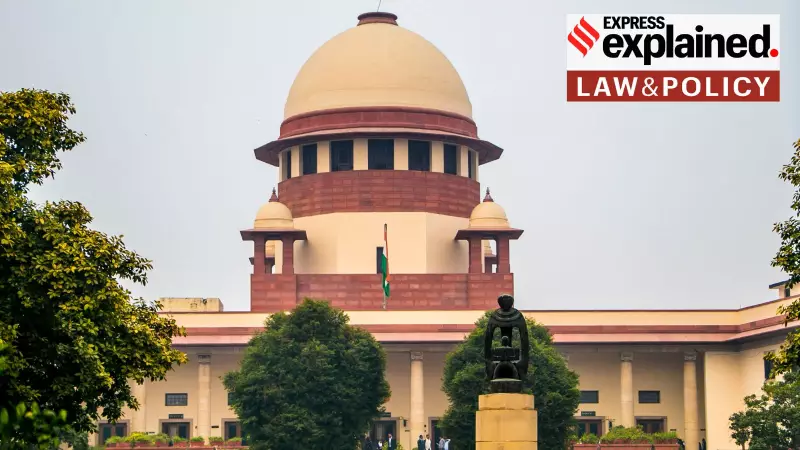
The Supreme Court of India has delivered a significant verdict, overturning a Rajasthan High Court decision and reinforcing a state policy that prohibits naming revenue villages after individuals. The apex court's ruling directly impacts two villages in Barmer district, Amargarh and Sagatsar, whose names were derived from the individuals who donated land for their creation.
The Core of the Controversy
The legal dispute began with a notification issued by the Rajasthan government in December 2020. This notification created four new revenue villages—Nainoni Darziyon Ki Dhani, Sagatsar, Amargarh, and Hemnagar—carved out from the existing revenue village of Sohda in Barmer. The creation was an administrative move to ease land record management and local governance in the sparsely populated, arid region near the Pakistan border.
To facilitate the process, two residents, Amarram and Sagat Singh, donated portions of their land. Officials at the time, including the Tehsildar, certified that the proposed village names were not associated with any individual, religion, caste, or community. The villages were formally entered into revenue records in January 2021.

The Policy Breach and Judicial Journey
The issue remained dormant until 2025, during a statewide exercise to redraw gram panchayat boundaries. Residents of a neighboring settlement, Meghwalon Ki Dhani, pointed out that the names Amargarh and Sagatsar appeared to be based on the donors' names. This triggered a legal challenge based on a 2009 government circular.
This circular, issued under the Rajasthan Land Revenue Act, 1956, contains a crucial clause: Clause 4. It mandates that a proposed village name must not be based on "any person, religion, caste or sub-caste." The policy's stated objective is to prevent any undue advantage to a particular group and to maintain communal harmony.
The Rajasthan High Court initially quashed the 2020 notification in July 2025, aligning with this policy. However, a Division Bench of the High Court later reversed this decision. It focused on the timing, noting that the villages were created years before key HC judgments on the naming rule. The Bench warned that reopening the issue could "open a Pandora's Box" of unsettled administrative decisions.
Supreme Court's Final Word
A Bench of Justices Sanjay Kumar and Alok Aradhe heard the case and delivered its verdict last week. The Supreme Court firmly set aside the Division Bench's order. The apex court clarified that the issue was not about applying the policy retrospectively.
The court held that the 2009 circular was already in force when the villages were named in 2020. Therefore, the breach of policy occurred at the very inception of the naming process. The SC emphasized that a policy decision, once made, binds the government itself.
"Any action taken in violation of such a policy, without amendment or valid justification, is arbitrary and violative of Article 14," the court observed. It made clear that administrative finality cannot cure an initial illegality. The state government, the ruling stated, cannot depart from its own binding policy.
Broader Implications and Precedents
This is not an isolated case. In February 2025, the Rajasthan HC itself had dealt with similar petitions against village names like "Gogaji Ki Jaal," named after a local deity. The court had ruled that this too violated Clause 4 of the 2009 circular, as it gave prominence to a deity worshipped by a specific community.
The Supreme Court's latest judgment reinforces this consistent judicial interpretation. It underscores that policies designed to uphold secular principles and social harmony must be strictly adhered to by the executive, regardless of when a discrepancy is discovered. The fate of the names Amargarh and Sagatsar now rests with the state government, which must rename them in accordance with its own long-standing rules.