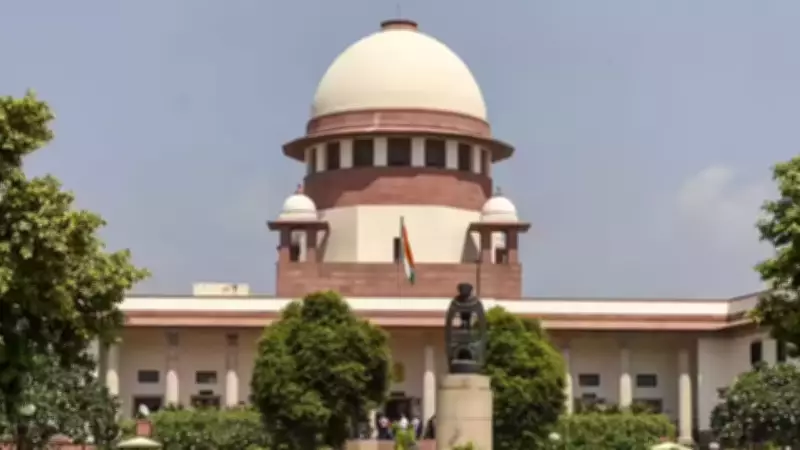
A nine-judge bench of the Supreme Court on Wednesday appeared to align with the government's stance on the limited scope of judicial review concerning religious practices, stating that constitutional courts should exercise extreme caution when questioning the collective religious beliefs of a denomination. The observation came from a bench comprising Chief Justice Surya Kant and Justices B V Nagarathna, M M Sundresh, Ahsanuddin Amanullah, Aravind Kumar, A G Masih, P B Varale, R Mahadevan, and J Bagchi during arguments by Solicitor General Tushar Mehta.
Mehta argued that there exists a plurality of sects and sub-sects within denominations, each with distinct religious practices and rituals. He emphasized that every denomination, sect, and sub-sect is entitled to practice its unique rituals. Even if secular activities are intermingled with these religious practices, courts should, when testing the validity of a law restricting the secular part of such religious activity, lean towards protecting the religious practices to preserve the identity of the denomination, sect, or sub-sect.
To illustrate his point, Mehta gave an example: the right to light a 'diya' is undoubtedly a matter of religion. However, if a particular denomination mandates lighting 100 diyas every day, the question arises whether the state can restrict the quantity of ghee to be purchased per day. Though purchasing ghee is a secular activity, it is intrinsically linked to a religious matter and therefore cannot be interfered with by the state.

Justices Nagarathna and Sundresh expressed the view that constitutional courts must not question the collective religious beliefs of followers of a denomination. Mehta added that reforms through legislation by the state must be grounded in constitutional principles such as public order, morality, and health.
Responding to the rationalist perspective advanced by senior advocate Sanjay Hegde, who argued that the right to freedom of conscience and religion permits a person to 'wake up a Hindu, have lunch as a Muslim, and go to sleep as a Christian,' Mehta retorted that anyone entertaining such thoughts 'needs psychiatric treatment.'
The bench has reserved its verdict on the reference concerning the tussle between faith and fundamental rights.