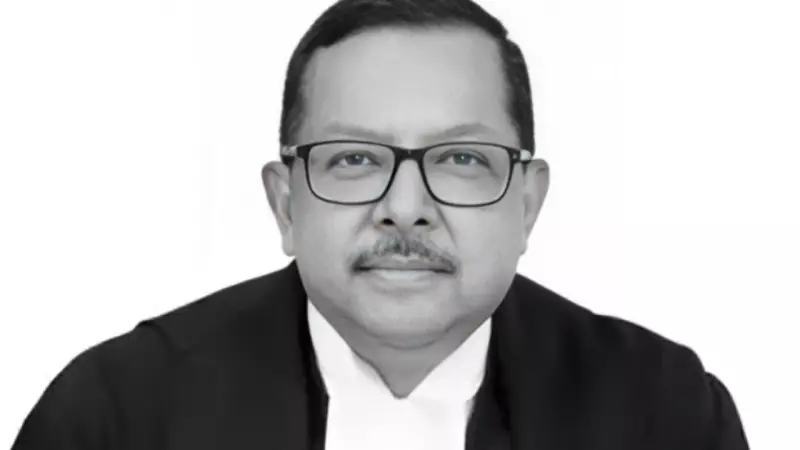
SC Judge Ujjal Bhuyan Decries Collegium's Transfer of Justice Sreedharan as Executive Intrusion
In a significant address that has stirred legal circles, Supreme Court judge Justice Ujjal Bhuyan expressed strong dissent and disappointment on Saturday over the collegium's decision to transfer Justice Atul Sreedharan from the Madhya Pradesh High Court to the Allahabad High Court. Speaking at the Principal G V Pandit Memorial Lecture on "Constitutional Morality and Democratic Governance" at ILS Law College in Pune, Justice Bhuyan emphasized that the biggest threat to judicial independence "is from within" and criticized what he termed a "striking intrusion of executive influence" in the collegium system.
Questioning the Motive Behind the Transfer
Without directly naming Justice Sreedharan, Justice Bhuyan posed a critical question: why should a judge be transferred from one high court to another merely because he had passed some "inconvenient order" against the government? This query comes in the backdrop of a bench headed by Justice Sreedharan that had taken suo motu cognisance in May against BJP minister Vijay Shah for using 'scurrilous language' against Colonel Sofiya Qureshi.
The collegium had initially recommended in August that Justice Sreedharan be transferred from Madhya Pradesh to the Chhattisgarh High Court. However, in a controversial move, the collegium changed its decision in October on the Centre's request, shifting him instead to the Allahabad High Court. Many legal experts have interpreted this as a punitive measure against Justice Sreedharan for passing orders that were inconvenient to the government.

Collegium Resolution Sparks Controversy
Justice Bhuyan highlighted a concerning aspect of the collegium resolution, which was briefly uploaded on the Supreme Court website before being withdrawn and replaced. The original resolution officially revealed, for the first time, that the government had interfered in the appointment of judges, though this part was omitted in the subsequent release. "When collegium itself records that the transfer was done at the request of the central government, it reveals a striking intrusion of executive influence to what is constitutionally supposed to be an independent process created to make such immune to executive and political influence," Justice Bhuyan stated.
He further argued, "Then again when it is noted in collegium resolution itself that a particular HC judge who was to be transferred to another HC was subsequently transferred to different HC by modifying earlier recommendation on reconsideration sought by central government. Does it not compromise the integrity of the collegium system?"
Erosion of Judicial Autonomy
Emphasizing that the government has no role or say in the transfer of judges, which falls within the exclusive domain of the judiciary, Justice Bhuyan warned that such actions erode the autonomy of the judicial system. "It reflects clear admission of political executive influencing collegium decision... It's unfortunate," he said, adding that the government cannot dictate which judge should be transferred to which high court.
Justice Bhuyan stressed the importance of maintaining the integrity of the collegium system, stating, "It has become more important for the judiciary, particularly members of collegium, to continue to function independently and the integrity of the collegium system must be maintained at all costs. As judges we have taken an oath of the Constitution to perform our duty without fear or favour. We must remain true to our oath. If we lose our credibility then nothing will remain of the judiciary."
Constitutional Morality and Democratic Governance
In his lecture, Justice Bhuyan elaborated on the concept of constitutional morality, describing it as the soul of democratic governance. He explained that it ensures democratic institutions function by adhering to constitutional values, rather than bulldozing through on the strength of numbers, authority, and power. "Judiciary has neither the purse nor the sword. All that it has is the faith reposed in it by the people and if that faith is breached then nothing will be left of the judiciary," he remarked.

While acknowledging that the collegium system is not perfect and has scope for reform, Justice Bhuyan noted, "Sociology says that a man is a political animal and a judge is also a human being. It is, therefore, natural for a judge to have political and ideological leaning and there is nothing wrong in it. But that should not cloud the decision-making process of a judge who is not supposed to follow political ideology but constitutional principle in judicial proceedings."
He concluded with a stark warning: "It would be a sad day for judiciary and by extension for our democracy if the decision in a case becomes a foregone conclusion the moment a case is listed before a particular judge or bench." This statement underscores the critical need for judicial independence and the preservation of constitutional principles in India's democratic framework.