

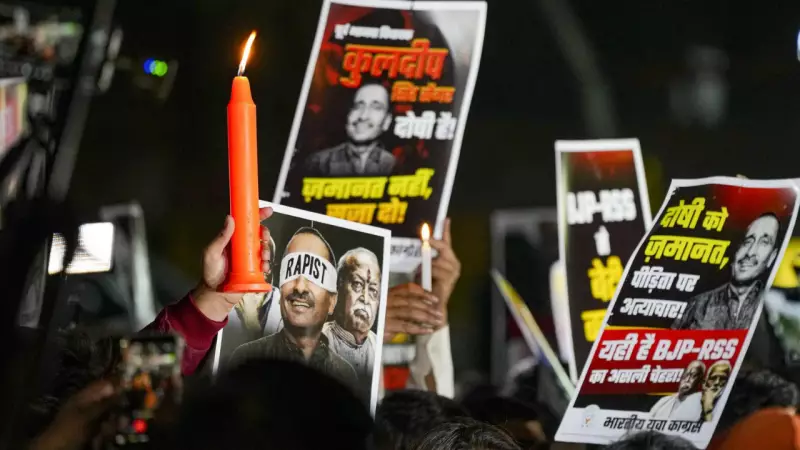
In a significant legal development, the Supreme Court of India on Monday intervened to halt a Delhi High Court order that had suspended the life sentence of former Bharatiya Janata Party (BJP) leader Kuldeep Singh Sengar in the infamous 2017 Unnao rape case. The apex court's decision came on an urgent plea filed by the Central Bureau of Investigation (CBI), which raised serious concerns about the interpretation of the law concerning elected representatives.
Supreme Court's Immediate Intervention
A three-judge vacation bench, led by Chief Justice Surya Kant and comprising Justices JK Maheshwari and Augustine George Masih, put a stay on the execution of the high court's December 23 order. That order had suspended Sengar's life sentence awarded under the stringent Protection of Children from Sexual Offences (POCSO) Act. The bench clarified that Sengar would not be released from jail as he remains in custody in a separate case related to the custodial death of the rape survivor's father.
The bench acknowledged that it is not ordinary practice to stay a sentence suspension without hearing the convict. However, it stated that the "peculiar facts" of this case warranted immediate action. "We are conscious of the fact that when a convict or an undertrial has been released, such orders are not ordinarily stayed by this court without hearing such persons. But in view of peculiar facts where the convict is convicted for a separate offence, we stay the operation of the Delhi high court order dated December 23," the court ordered.

The Core Legal Debate: Is an MLA a 'Public Servant'?
The heart of the CBI's challenge lies in a critical legal question: Can a Member of the Legislative Assembly (MLA) be considered a 'public servant' for the purpose of invoking aggravated offences under the POCSO Act? Solicitor General Tushar Mehta, appearing for the CBI, argued that Sengar, who was a powerful MLA at the time of the crime, exercised dominance over the minor survivor. He contended this squarely placed the offence within the scope of aggravated sexual assault, which mandates stricter punishment.
Senior advocates Siddharth Dave and N Hariharan, representing Sengar, countered this argument. They submitted that an MLA cannot automatically be treated as a public servant under the specific definitions within the POCSO Act. The Supreme Court bench, however, expressed deep unease with the high court's reasoning that seemed to accept this interpretation. The judges warned that such a view could lead to an anomalous situation where lawmakers are exempted from the stricter punishment meant for those in authority.
"We are worried that a constable or patwari will be a public servant under the Act, but an MLA or MP will not be and get exempted," the bench observed, highlighting the potential loophole.
Why This Legal Interpretation Matters
The classification is crucial because Section 5 of the POCSO Act treats sexual assault as "aggravated" when committed by a public servant or a person in a position of trust or authority. This aggravated charge attracts a minimum punishment of 20 years, which can extend to imprisonment for the remainder of the convict's natural life. In 2019, a Delhi trial court had held Sengar guilty as a public servant and sentenced him to imprisonment for life. The high court's subsequent suspension of this sentence had drawn sharp criticism for potentially diluting the law's intent.
The Supreme Court has now issued a formal notice to Sengar and will undertake a detailed examination of whether the high court erred in excluding legislators from the definition of "public servant" under POCSO. The CBI will file its counter within four weeks.
Survivor's Reaction and Plea for Security
The Unnao rape survivor welcomed the Supreme Court's intervention, expressing her continued faith in the judicial system. Speaking to reporters, she said, "I am very happy. I had faith in the Supreme Court. I will ensure that he is given a death sentence." Her mother echoed the sentiment and raised concerns about safety, requesting enhanced security for the family and their legal counsel. "My family needs security. Our advocates need security. I request that the government keep us all safe," she stated.

The Supreme Court's swift action underscores the gravity with which it views both the crime and the precedent-setting legal principle at stake. The final ruling will have far-reaching implications for how the law perceives the accountability of elected representatives in cases of sexual violence against minors.





