Telangana High Court Overturns Death Sentence in Infant Killing Case, Accepts Insanity Plea
In a significant legal development, the Telangana High Court has set aside the death sentence awarded to a 35-year-old woman from Suryapet district for the 2021 killing of her seven-month-old daughter. The court accepted her plea of insanity, ruling that she was incapable of understanding the nature of her actions at the time of the tragic incident.
Court Accepts Insanity Defense Based on Mental Health Diagnosis
The woman, who has been diagnosed with paranoid schizophrenia, committed the act under severe delusions that she was suffering from 'sarpa dosha' (serpent curse). According to court documents, she believed—after consuming content on social media—that performing a human sacrifice would rid her of this perceived affliction. A division bench comprising Justices K Lakshman and Vakiti Ramakrishna Reddy held that, at the time of the incident, the woman was completely incapable of understanding that her act was wrong or illegal.
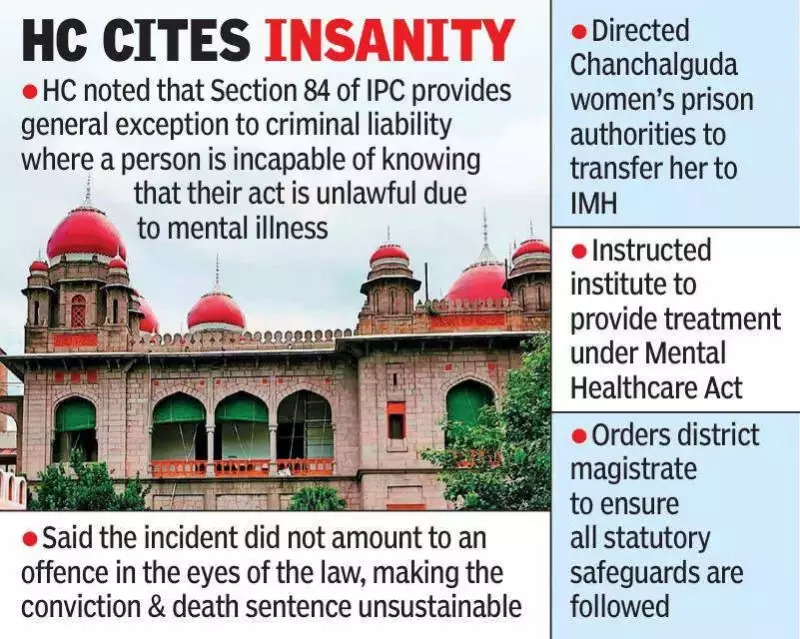
The bench observed that her mental condition rendered her unable to comprehend the consequences of her actions, thereby attracting protection under Section 84 of the Indian Penal Code. This legal provision provides a general exception to criminal liability when a person is incapable of knowing that their act is unlawful due to mental illness.

Past Conduct Shows Serious Mental Instability and Violent Behavior
While noting that her family expressed willingness to care for her, the bench pointed to her past conduct as evidence of serious mental instability and violent tendencies. The court referenced an incident in which she allegedly attempted to kill her husband while on bail in her daughter's murder case. Given this troubling history, the bench determined that releasing her into society would pose a serious risk to public safety.
In its comprehensive 52-page judgment, the court emphasized that although the physical act of killing was committed by the woman, it could not be treated as a criminal act under the circumstances. The evidence, assessed on a preponderance of probabilities, clearly established that she was suffering from such unsoundness of mind that she could not understand the nature of her actions or their legal implications.
Court Orders Transfer to Specialized Mental Health Facility
The bench has ordered that the woman be immediately shifted from Chanchalguda women's prison to the Institute of Mental Health in Erragadda. The court observed that she would receive better care and treatment in a specialized mental health facility equipped to handle her condition.
Furthermore, the court directed the institute to provide appropriate treatment under the provisions of the Mental Healthcare Act. The district magistrate has been tasked with periodic supervision to ensure all statutory safeguards are properly followed during her treatment and confinement.
The ruling sets aside the death sentence imposed by the Suryapet district court in April 2025, marking a significant application of mental health considerations in criminal jurisprudence. The court concluded that the incident did not amount to an offence in the eyes of the law, making the original conviction and death sentence legally unsustainable.