

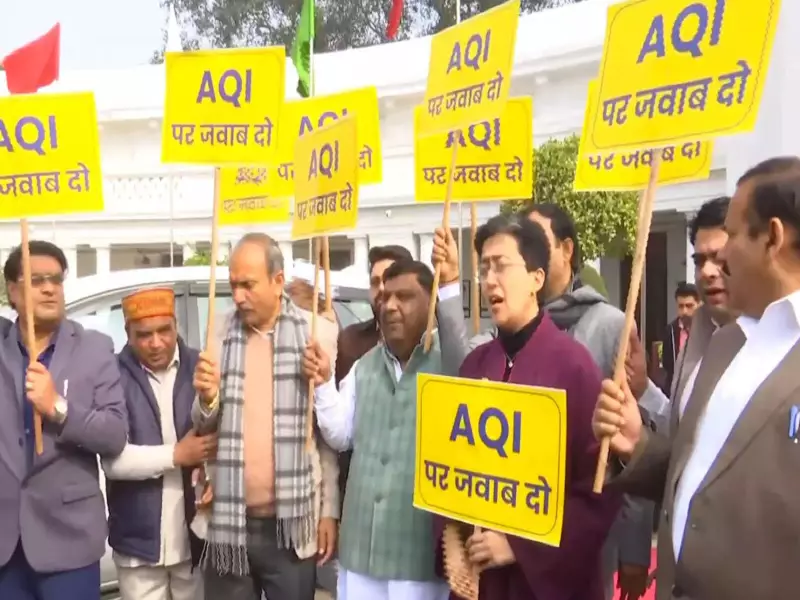
The Aam Aadmi Party (AAP) launched a significant demonstration at the premises of the Delhi Legislative Assembly on Tuesday, bringing the escalating crisis of air pollution and dangerously high Air Quality Index (AQI) levels in the national capital into sharp focus.
Opposition Alleges Government Evasion on Pollution Crisis
Leading the charge, Atishi, the Leader of the Opposition in the Delhi assembly and a senior AAP figure, launched a sharp critique against the Bharatiya Janata Party (BJP). She asserted that the ruling party is actively "running away" from confronting the vital issue of pollution. Atishi accused the BJP of sidestepping responsibility and refusing to participate in substantive debates aimed at finding solutions for Delhi's toxic air.
Addressing the media, Atishi painted a grim picture of the public health emergency unfolding in the city. She highlighted that young children are now "forced to rely on steroid inhalers" to breathe. Major healthcare institutions, including the premier All India Institute of Medical Sciences (AIIMS), are reportedly overflowing with patients suffering from respiratory distress. She further warned that senior citizens are confronting life-threatening risks due to the persistently poor air quality.

"Pollution is the most significant problem facing Delhi today," Atishi stated. "When the AAP pushes for a discussion on this critical matter in the assembly, the BJP concocts excuses to avoid it. Historically, it's the opposition that protests, but here, the ruling party itself staged a walkout. This theatrical protest by the government only proves they wish to dodge the pollution discussion because they have no concrete answers."
Accusations of Data Manipulation and Continued Protests
The AAP leader escalated her allegations by accusing the Delhi government of engaging in "theatrics" to mask the true severity of the situation. She claimed that AQI monitoring data is being tampered with through the use of water sprays near sensors to artificially improve readings. "The entire nation is aware of how AQI monitors are being manipulated. Water is sprayed to alter the numbers, while people continue to suffer and die from pollution. We demand an end to this charade and an immediate legislative discussion," she added.
This protest followed a similar demonstration by AAP MLAs inside the Delhi Assembly on Monday. The legislators have been consistently demanding urgent policy interventions and greater accountability regarding the capital's air quality. Their demands include:
- Stricter measures to control vehicular emissions.
- Curbing industrial pollution discharges.
- Addressing the issue of stubble burning in neighboring states.
Widespread Fog and 'Poor' to 'Very Poor' AQI Grips Delhi
The political drama unfolded against a backdrop of visibly deteriorating environmental conditions. On Monday morning, Delhi, along with other Indian cities like Mumbai and Guwahati, was shrouded in a dense layer of fog and smog. Air quality across the national capital ranged from 'Poor' to 'Very Poor', causing significant disruption.
According to data from the Central Pollution Control Board (CPCB), Delhi's overall AQI was recorded at 260 (Poor category) by 8 am on Monday. Specific locations reported even more alarming figures:
Akshardham registered an AQI of 294 (Poor).
ITO recorded an AQI of 256 (Poor).
Anand Vihar saw a sharper decline to 320, placing it in the 'Very Poor' bracket.
Chandni Chowk remained one of the worst-hit areas with an AQI of 337 (Very Poor).
The reduced visibility severely impacted air travel, leading to multiple flight delays at Delhi's Indira Gandhi International (IGI) Airport in the early hours.
In a related development, the Sub-Committee on the Graded Response Action Plan (GRAP) under the Commission for Air Quality Management (CAQM) had lifted Stage-III restrictions in Delhi on Friday evening. This decision was based on noted improvements in air quality due to favourable meteorological conditions at the time.






