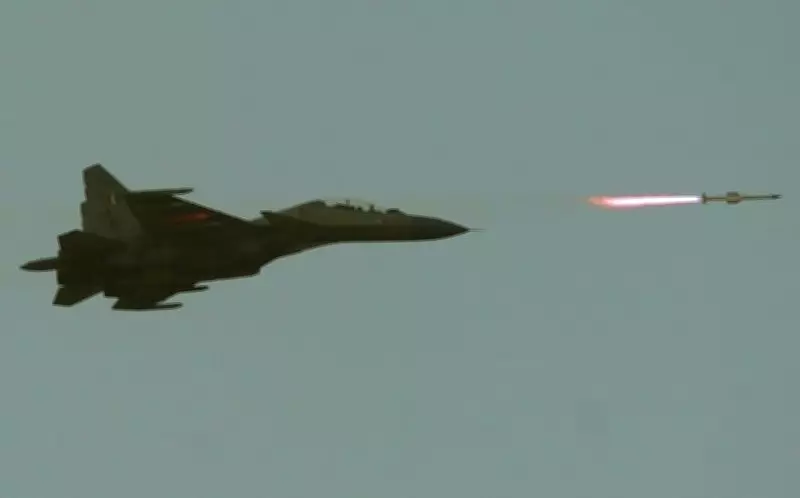
Astra Missile System: Overview and Key Facts
The Astra missile system is an all-weather, Beyond-Visual-Range (BVR) air-to-air missile developed by the Defence Research and Development Organisation (DRDO). It uses a solid-propellant rocket motor and is designed primarily for integration with the Sukhoi Su-30MKI fighter aircraft of the Indian Air Force. The missile has been successfully integrated and tested on other indigenous platforms as well.
Incorrect Statement Identification
Regarding the Astra missile system, the incorrect statement is that it was jointly developed by DRDO and the European consortium MBDA. In reality, the Astra missile is indigenously developed solely by DRDO without any foreign joint development partner. The other statements are correct: it is an all-weather BVR air-to-air missile, uses a solid-propellant rocket motor, and is primarily designed for the Su-30MKI.
Difference Between Astra Mk-1 and Astra Mk-2
The Astra Mk-1 has a strike range of approximately 80-110 km, while the Astra Mk-2 is designed to engage targets at a longer range of about 160 km. This range extension is achieved through improvements in propulsion and aerodynamics. The Mk-2 variant does not use a ramjet engine; that is a feature of the future Astra Mk-3. Both variants are air-to-air missiles, not surface-to-air. The guidance system for both is Active Radar Homing (ARH) in the terminal phase, not Semi-Active Radar Homing.

Primary Guidance System in Terminal Phase
During the terminal phase of interception, the Astra missile employs Active Radar Homing (ARH). This means the missile has its own radar seeker to lock onto and track the target, providing fire-and-forget capability. Other guidance methods like Semi-Active Laser Homing, Imaging Infrared Homing, or Laser Beam Riding are not used in the Astra.
Integration with Indigenous Fighter Aircraft
Apart from the Sukhoi Su-30MKI, the Astra missile has undergone successful integration and captive flight trials with the HAL Tejas, India's indigenous light combat aircraft. The integration enhances the Tejas's BVR combat capability. Other aircraft like HAL Rudra (a helicopter), SEPECAT Jaguar, and Mikoyan MiG-29K have not been officially confirmed for Astra integration in the same manner.
Key Operational Capability
A key operational capability of the Astra weapon system is its ability to engage highly manoeuvring supersonic targets at both short and long ranges. It is not exclusively designed for Within-Visual-Range (WVR) dogfights; its BVR capability allows engagement beyond visual range. It does not have a dual-role as a surface-to-surface ballistic missile, and it does not rely on semi-active radar for the entire flight; it uses inertial navigation with mid-course updates and active radar homing in the terminal phase.