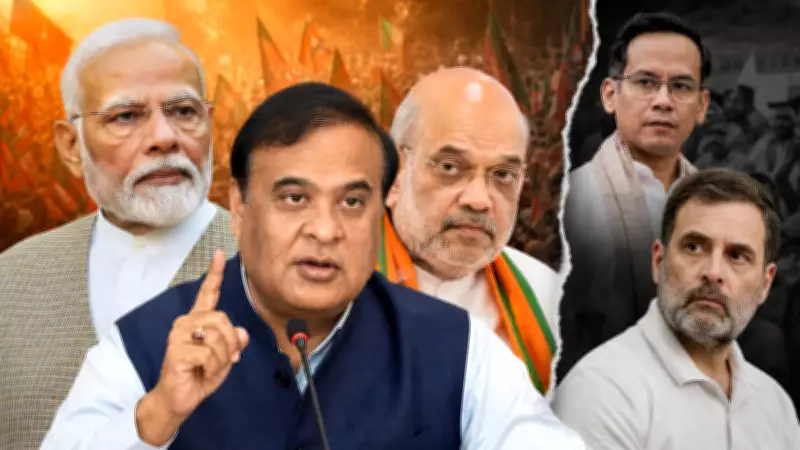
The Bharatiya Janata Party has not just returned to power in Assam but secured a third consecutive term with a commanding mandate, underlining its transformation from a marginal player into the state's dominant political force.
Himanta Biswa Sarma: The Architect of Victory
At the centre of this emphatic victory stands Himanta Biswa Sarma, widely seen as the chief architect of the party's rise. Over the past decade, he has built a formidable electoral machine by combining organisational depth, strategic alliances, welfare outreach, and a sharply defined political narrative.
In Jalukbari, Sarma has registered a resounding win, securing 1,27,151 votes and defeating his nearest rival by a massive margin of 89,434 votes. The scale of the victory goes far beyond a routine electoral triumph in a stronghold seat; it reinforces his enduring grip over the constituency he has dominated since 2001 and mirrors the BJP's firm hold over Assam's political landscape.

From Congress Insider to BJP's Chief Strategist
For over a decade, Himanta Biswa Sarma was not merely a senior leader within the Indian National Congress in Assam; he was its principal troubleshooter, strategist, and organisational backbone. During the long tenure of Tarun Gogoi, Sarma handled crucial ministries including health, education, and finance, building a reputation as an efficient administrator who could translate political messaging into electoral outcomes.
Within the party structure, Sarma's influence grew steadily. He cultivated a network of loyal legislators and grassroots workers, many of whom saw him as the future face of the Congress in Assam. By the early 2010s, he was arguably the most powerful leader in the state after Tarun Gogoi himself, commanding the support of a majority of party MLAs.
The fault lines became visible around 2012-2014 when questions of succession began to dominate internal Congress politics. Tarun Gogoi's perceived inclination to promote his son, Gaurav Gogoi, created unease among senior leaders, but none felt it more sharply than Sarma. For a leader who had invested years in building the party's organisational strength, the prospect of dynastic succession was seen as a direct challenge to merit-based leadership.
In 2015, Sarma exited the Congress, ending a long association that had defined his early political career. His departure triggered a cascading effect within Assam's Congress unit, with several MLAs, district leaders, and grassroots workers following him. In one stroke, the Congress lost not just a senior leader but a significant portion of its organisational spine.
His entry into the Bharatiya Janata Party marked the beginning of a new phase. Sarma integrated quickly into the BJP's structure, leveraging his deep understanding of the state's political landscape. He brought with him an insider's knowledge of Congress strategies, voter networks, and regional dynamics, which proved invaluable for a party that was still expanding its base in Assam.
The Dismantling of the '3 Gogois'
If Himanta Biswa Sarma's rise explains the BJP's ascent in Assam, the decline of what is often termed the '3 Gogois' explains the collapse of the old order. This phrase captures three distinct political challenges: the legacy of Tarun Gogoi, the leadership ambitions of Gaurav Gogoi, and the agitational politics of Akhil Gogoi. Sarma's strategy was to isolate, weaken, and outmanoeuvre each strand individually.
The first layer involved the systematic erosion of Tarun Gogoi's legacy. Once Sarma exited the Congress in 2015, he effectively hollowed out the party's organisational base. Many MLAs, district leaders, and grassroots workers who had once rallied behind Gogoi shifted allegiance, leaving the Congress structurally weakened.
The second front was the challenge posed by Gaurav Gogoi. The BJP's campaign messaging increasingly framed the Congress as a party driven by inheritance rather than merit, a contrast carefully crafted against Sarma's own image as a self-made leader. Sarma also targeted Congress alliances, particularly its understanding with Badruddin Ajmal's AIUDF, portraying it as a miscalculation that alienated large sections of indigenous Assamese voters.

The third dimension was the rise of Akhil Gogoi, whose politics drew from grassroots mobilisation and anti-establishment sentiment. During the anti-CAA protests, he emerged as a central figure capable of galvanising large sections of youth and civil society. Sarma's response combined administrative firmness with strategic political messaging, reframing the political discourse from agitation to administration.
Perhaps Sarma's most significant achievement lay in preventing these three strands from converging into a cohesive opposition front. By keeping the opposition divided, Sarma ensured that the BJP faced no singular, consolidated challenge.
Building the BJP Fortress: Strategy, Welfare, and Identity
The transformation of Assam into a BJP stronghold was the result of a carefully layered strategy driven by Himanta Biswa Sarma. His approach blended electoral arithmetic with long-term social engineering, ensuring that the BJP was not merely winning elections but embedding itself deeply within Assam's political and social fabric.
At the core was Sarma's ability to build and sustain a broad coalition. Through his role in the North East Democratic Alliance (NEDA), he forged partnerships with regional parties, tribal leaders, and smaller political formations. This alliance-building exercise created a durable political ecosystem where local aspirations could coexist with the BJP's larger ideological framework.
Equally significant was his focus on welfare-driven governance. Schemes such as Orunodoi, which provides direct financial assistance to lakhs of women, became a cornerstone of the BJP's electoral strategy. These initiatives created a dependable 'beneficiary class' that cut across caste, community, and regional lines, reshaping traditional voting patterns.
Alongside welfare, Sarma demonstrated a keen understanding of identity politics. By positioning the BJP as the protector of indigenous Assamese interests, often framed through the 'Khilonjia' narrative, he successfully merged regional concerns with the party's broader ideological messaging. Issues such as illegal immigration, cultural identity, and demographic change were woven into a narrative that resonated strongly with voters.
This combination of alliances, welfare, and identity was first tested in the 2016 Assembly elections, where Sarma played a decisive role in ending 15 years of Congress rule. As a senior minister in the government led by Sarbananda Sonowal, he handled key portfolios such as finance and health, using his administrative role to further strengthen his political base.
By the time he was elevated as chief minister in 2021, Sarma had already established himself as the BJP's central strategist in the region. His transition to the top post was less a shift and more a consolidation of power. As chief minister, he combined administrative decisiveness with constant political engagement, maintaining a high level of visibility while continuing to refine the party's electoral strategy.
2026: Consolidation of Power
The 2026 election appears to be less about a contest and more about consolidation. Early trends and projections suggest that the BJP is on course to retain power comfortably, reinforcing Sarma's status as the party's most influential leader in the Northeast.
His massive lead in Jalukbari underscores not just personal popularity but also the organisational depth he has built over the years. Each successive election has seen his margin grow, reflecting an expanding support base.
Sarma's rise has also altered the BJP's internal dynamics. Unlike many regional leaders, he has managed to carve out space at the national level, becoming a key link between the party's central leadership and the complex political landscape of the Northeast.
The Road Ahead
As Assam's political landscape continues to evolve, one reality stands out: the era of Congress dominance, once synonymous with the Gogoi name, has given way to a new order defined by Sarma's leadership. Whether this BJP 'fortress' remains unchallenged in the long term will depend on how the opposition reorganises and whether new political currents emerge. But for now, the 2026 results reaffirm a decisive shift driven by a leader who not only changed sides but rewrote the rules of the game.