

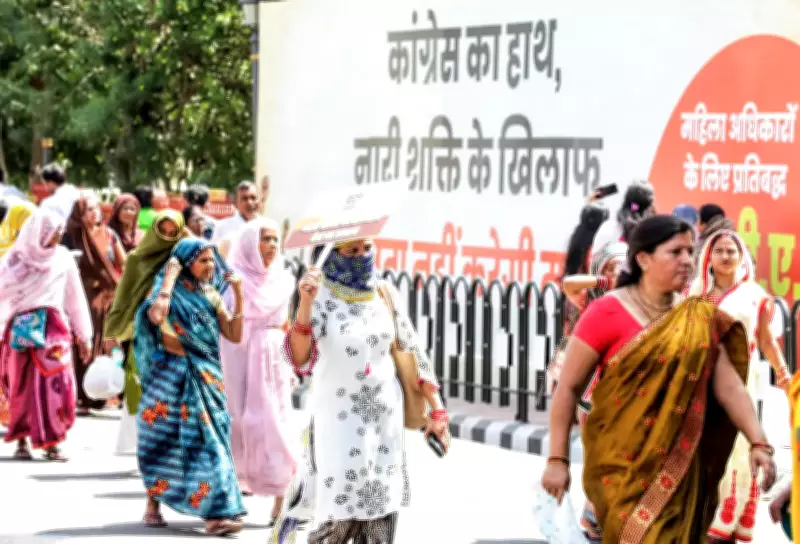
BJP Women Leaders Spearhead Campaign Against Opposition Parties Over Women's Reservation Act
In a significant political development, the Bharatiya Janata Party (BJP) on Tuesday prominently showcased its women leaders at the forefront of a vigorous campaign targeting Opposition parties. This strategic move came immediately after an amendment to the Women's Reservation Act was defeated in Parliament, sparking widespread debate and political maneuvering.
Yogi Adityanath Leads Symbolic Padyatra in Lucknow
Uttar Pradesh Chief Minister Yogi Adityanath took center stage by leading a symbolic padyatra (foot march) in Lucknow. He was joined by women members of his Cabinet and several senior party leaders, who collectively launched a scathing attack on the Samajwadi Party (SP) and the Indian National Congress. The BJP leaders accused these Opposition parties of adopting what they termed an "anti-women" stand on the crucial issue of women's reservation.
Sharp Criticism from UP Education Minister Gulab Devi
Uttar Pradesh's Secondary Education Minister, Gulab Devi, launched a particularly sharp and pointed attack on the Opposition. She characterized their thinking as regressive and backward, urging women across the state and the nation to recognize what she described as the true, underlying mindset of the SP and Congress parties.

Minister Devi asserted that women throughout the country were filled with anger and disappointment over the defeat of the amendment in Parliament. She called for this collective anger to be channeled and reflected politically at every level of governance—from local panchayats to state legislative assemblies and the national Parliament itself.
In a direct political appeal, Gulab Devi urged women to continue their struggle for representation and to actively help bring the BJP government to power in the upcoming elections of 2027 and 2029, framing the issue as central to women's political empowerment.
Allegations of Celebration by Opposition Women MPs
Adding a layer of controversy to the discourse, Women's Welfare Minister and former Governor Baby Rani Maurya made specific allegations against prominent Opposition figures. She pointed out that Congress MP Priyanka Gandhi and SP MP Dimple Yadav were both present in Parliament during the session when the amendment was defeated.
Maurya alleged that women Members of Parliament from Opposition parties celebrated this development by thumping their desks—a gesture typically indicating approval or triumph. She argued that if these MPs were genuinely and sincerely committed to women's rights and empowerment, they would have expressed profound disappointment or regret instead of celebration. Maurya strongly urged women voters to respond decisively to what she termed a direct insult to their aspirations.
Former BJP MP Rita Bahuguna Joshi Joins the Fray
Former BJP MP Rita Bahuguna Joshi also added her voice to the criticism, directing her remarks at the Opposition bloc. She credited Prime Minister Narendra Modi with introducing the bill aimed at women's empowerment through reservation. Joshi claimed that rival political parties deliberately blocked the amendment due to what she described as an inherent anti-women mindset.
Joshi issued a clarion call to women across the political spectrum to unite and demonstrate their collective political strength against the Opposition. She emphasized the need for a cohesive and powerful response to safeguard women's legislative interests.
Political Implications and Strategic Posturing
This coordinated campaign by BJP women leaders represents a calculated political strategy to frame the narrative around women's reservation. By positioning themselves as the sole champions of women's rights and simultaneously painting the SP and Congress as adversaries to gender equality, the BJP aims to consolidate its support among women voters—a crucial demographic in Indian elections.
The use of high-profile padyatras, strong ministerial statements, and specific allegations against Opposition MPs is designed to keep the issue in the public eye and apply sustained political pressure. The focus on the 2027 and 2029 elections indicates a long-term electoral plan centered on women's empowerment as a key plank.

As the debate intensifies, the response from the Samajwadi Party and Congress, as well as the reaction from women's organizations and the broader electorate, will be critical in shaping the political landscape in Uttar Pradesh and potentially at the national level.





