

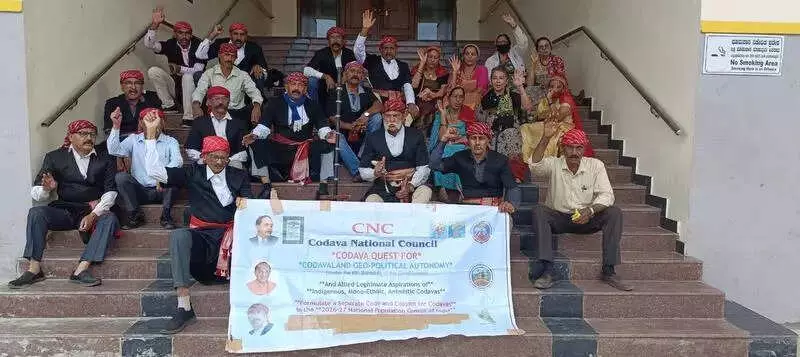
Codava National Council Stages Dharna for Kodava Community Rights in Madikeri
In a significant development in Madikeri, members of the Codava National Council (CNC) organized a peaceful dharna at the Kodagu Deputy Commissioner's office premises on Monday. The protest was centered on a crucial demand: the establishment of a dedicated commission to address the long-standing issue of geo-political autonomy for the indigenous Kodava community.
Urgent Call for Action on Indigenous Demands
The CNC activists emphasized the urgent need to resolve the persistent demands of the Kodava people, which have been pending for years. They articulated that the community fulfills all necessary criteria to be recognized as a 'primitive ethnic tribe', citing their unique cultural heritage, geographical isolation in the Kodagu region, and distinct customs that set them apart from other groups.
According to the protestors, achieving Scheduled Tribe (ST) status under Article 342 of the Indian Constitution would bring substantial benefits to the Kodava community. This status would not only provide legal recognition but also unlock access to various government schemes, educational opportunities, and economic support aimed at preserving their cultural identity and improving livelihoods.

Leadership and Formal Appeals
NU Nachappa, the president of the Codava National Council, played a pivotal role in the demonstration. He explained that a comprehensive memorandum detailing the community's demands has been formally submitted to key authorities at the national level. This includes appeals to the President of India, the Prime Minister, and the Union Minister for Home Affairs, urging immediate action to address their grievances.
The memorandum outlines the historical and cultural significance of the Kodava community, reinforcing their claim for autonomy and ST classification. Nachappa highlighted that such recognition is essential for safeguarding their traditions and ensuring equitable development in the region.
Broader Implications and Community Impact
The dharna in Madikeri underscores a broader movement for indigenous rights and self-determination in India. The Kodava community's struggle reflects similar efforts by other tribal groups across the country seeking recognition and autonomy. Key aspects of their demand include:
- Cultural Preservation: Protecting the unique Kodava language, festivals, and social practices from assimilation.
- Geopolitical Autonomy: Advocating for greater administrative control over local affairs to address community-specific issues.
- Economic Empowerment: Leveraging ST status to access reserved quotas in education, employment, and political representation.
- Legal Recognition: Formal acknowledgment under Indian law to strengthen their identity and rights.
This protest marks a renewed push by the CNC to bring national attention to the Kodava cause, emphasizing that delays in addressing their demands could further marginalize the community. As the situation develops, stakeholders are closely monitoring responses from governmental bodies, hoping for a constructive dialogue that leads to meaningful resolutions.






