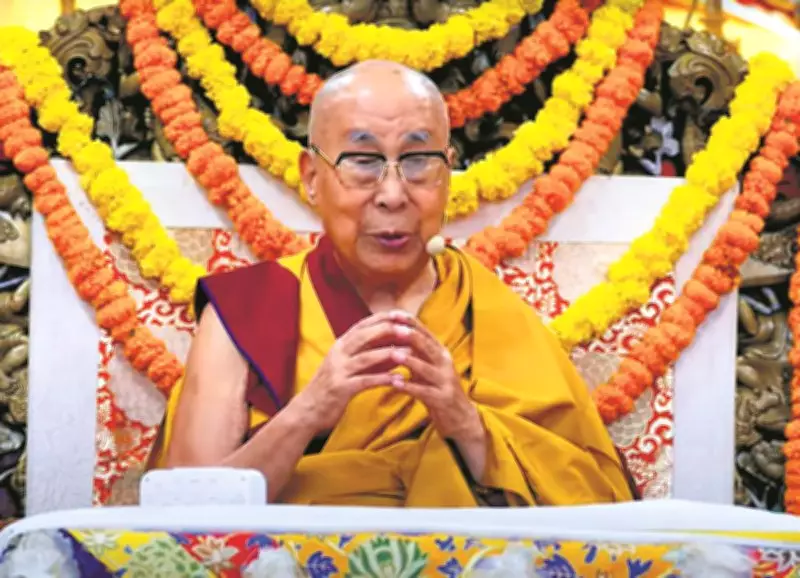
In the summer of 1959, a young man crossed into India on foot, having lost a country. Sixty-seven years later, the ledger of what India has received in return from him deserves to be read with more precision than any birthday tributes usually allow. The man — His Holiness Dalai Lama — turns 91 on July 6.
Intellectual Repatriation: A Philosophical Inheritance Restored
Let us begin with what he salvaged. In 1959, whole categories of Buddhist philosophical literature, logic, epistemology, and the great commentarial traditions built on Nalanda’s foundations survived only in Tibetan translation, the Sanskrit originals long lost to India itself. Within a decade, in dialogue with Jawaharlal Nehru, His Holiness helped found the Central Institute of Higher Tibetan Studies at Sarnath, near where the Buddha first taught, to translate that inheritance back into Sanskrit and Hindi. It remains one of the more improbable acts of intellectual repatriation in modern history: a refugee handing a civilisation back its own philosophical memory, in the place that memory was first spoken aloud.
Global Standing and Moral Authority
Consider next what his presence has done for India’s standing in the world. The Nobel Peace Prize of 1989 was his, but he used the address to name Gandhi’s legacy of non-violence as the tradition the prize truly honoured. Its implicit endorsement, that a nation willing to shelter such a man was itself worth honouring, accrued to India as much as to him. Every head of state, scientist, and pilgrim who has since made the journey to Dharamsala has made it to Indian soil.

Leadership as Duty: Voluntary Dismantling of Power
The clearest instance of leadership as duty sits in a single decision most of the world barely registered. On March 14, 2011, at 75, His Holiness formally relinquished the political authority he had held since childhood, transferring it entirely to a democratically-elected Sikyong. Four centuries of an institution that had fused spiritual and temporal rule chose, of its own accord, to end that fusion within a single lifetime. Few leaders anywhere have voluntarily dismantled power they were entitled to keep. He did so as the deliberate completion of a project decades in the making: a Tibetan democracy that would outlast him.
Institutional Legacy and Himalayan Borderlands
There is a fourth dimension to this ledger, quieter but no less consequential. The institutions he founded, at Sarnath, in Dharamsala, across Karnataka’s monastic settlements, drew students disproportionately from India’s own Himalayan borderlands: Ladakh, Sikkim, Arunachal Pradesh, Kinnaur and Spiti, regions whose Buddhist inheritance had long sat at the edge of national attention.
Unbroken Lineage of Teaching
Older still is a fifth: the guru-shishya lineage he embodies has multiplied outward, the shishya he trained becoming gurus in turn, an unbroken chain of teaching reaching well past any one monastery’s walls.
This is what India has actually been given, beyond the language of compassion that dominates most birthday commentary. A rescued philosophical inheritance, restored to the soil it came from. A moral standing in the world no ministry could have purchased. A working demonstration of what it looks like when a leader treats power as duty rather than possession. And, at a moment when religious suspicion travels faster than religious understanding, a living case for interfaith harmony as practice rather than policy.
A Shared Achievement of Exile
Beyond the man himself lies a wider achievement, belonging jointly to him, his people, and his hosts. Tens of thousands of Tibetans arrived in India in 1959 with almost nothing beyond what they carried. Six decades on, that community has managed something few displaced peoples have: it has kept its language, monastic institutions, script and ceremonies intact, without asking its host to bend for them. India, in turn, never demanded they dissolve into the State. Few chapters in the history of exile read as closer to success than loss. This one does, and belongs to both nations at once.

At 91, he is owed a more exact accounting than reverence alone provides. India’s oldest instinct, sanctuary offered without calculation, produced returns few nations have collected from one act of hospitality. That, stated plainly rather than reverently, is the debt this birthday actually marks.
— The writer is Managing Trustee of the Foundation for Universal Responsibility of the Dalai Lama. His views are personal.