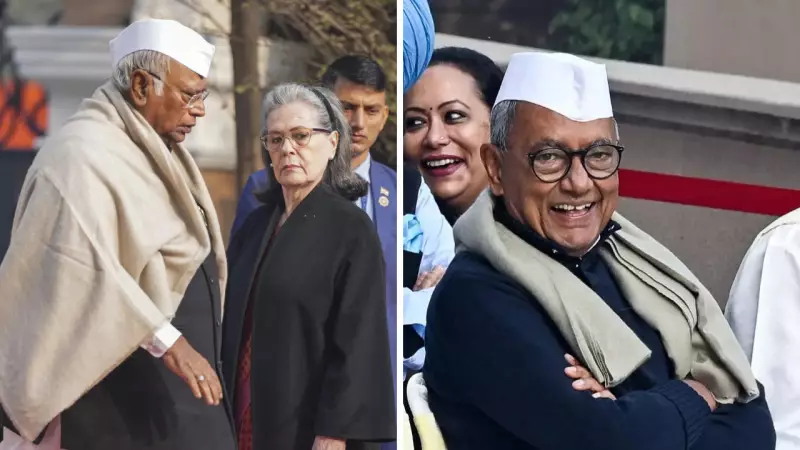
On the occasion of the Indian National Congress's 140th foundation anniversary, a fresh internal controversy erupted as senior party leader Digvijay Singh's public appreciation for the organisational prowess of the Rashtriya Swayamsevak Sangh (RSS) drew sharply divided reactions from his colleagues.
The Spark That Ignited the Row
The controversy began when Digvijay Singh shared a historic black-and-white photograph on social media platform X. The image depicted Prime Minister Narendra Modi sitting on the floor near senior BJP leader L.K. Advani in Gujarat. In his accompanying post, Singh highlighted the trajectory of a grassroots RSS worker rising to become Chief Minister and then the Prime Minister, attributing this ascent to the "power of organization."
He tagged several high-profile figures, including Congress president Mallikarjun Kharge, MPs Rahul Gandhi and Priyanka Gandhi Vadra, general secretary Jairam Ramesh, PM Modi, and the official Congress handles. His post, which ended with "Jai Siya Ram," immediately set off a political firestorm within his own party.

Sharp Rebukes and Veiled Jibes Within Congress
The reaction from Congress leaders was swift and pointed. Party spokesperson Pawan Khera delivered a strong rebuttal, stating that an organization linked to Nathuram Godse, Mahatma Gandhi's assassin, had nothing to teach a party founded by Gandhi himself.
Congress MP Manickam Tagore took a more sarcastic approach, sharing a video of a football own goal with the caption "Famous Self goal. We have one." He later added that there was "nothing to learn from Godse's organisation other than Hate."
Senior leader Shashi Tharoor distanced himself from Singh's comments, emphasizing the Congress's own 140-year history as a source of learning. "Digvijay Singh can speak for himself," Tharoor stated, while also stressing the need for organizational discipline and strength within the Congress.
In a conciliatory tone, former Rajasthan Deputy Chief Minister Sachin Pilot asserted that the party remained united and that every member had the right to express their opinion, with the common goal of strengthening the leadership of Kharge and Rahul Gandhi.
Clarifications and Calls for Internal Reform
Facing backlash, Digvijay Singh issued a clarification, reiterating his opposition to the RSS ideology. "I am opposed to the ideology of the RSS. They neither respect the Constitution nor the country's laws," he said. However, he maintained his admiration for their organizational capacity, noting how an unregistered body had grown into what the Prime Minister called the world's largest NGO.
This incident is not an isolated call for change within the Grand Old Party. Earlier in the week, Singh had praised Rahul Gandhi on socio-economic issues but simultaneously called for "pragmatic decentralised functioning" within the Congress, drawing a parallel with the need for Election Commission reforms.
This sentiment echoes earlier calls for restructuring. In December, former Odisha MLA Mohammed Moquim wrote to Sonia Gandhi advocating for an "open-heart surgery" in the party, flagging a disconnect between leadership and workers. This follows the 2020 letter by 23 senior leaders demanding collective leadership, a move that led to expulsions and exits but little visible change in party functioning.
BJP Seizes the Opportunity
The Bharatiya Janata Party was quick to capitalize on the internal strife of its principal opponent. BJP national spokesperson Sudhanshu Trivedi framed Singh's comments as "open dissent" against Rahul Gandhi's leadership. He contrasted Modi's rise from the grassroots with Gandhi's political inheritance, suggesting the latter was bringing his party "upside down."
BJP leader C.R. Kesavan termed the Congress leadership "autocratic and undemocratic," questioning whether Rahul Gandhi would react to the "shocking truth bomb" dropped by his own senior colleague.

In his final clarification, Digvijay Singh attempted to draw a clear line, stating, "I support the organisation. I am against the RSS and Modi ji... I was, am, and will remain a staunch opponent of the RSS and Modi." However, the episode has already exposed the persistent undercurrents of discontent and the ongoing debate about organizational revitalization within the Congress, casting a shadow over its 140th-anniversary commemorations.