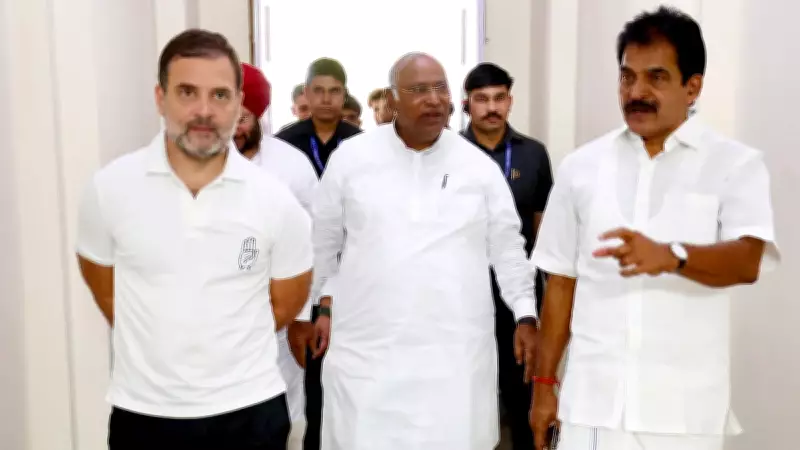
The opposition INDIA bloc has urged the Supreme Court to intervene and halt the 'One Nation, One Election' initiative, describing it as the "gravest threat" posed by the Modi-Shah regime. In a letter to Chief Justice of India D.Y. Chandrachud, the coalition argued that simultaneous polls would undermine India's federal structure and democratic principles.
Letter to the Chief Justice
The letter, dated October 22, was signed by leaders of 17 opposition parties, including Congress president Mallikarjun Kharge, Nationalist Congress Party (Sharad Pawar faction) chief Sharad Pawar, and Trinamool Congress leader Derek O'Brien. It requested the CJI to list a pending petition challenging the constitutional validity of simultaneous elections for early hearing. The petition, filed by former Union Minister and Congress leader Jairam Ramesh, has been pending since 2022.
The opposition leaders stated that the government's push for 'One Nation, One Election' is an attempt to subvert the country's democratic fabric. They argued that holding elections for the Lok Sabha and state assemblies simultaneously would benefit the ruling party at the Centre, as it could set the national narrative and overshadow regional issues.

Government's Response and Constitutional Concerns
The central government has defended the proposal, citing reduced election costs and administrative efficiency. A high-level committee headed by former President Ram Nath Kovind submitted a report in March 2024 recommending simultaneous polls. The committee proposed two phases: first, simultaneous elections for the Lok Sabha and state assemblies, followed by local body elections within 100 days.
However, the opposition contends that the plan requires amendments to at least five articles of the Constitution and would need ratification by at least 15 state assemblies. They argue that it violates the basic structure doctrine, which the Supreme Court has upheld in several landmark judgments. The letter warned that the initiative could lead to a "presidential-style" system, eroding the federal character of India's polity.
Political Implications
The INDIA bloc's move comes ahead of the winter session of Parliament, where the government is expected to introduce a bill on simultaneous elections. The opposition fears that the government might use its majority in the Lok Sabha to push through the legislation without adequate debate. The letter emphasized that the matter requires urgent judicial scrutiny to prevent what they called "irreparable damage" to the democratic system.
Political analysts note that the opposition's united stance is significant given their internal differences. The letter was also signed by leaders from the Samajwadi Party, Rashtriya Janata Dal, Aam Aadmi Party, and Communist Party of India (Marxist), among others. This rare show of unity indicates the high stakes involved in the 'One Nation, One Election' debate.
Supreme Court's Role
The Supreme Court has yet to respond to the letter. The pending petition by Jairam Ramesh challenges the constitutional validity of simultaneous elections, arguing that it infringes upon the federal structure. The opposition hopes that the CJI will list the case for an early hearing, potentially before the government tables the bill. Legal experts suggest that the court may consider the matter but is likely to await the government's formal proposal before intervening.
The 'One Nation, One Election' proposal has been a pet project of Prime Minister Narendra Modi, who has advocated for it since his first term. The BJP argues that it will save public money, reduce the burden on security forces, and ensure uninterrupted governance. However, critics contend that it could destabilize state governments if they are dissolved mid-term, leading to President's rule or by-elections.
Conclusion
The INDIA bloc's letter to the CJI marks a significant escalation in the opposition's campaign against simultaneous elections. By seeking the Supreme Court's intervention, they are attempting to check what they perceive as an overreach by the executive. The outcome of this legal challenge could have far-reaching implications for India's electoral system and democratic governance.