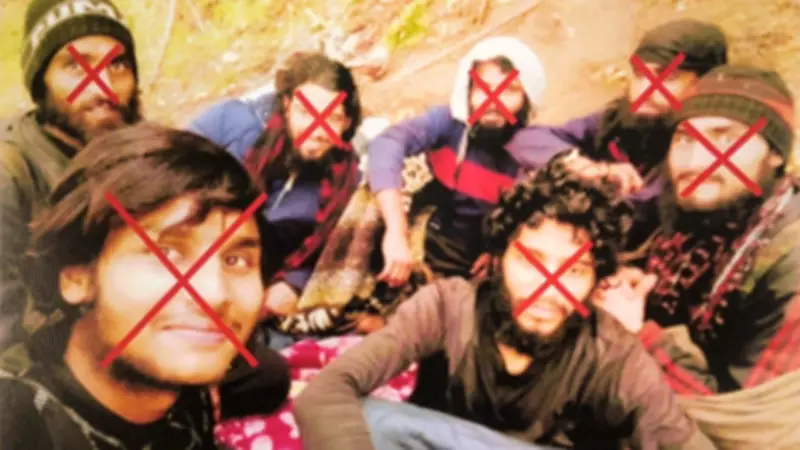
Indian Forces Neutralize Seven Terrorists in Extensive Jammu and Kashmir Operation
In a significant counter-terrorism achievement, Indian security forces announced on Monday the elimination of seven terrorists in the Kishtwar district of Jammu and Kashmir. This successful outcome followed nearly a year of relentless joint operations conducted in the challenging high-altitude Chatroo belt.
Year-Long Pursuit in Harsh Terrain
The operation, executed by the White Knight Corps in collaboration with Jammu and Kashmir Police and the Central Reserve Police Force (CRPF), spanned an impressive 326 days. Forces meticulously tracked militants through dense forests and rugged mountainous terrain, enduring extreme cold, wet, and freezing weather conditions. According to the White Knight Corps, "relentless and painstaking high-altitude joint operations were conducted over 326 days in the Kishtwar region." The troops faced multiple contacts with terrorists in this daunting environment, showcasing their perseverance and tactical expertise.
Intelligence and Technology Integration
A critical factor in the operation's success was the integration of a well-knit intelligence grid established by civil and military intelligence agencies. This network enabled precise tracking and targeting of the militants. Additionally, modern technological tools played a central role, with forces continuously leveraging:

- First-Person View (FPV) drones
- Satellite imagery
- Remotely Piloted Aircraft (RPAs) and Unmanned Aerial Vehicles (UAVs)
- Advanced communication systems
This technological assistance proved invaluable in navigating the difficult terrain and ensuring operational efficiency.
Key Encounters and Leadership Neutralization
Among the eliminated terrorists, three were members of the Pakistan-based Jaish-e-Mohammad group, killed in an encounter on Sunday in forested foothills. Officials reported that militants opened fire from inside a mud house as search parties approached, leading to a gunfight that resulted in the structure catching fire. The recovered bodies were charred beyond recognition, but preliminary assessments indicate one of those killed was Saifullah, a senior commander believed to have infiltrated nearly five years ago and linked to several deadly attacks.
The White Knight Corps emphasized the significance of this elimination, stating, "The relentless pursuit & resolve of our forces, culminating in elimination of Saifullah and his associates, proves that nothing can stand against the determination, courage and valour of our men in uniform & Intelligence agencies."
Operation Trashi-I: Coordination and Local Dynamics
Speaking about Operation Trashi-I, Major General A P S Bal, General Officer Commanding of Counter-Insurgency Force Delta, highlighted the operation as a model of seamless coordination. He noted that the militants had local backing, stating, "There was a support system which was available to them and it cannot happen without the support system... it cannot be possible without any support and the police is fully aware of it and without taking names they (police) have the information and they will do requisite action against all of them..."
He praised the collaborative efforts, describing the operation as "the perfect example of perseverance... seamless coordination at all levels... everybody contributed towards the success of this operation." The forces acted "in a very calm, composed, collective, collaborative manner," achieving success without suffering any human casualties, though they mourned the loss of a brave dog named Tyson, who initiated the operation.
This operation underscores the ongoing efforts by Indian security forces to maintain stability and combat terrorism in the region, demonstrating effective inter-agency cooperation and the strategic use of technology in modern warfare.