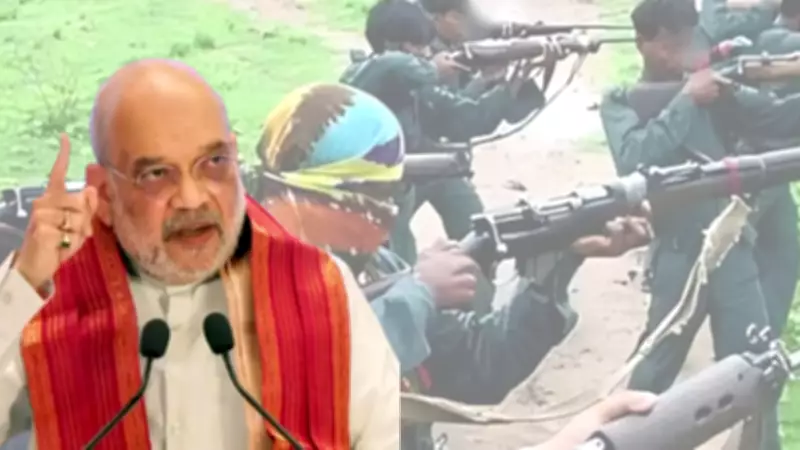
Historic Deadline Arrives in India's Battle Against Naxalism
As dusk settles over the dense forests of Chhattisgarh today, it marks more than just another sunset. March 31, 2026, represents a historic deadline set by Union Home Minister Amit Shah—a security benchmark that signals India's determined push toward ending one of its longest-running internal security threats. This date was never merely symbolic; it served as both a message to Naxalites and a national commitment. With the deadline now upon us, a critical question echoes louder than ever: Is India closer than at any point in decades to eliminating Naxalism?
The Shrinking Red Corridor: From 126 Districts to Just 38
Addressing the Lok Sabha on Monday, Home Minister Shah declared that India's anti-Naxal campaign has entered its final phase. He asserted that Naxalism has been nearly eradicated in Bastar, the region once considered the heartland of "Red Terror." Today, Bastar is witnessing unprecedented development with new roads, schools, ration shops, health centers, and welfare delivery systems—a dramatic transformation for an area that symbolized peak Naxal influence.
But how did Bastar and much of central India become part of the Red Corridor? The story began in 1967 in Naxalbari, West Bengal, where a peasant uprising sparked what would evolve into the Naxalite movement. This local rebellion gradually spread to India's most remote, underdeveloped, and tribal-dominated regions, eventually stretching across Chhattisgarh, Jharkhand, Odisha, Maharashtra, Madhya Pradesh, Andhra Pradesh, Telangana, and pockets of Kerala and Karnataka. This expanding belt of unrest became known as the "Red Corridor."

What started as ideological resistance soon transformed into a violent armed challenge against the Indian state. Naxal groups established parallel control systems in remote areas, attacked security forces, destroyed public infrastructure, engaged in extortion, and forcibly recruited civilians, including children, into their networks.
At its peak, Naxal violence affected 126 districts, penetrating deep forest regions where state presence was minimal. However, that reality has fundamentally changed.
Dramatic Reduction in Affected Areas
Government data reveals a steady contraction of the Red Corridor. The number of Left Wing Extremism (LWE)-affected districts has fallen from 126 to 90 in April 2018, then to 70 in July 2021, and further to just 38 by April 2024. Even within these remaining districts, the worst-hit areas have been reduced from 12 to just 6: Bijapur, Kanker, Narayanpur, and Sukma in Chhattisgarh; West Singhbhum in Jharkhand; and Gadchiroli in Maharashtra.
The contraction becomes even more apparent when examining specific categories. The number of "districts of concern"—areas requiring intensive resources beyond the worst-hit zones—has decreased from 9 to 6. These include Alluri Sitarama Raju in Andhra Pradesh, Balaghat in Madhya Pradesh, Kalahandi, Kandhamal and Malkangiri in Odisha, and Bhadradri-Kothagudem in Telangana.
Similarly, other LWE-affected districts have thinned from 17 to 6, encompassing Dantewada, Gariaband and Mohla-Manpur-Ambagarh Chowki in Chhattisgarh, Latehar in Jharkhand, Nuapada in Odisha, and Mulugu in Telangana.
Ministry of Home Affairs data quantifies this geographical squeeze: Naxal active territory has shrunk from over 18,000 square kilometers in 2014 to approximately 4,200 square kilometers by 2024, and further reduced to just a few hundred square kilometers by 2025. What was once a wide corridor has been compressed into a few dense forest holdouts.
Insurgency Losing Ground and People
The numerical decline within the movement is equally striking. Over the past decade, as security operations combined with infrastructure development and stronger state presence, the insurgency has steadily weakened. Between 2004–2014 and 2014–2024, violent incidents nearly halved from 16,463 to 7,744. During the same period, security personnel deaths fell from 1,851 to 509, while civilian deaths dropped from 4,766 to 1,495.

This trend continued in 2025, when security forces neutralized 270 Naxals, arrested 680, and witnessed 1,225 cadres surrender. Major operations like Operation Black Forest, along with mass surrenders in Bijapur, Chhattisgarh, and Maharashtra, underscore a clear pattern: the Maoist movement is losing both territory and fighters. More than 8,000 Naxalites have abandoned violence in the last decade, reinforcing the government's claim that the insurgency is being systematically squeezed into its final pockets rather than spreading outward.
Why March 31 Matters Beyond Security
The March 31 deadline represents India's attempt to draw a final line under a complex security threat that extended far beyond jungle gunfights. Over decades, Maoist groups targeted security forces, roads, telecom towers, public infrastructure, and democratic institutions. They employed violence, extortion, coercion, and recruitment in tribal belts, transforming remote regions into areas where state authority struggled to function.
In Parliament, Shah articulated a crucial insight: "Red terror was not there because there was no development; rather, development could not happen there because of red terror." He contrasted Naxalbari and Bastar with Saharsa and Ballia—all four regions had similarly low literacy and income levels in earlier decades, yet Naxalism took root only in the former two. His message emphasized that extremism prevented development, not the reverse.
Shah highlighted the brutal human cost: Naxalites hanging innocent villagers as "enemy informers," staging sham "People's Courts" without due process, and attempting to replace the Constitution with fear-based parallel rule. Thus, March 31 symbolizes more than a security deadline—it represents India's effort to end not just armed rebellion but decades of Naxal control over neglected tribal regions, replacing it with governance, law, and development.
Government Strategy: Security, Development, and Engagement
As India reaches this crucial milestone, years of coordinated planning, operations, and development initiatives are yielding results. The government's zero-tolerance approach combines security operations, welfare schemes, and community engagement to restore normalcy in affected areas.
Security Reinforcement: Infrastructure has been dramatically enhanced with 612 fortified police stations (up from 66 in 2014), 302 new security camps, 68 night landing helipads, 15 Joint Task Forces, and six CRPF battalions supporting state police. The National Investigation Agency and Enforcement Directorate have targeted Naxal finances, seizing substantial funds and prosecuting funders.
Development as a Weapon: Development initiatives have become central to countering extremism. Schemes like Special Central Assistance, Special Infrastructure Scheme, and the Dharti Aaba Janjatiya Gram Utkarsh Abhiyan focus on roads, mobile connectivity, financial inclusion, and public infrastructure. Over 17,500 kilometers of roads have been sanctioned, 10,505 mobile towers planned, and more than 1,000 bank branches, 937 ATMs, and 5,700 post offices established.
Community Empowerment: Skill development through ITIs, Skill Development Centres, and 178 Eklavya Model Residential Schools provides youth with alternatives to insurgency. Civic Action Programmes and media campaigns counter Naxal propaganda while building trust with local communities.
How Close Is India to Ending Naxalism?
The short answer: India appears very close to ending large-scale organized Naxal violence. According to Amit Shah, the country may have already effectively crossed that threshold. In Parliament, he declared that the Naxal leadership has been almost completely dismantled: "Their Politburo and central structure have been almost completely dismantled. Our goal was a Naxal-free India by March 31. The country will be informed once the entire process is formally completed, but I can say that we have become Naxal-free."
Shah emphasized that the Centre would continue acting firmly against armed extremism, calling a "Naxal-free India" one of the government's most significant achievements. He reiterated that the Constitution provides solutions for addressing injustice, not armed rebellion.
However, important caveats remain. Even if the main Maoist structure has been dismantled, smaller underground cells, splinter groups, extortion networks, or isolated local violence could persist. If governance weakens in tribal areas, underlying issues like land insecurity, displacement, poor administration, and mistrust of the state could resurface.
The next phase shifts from counter-insurgency to consolidation. While the battlefield may have been won, securing lasting peace requires sustained effort. By Shah's own assessment, India is closer than ever—and effectively there—but the journey from conflict to complete stability continues.