

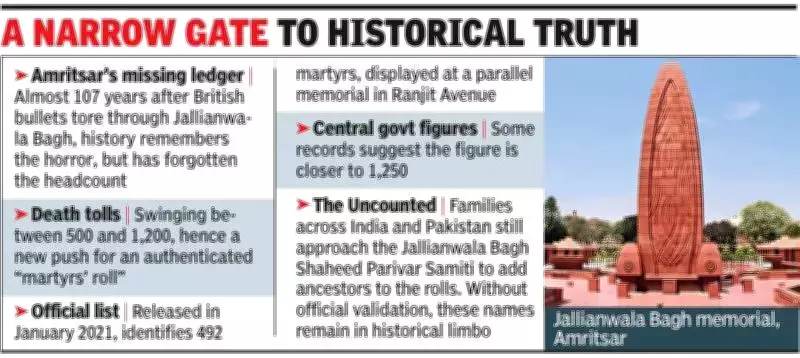
Jallianwala Bagh Massacre: 107 Years Later, Death Toll Remains Unverified
More than a century after the Jallianwala Bagh massacre, one of the bloodiest episodes of British colonial rule in India, a definitive death toll remains elusive. This historical ambiguity has sparked renewed calls for the Punjab government to verify the names of the fallen, as the absence of an authenticated list continues to fuel debate and prevent closure for descendants of those killed in the Baisakhi bloodbath of April 13, 1919.
Persistent Historical Uncertainty
While the tragedy occurred 107 years ago, the lack of a verified martyrs' list has created ongoing historical controversy. Estimates of casualties vary dramatically, ranging from 500 to more than 1,200 victims. This significant discrepancy has prompted Tarlochan Singh, a former Rajya Sabha MP and trustee of the Jallianwala Bagh National Memorial Trust, to urgently appeal to the state government for action.
Tarlochan Singh has specifically called for the deputy commissioner of Amritsar to authenticate a final list for display at the memorial site, arguing that current records remain disputed and incomplete. "The authenticated list displayed at Jallianwala Bagh will bring clarity and closure to the long-standing uncertainty," Singh emphasized, highlighting how this official validation could finally resolve decades of confusion.

Administrative Challenges and Historical Context
The push for clarity comes as the memorial trust itself faces administrative limbo, with the tenure of its office-bearers having expired in 2023 and yet to be reconstituted. This bureaucratic stagnation mirrors the historical impasse surrounding the massacre's documentation.
The roots of the tragedy trace back to the repressive Rowlatt Act of 1919, which granted British authorities power to detain Indians without trial. This legislation sparked nationwide outrage, culminating in Amritsar following the arrest of local leaders Saifuddin Kitchlew and Satyapal on April 10. In response to protests, colonial authorities imposed martial law and banned all public gatherings.
Despite this prohibition, thousands of men, women, and children—many unaware of the ban—gathered at Jallianwala Bagh on Baisakhi festival day to celebrate and protest peacefully. British General Reginald Dyer viewed this assembly as defiance, entering the walled garden with troops, blocking the only narrow exit, and ordering his men to fire into the crowd without warning. The indiscriminate shooting lasted approximately ten minutes, creating one of India's most traumatic colonial-era events.
Conflicting Records and Family Appeals
The struggle to quantify the dead has persisted for generations. In January 2021, the Amritsar deputy commissioner's office issued an official local list identifying 492 martyrs, displayed at a parallel memorial in Ranjit Avenue. However, some central government records suggest the figure approaches 1,250, while numerous victims remain uncounted entirely.
Mahesh Behl, president of the Jallianwala Bagh Shaheed Parivar Samiti, reports that families continue approaching his organization to add ancestors to the rolls. Without official validation, these names remain in historical limbo. "No authenticated and universally accepted list has been released so far," Behl stated, noting that many descendants now reside in Pakistan, further complicating verification efforts.
For victims' families, the demand remains straightforward: a definitive, government-backed record ensuring their ancestors' sacrifices are accurately preserved in historical annals. As General Dyer physically blocked the exit in 1919, today a wall of bureaucracy prevents families from achieving closure, keeping this painful chapter unresolved more than a century later.






