

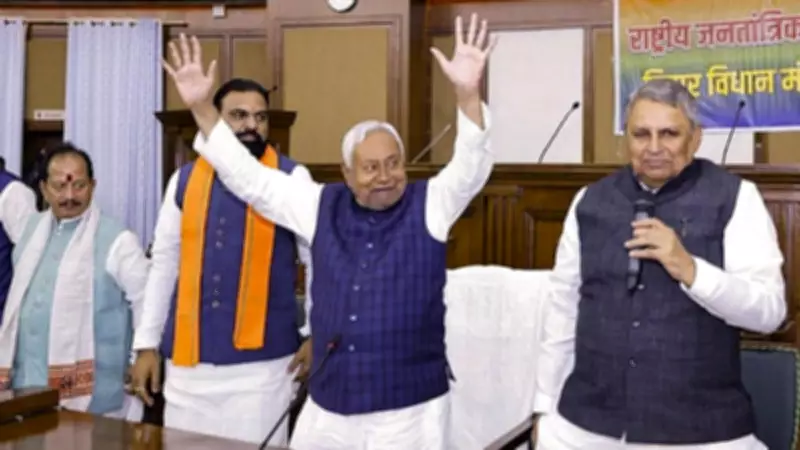
From Lohia's Vision to Nitish Kumar's Politics: A Journey of Fragmentation
In the intricate tapestry of Indian politics, the ideological journey from Ram Manohar Lohia's vision to Nitish Kumar's contemporary strategies marks a significant transformation. What originated as a sharp critique of the Congress party's elitism has, over decades, morphed into a complex landscape characterized by patronage, fragmentation, and strategic accommodations with Hindutva forces. This evolution reflects broader shifts in the political ethos of India, particularly in states like Bihar, where these dynamics play out vividly.
The Genesis: Lohia's Critique of Congress Elitism
Ram Manohar Lohia, a prominent socialist leader, laid the groundwork for a political movement that challenged the Congress party's dominance in post-independence India. His vision was rooted in principles of social justice, anti-elitism, and the empowerment of marginalized communities. Lohia argued that the Congress, under the leadership of figures like Jawaharlal Nehru, perpetuated a system that favored the elite and neglected the masses. This critique resonated with many, sparking a wave of socialist politics aimed at redistributing power and resources more equitably.
Lohia's ideas inspired a generation of politicians, including those who would later shape regional parties. His emphasis on decentralization and grassroots mobilization was intended to dismantle hierarchical structures and foster a more inclusive democracy. However, as time passed, the practical implementation of these ideals began to diverge from their original intent, setting the stage for the political fragmentation observed today.

The Transition: From Redistribution to Patronage Politics
Under leaders like Nitish Kumar, the political landscape in Bihar and beyond has shifted from Lohia's redistributive ideals to a system heavily reliant on patronage. Nitish Kumar, as the chief of the Janata Dal (United) or JD(U), has navigated the complexities of coalition politics, often prioritizing pragmatic alliances over ideological purity. This approach has enabled him to maintain power but at the cost of diluting the socialist principles that once defined his political roots.
Patronage politics involves distributing favors, resources, and positions to secure loyalty and support, often leading to fragmented political entities. In Bihar, this has resulted in a scenario where multiple parties and factions compete for influence, creating a volatile environment. The JD(U)'s alliances, particularly with the Bharatiya Janata Party (BJP), exemplify how strategic accommodations can reshape political agendas, moving away from Lohia's vision of a unified socialist front.
The Accommodation: Hindutva and Fragmentation
A critical aspect of this evolution is the accommodation of Hindutva, or Hindu nationalist politics, within frameworks that were once staunchly secular. Nitish Kumar's JD(U) has, at times, aligned with the BJP, a party rooted in Hindutva ideology, to form governments and secure electoral victories. This accommodation reflects a broader trend in Indian politics where regional parties balance their core principles with the realities of power dynamics.
This shift has contributed to political fragmentation, as parties like the JD(U) navigate between socialist heritage and nationalist currents. The result is a fragmented political scene where ideologies blur, and patronage networks thrive. This fragmentation undermines cohesive policy-making and often leads to instability, as seen in Bihar's frequent political realignments.
Implications for Indian Politics
The journey from Lohia's vision to Nitish Kumar's politics highlights key themes in contemporary Indian governance. Fragmentation has become a defining feature, with multiple parties vying for influence, often at the expense of ideological consistency. Patronage systems have entrenched themselves, rewarding loyalty over merit and perpetuating inequalities. Meanwhile, the accommodation of Hindutva signals a shift in the political center of gravity, influencing how regional parties engage with national issues.

As Indian politics continues to evolve, understanding this trajectory is crucial for analyzing future trends. The legacy of Lohia's critique endures in rhetoric, but its practical manifestation has been transformed by the imperatives of power and survival. This analysis underscores the dynamic nature of political ideologies and their adaptation in a changing socio-political landscape.





