Centre-State showdown over rural employment scheme
The proposed implementation of the VB-G RAM G scheme from July 1, 2026, has triggered a high-stakes confrontation between the Central Government and the Himachal Pradesh government led by Chief Minister Sukhvinder Singh Sukhu. This dispute over replacing the Mahatma Gandhi National Rural Employment Guarantee Act (MGNREGA) could emerge as one of the defining political battles in the 2027 Assembly elections.
Chief Minister Sukhu faces a profound irony: both accepting and rejecting the Centre's VB-G RAM G scheme carry enormous risks. If the state accepts the new framework in its present form, it will have to shoulder an additional financial burden of around Rs 164 crore, including wage payments and administrative expenses. For a government already battling mounting debt, shrinking revenue, and increasing expenditure on salaries, pension, and disaster relief, mobilising such additional resources will be extremely difficult.
Rejection equally perilous
However, outright rejection of the proposed scheme is equally perilous. Should the Central Government decide to discontinue the existing framework without accommodating Himachal's concerns, the state simply lacks the financial capacity to independently sustain a rural employment programme on the scale of MGNREGA. Rural Development Minister Anirudh Singh has already warned that the available budget will force the state government to "artificially suppress demand".

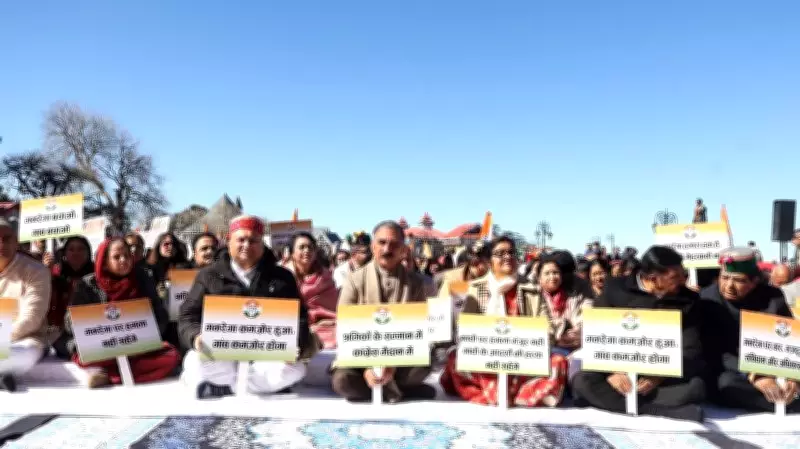
The political implications of this dispute extend well beyond administrative reforms. Rural employment schemes directly affect a large section of Himachal's electorate, and any reduction in employment opportunities or wages is likely to influence public opinion. The Congress government is expected to portray itself as defending rural workers against what it describes as the dilution of MGNREGA. If the Central Government proceeds without addressing the state's concerns and beneficiaries perceive that employment has declined because of the new framework, the BJP can face political criticism in rural constituencies in the run-up to the 2027 Assembly elections.
Fragile administrative structure
The confrontation may expose the fragile administrative structure supporting rural employment programmes. The state government has alleged that the Central Government has not released around Rs 20 crore meant for administrative personnel under MGNREGA, resulting in unpaid salaries since February. If salaries continue to remain unpaid, administrative efficiency is likely to suffer, directly affecting the delivery of employment to beneficiaries.
A high-level committee constituted under the Rural Development Minister faces perhaps the most challenging policy exercise. Its responsibility extends well beyond preparing a political response to the Central Government.
12 lakh rural workers at risk
It is not the government but around 12 lakh rural workers who will bear the most immediate fallout of the confrontation. Himachal Pradesh generated around 395 lakh person-days under MGNREGA during the previous financial year, whereas the proposed scheme will finance only 250 lakh person-days. This reduction of around 145 lakh person-days can substantially reduce employment opportunities for thousands of households. For a hill state where agriculture is fragmented, industries are scarce, and migration opportunities remain limited, the social consequences can be severe.
Lower wages amid rising inflation
The wage issue has the potential to become equally contentious. Though the statutory MGNREGA wages stand at Rs 247 in non-tribal areas and Rs 309 in tribal regions, the Himachal Government has been supplementing these from its own resources, effectively raising the daily wage to around Rs 320. According to the state government, the proposed VB-G RAM G framework contains no provision permitting such state-funded top-ups. If this position remains unchanged, workers can effectively receive lower wages despite persistent inflation and rising living costs.
Ultimately, voters may not evaluate constitutional arguments over federalism; they are more likely to ask a simple question — who ensured that employment and wages continued to reach rural households when they needed them the most? That answer can significantly shape the electoral narrative in 2027.