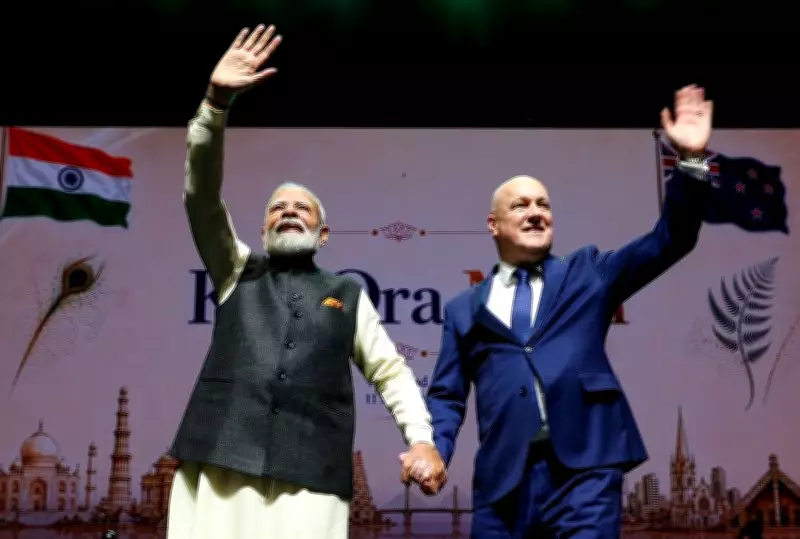
Prime Minister Narendra Modi on Saturday addressed over 10,000 members of the Indian diaspora at Auckland's Spark Arena, promising that his next visit to New Zealand would not take another 40 years. The event, attended by New Zealand Prime Minister Christopher Luxon and political leaders, marked the first visit by an Indian prime minister in nearly four decades.
Emotional connection with the muffler
Modi held up a woollen muffler gifted to him by an Indian-origin New Zealander nearly 25 years ago, before he became prime minister. "I have kept this muffler safely, just as I have kept your love safely in my heart," he said, drawing loud applause. He opened his address with "Namaste" and "Kia Ora," thanking the community for the reception and bringing the affection of 1.4 billion Indians.
"Your body may be here, but your heart remains connected with India," Modi told the gathering, acknowledging the diaspora's emotional and cultural bond with India. The crowd responded with chants of "Modi, Modi" and "Bharat Mata Ki Jai."

Diaspora as a living bridge
Modi described the India-New Zealand relationship as built on trust, shared democratic values, and mutual respect, entering a new phase with 'a sky full of opportunities.' He credited the Indian diaspora as a living bridge between the two countries, strengthening ties in business, education, science, politics, public service, and sport. "Every Indian living in New Zealand has become part of this shared journey," he said.
He acknowledged the presence of members of New Zealand's Opposition Labour Party, saying bipartisan support showed the relationship extended beyond governments and party politics.
Success stories of Indian-origin Kiwis
Modi praised the achievements of Indian-origin New Zealanders, including Air New Zealand CEO Nikhil Ravishankar, former Governor-General Sir Anand Satyanand, and Black Caps cricketers Rachin Ravindra and Ish Sodhi. Their success, he said, showed how deeply the Indian community was woven into New Zealand's social, economic, and cultural fabric.
In a lighter moment, he joked that the Indian connection could be seen on New Zealand's map, with places like Bombay Hills, Khandallah, Kolkata Street, and Amritsar Street. "It seems Indians are not only present in New Zealand's economy and society, but also on its roads and signboards," he said, prompting laughter and applause.
Learning from New Zealand
Modi said India had much to learn from New Zealand, particularly in agriculture, food safety, sustainability, women's empowerment, and high-quality food production. He praised New Zealand as the first country to grant women the right to vote and highlighted its leadership in climate-smart farming, precision agriculture, and sustainable food production. He described New Zealand's mānuka honey as "liquid gold" and said closer cooperation could strengthen India's beekeeping and honey-production programmes.
"When New Zealand's expertise combines with India's scale, both countries can unlock significant opportunities in agriculture, food technology, and research," he said.
Sporting and space cooperation
Modi recalled the historic 1926 Indian Army hockey tour of New Zealand led by Major Dhyan Chand, and said the two countries were preparing to mark 100 years since the tour. He congratulated the All Blacks on their rugby success and said India hoped to benefit from New Zealand's coaching expertise to deepen cooperation in rugby development, sports science, and technology.
He also pointed to growing collaboration in the space sector, noting that New Zealand companies had contributed to India's Chandrayaan lunar missions. India's expanding space ecosystem and New Zealand's innovation capabilities could open new avenues in satellite technology, scientific research, and the commercial space industry, he said.

Cultural parallels with Māori traditions
Modi drew parallels between Māori and Indian traditions, saying values such as 'manaakitanga', 'whānau', and 'kaitiakitanga' closely reflected Indian principles of hospitality, family, and environmental responsibility. He compared 'manaakitanga' with the Indian philosophy of 'Atithi Devo Bhava' (the guest is like God), and linked 'kaitiakitanga' with India's cultural respect for nature. "The values of India and Māori culture may be expressed in different languages, but their spirit is very similar," he said.
India's economic rise and digital revolution
Turning to India's economy, Modi described the country as the world's fastest-growing major economy and a global centre for innovation, manufacturing, and digital technology. He highlighted India's position as the largest vaccine producer and milk producer, one of the biggest mobile-phone manufacturers, and home to one of the world's largest startup ecosystems. "Today's India is confident, innovative, and ambitious. It does not only dream big; it also has the ability to turn those dreams into reality," he said.
He cited the Unified Payments Interface, digital public infrastructure, drone technology, renewable energy, and space sector advances as examples of India's transformation, noting that the digital revolution was now empowering farmers, street vendors, small businesses, and ordinary citizens.
Tribute to Sikh history
In an emotionally charged section, Modi paid tribute to Sikh history and the sacrifices of the Sahibzadas. He referred to his government's efforts to bring sacred saroops of Sri Guru Granth Sahib from Afghanistan to India after the security situation deteriorated. He also spoke about the observance of Veer Bal Diwas, efforts to improve access to Hemkunt Sahib, and initiatives to preserve Sikh religious artefacts, including the historic Jore Sahib at Takht Sri Patna Sahib. "The sacrifices of the Sahibzadas are not only part of Sikh history but remain a source of inspiration for India and humanity," he said.
Invitation to visit India
Modi invited diaspora members to visit India more frequently and urged them to ensure younger generations remained connected with the country's languages, traditions, faiths, and cultural heritage. Concluding his address, he referred to the nearly 40-year gap since an Indian prime minister last visited New Zealand. "This time, it took 40 years," he said, pausing as the crowd cheered. "The next visit will not take another 40 years. That is Modi's guarantee."