

Noida Authority's Corruption Scandals Under Supreme Court Microscope
Allegations by farmers, mentioned in the Supreme Court, about Noida Authority officials demanding a 10% cut from excess compensation funds have once again thrust the functioning of Uttar Pradesh's wealthiest development body under intense judicial scrutiny. This latest episode adds to a long history of corruption controversies that have plagued the authority for decades.
A Legacy of Corruption and Collusion
In recent years, Noida Authority's reputation has suffered repeated blows due to systemic corruption within its ranks. The conviction of former CEO Neera Yadav for illegally allotting land to her own family members stands as a landmark case. Similarly, the massive maintenance contracts fraud under former chief engineer Yadav Singh revealed deep-seated irregularities, many of which were highlighted by the Comptroller and Auditor General (CAG).
The Supertech twin towers case, where the Supreme Court delivered scathing remarks about collusion between builders and officials, further cemented the authority's troubled reputation. The terms "corruption" and "collusion" have become recurring themes in discussions about Noida Authority's operations.

Judicial Interventions Across Multiple Cases
The Supreme Court has referenced Noida Authority's problematic practices in multiple significant rulings. Beyond ordering the demolition of the Supertech twin towers in 2021, the court also cited corruption concerns while scrapping toll collection on the DND Flyway in 2024. As far back as 2011, Noida officials faced judicial rebuke for showing favoritism in plot allotments to selected contractors.
With an annual budget of Rs 8,732 crore for 2025-26, Noida Authority controls some of the most valuable urban land in India. This powerful position, and the discretion it wields over land allocation terms, has consistently attracted scrutiny from judicial and investigative bodies.
Land Allotment Scandals: From Neera Yadav to Systematic Favoritism
Neera Yadav, a 1971-batch IAS officer who served as Noida chairperson in 1994 before becoming UP's chief secretary in 2005, was convicted by a CBI special court in 2012 along with her husband Rajiv Kumar, then deputy CEO. They were found guilty of illegally allotting plots to Neera herself and her two daughters during her 1994-95 tenure. Originally sentenced to three years imprisonment, her sentence was later reduced to two years by the Supreme Court.
Long before this conviction, a 1997 writ petition filed by the Noida Entrepreneurs Association alleged systematic favoritism in plot allotments. When the Supreme Court finally ruled on this matter in 2011, it found that Noida Authority officials had "passed orders in colourable exercise of power favouring himself and certain contractors" and directed a CBI inquiry.
Contract Fraud and Tender-Rigging Schemes
Tender-rigging in exchange for bribes represented a second major category of corruption that paralleled the land scandals. The most prominent case involves Yadav Singh, who served as chief engineer of Noida, Greater Noida and Yamuna Expressway Authority. Singh executed 1,280 maintenance contracts worth Rs 954 crore in 2011 alone.
Suspended in June 2012 after being named in a contract "scam" and accused of embezzlement in infrastructure projects, Singh was eventually sacked and arrested following Income Tax raids. Tax authorities discovered Rs 12 crore in cash in an SUV parked outside Singh's Noida home, along with diamond-studded gold jewellery worth crores of rupees.
A CBI chargesheet alleged that in December 2011, Singh awarded contracts worth Rs 92 crore for underground cable-laying work to three specific firms, with bribes routed as investments through his wife's company, Meenu Creation. The case remains sub-judice, with Singh currently out on bail.

Builder-Official Collusion in Real Estate Projects
In the Supertech twin towers case, where buildings were constructed in violation of norms, the Supreme Court bench noted that nobody in Noida Authority had apparently noticed anything amiss. Justice D.Y. Chandrachud, who later served as Chief Justice of India, observed in his August 31, 2021 judgment that "the record of this case is replete with instances which highlight the collusion between the officers of Noida Authority with the appellant and its management."
The towers were demolished using controlled implosion on August 28, 2022, generating 80,000 tonnes of debris and prompting stricter scrutiny of real estate projects throughout Noida.
DND Flyway Toll Collection Controversy
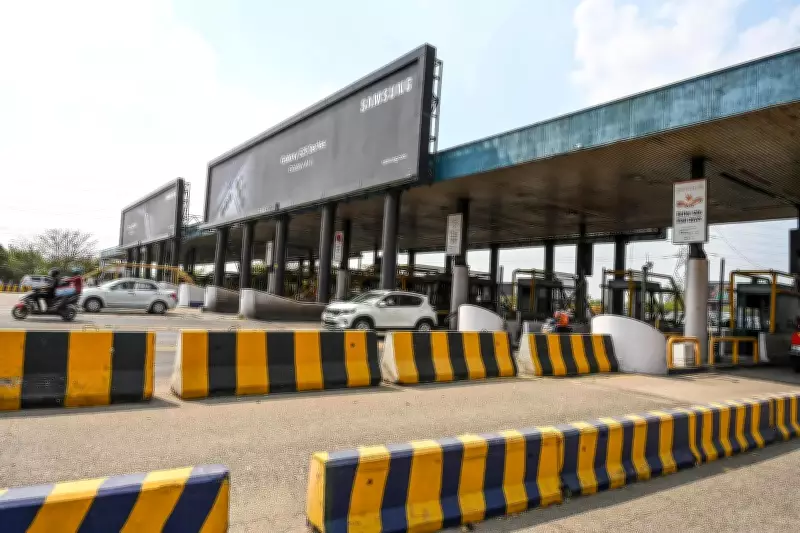
The December 2024 DND Flyway ruling contained similar language about corruption. Upholding an Allahabad High Court order to abolish toll collection, the Supreme Court observed that concessionaire Noida Toll Bridge Company Ltd had already recouped its investment and was unfairly profiting from continued toll collection. Citing a CAG report, the court found "serious impropriety" and "blatant misuse of power and breach of public trust" in how toll collections were allowed to continue far beyond reasonable limits.
The court order stated: "This could not have been done but for the collusion of the then officers of the two state (Delhi and UP) governments and of Noida Authority, who closed their eyes while the contractual obligations were incurred." The judgment described the siphoning of project funds by senior bureaucrats for personal gain as a fit case for investigation under the Prevention of Corruption Act, while acknowledging it might be too late for legal action.
Current Investigations and Proposed Reforms
The farmers' allegations about officials taking cuts from compensation funds, aired before the court this week, are being investigated by a special investigation team attempting to establish the cash trail of these alleged payments.
Senior Supreme Court advocate M.L. Lahoty noted that the apex court has repeatedly pointed out corruption in Noida Authority, implying the problem is structural and likely to regenerate unless underlying conditions change.
Yogendra Narain, a former UP chief secretary and founding chairman of Greater Noida Authority, observed: "Right now, there is no agency which can keep a direct check on the three authorities." He proposed creating an ombudsman headed by a retired high court judge, supported by retired officials from CAG and police, fully staffed and empowered to conduct independent investigations "to check corruption in Noida Authority."
A senior Noida Authority official stated that for transparency, the authority has begun e-auctioning all properties. "This is to ensure a level-playing field for all stakeholders and every participant. We have a Jan Sunwai portal, Integrated Grievance Redressal System, and regular audits by CAG and the state to check Noida Authority's functioning," the official explained.





