

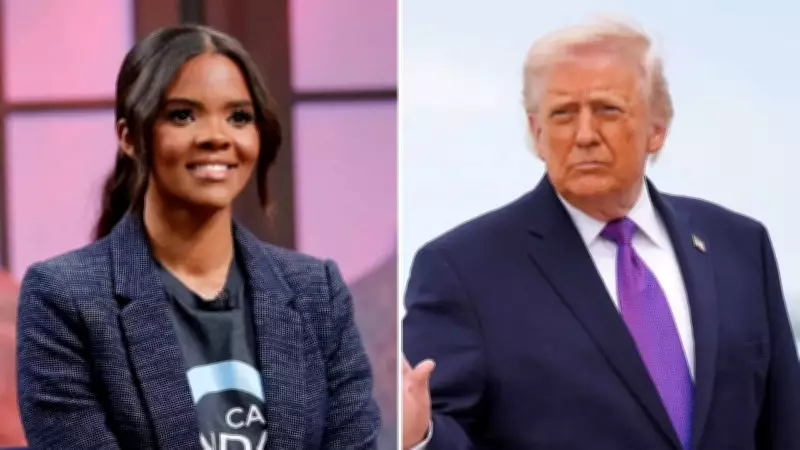
Candace Owens and Donald Trump Engage in Public War of Words
The once-subtle tensions between conservative commentator Candace Owens and former President Donald Trump have erupted into a full-blown, highly public confrontation. What initially appeared as mere policy differences has now transformed into a deeply personal and acrimonious exchange, capturing significant attention across political circles.
From Vocal Defender to Vocal Critic
For years, Candace Owens stood as one of Donald Trump's most steadfast and outspoken supporters. This historical context makes her current stance particularly noteworthy and impactful. Her recent actions do not represent mild criticism but rather appear to signify a definitive and clean break from her previous alignment with the former president.
While other conservative figures like Tucker Carlson and Megyn Kelly have expressed reservations about Trump's rhetoric in recent times, Owens has adopted a notably more direct and confrontational approach. Her response did not merely offer pushback—it directly challenged Trump's tone, questioned his judgment, and potentially undermined his standing among former allies.

The Exchange That Captured National Attention
The conflict reached its peak when Trump released an extensive and aggressive statement specifically targeting Owens and several other conservative personalities. In his message, Trump wrote:
"I know why Tucker Carlson, Megyn Kelly, Candace Owens, and Alex Jones have all been fighting me for years, especially by the fact that they think it is wonderful for Iran, the Number One State Sponsor of Terror, to have a Nuclear Weapon — Because they have one thing in common, Low IQs. They're stupid people, they know it, their families know it, and everyone else knows it, too! Look at their past, look at their record. They don't have what it takes, and they never did!
They've all been thrown off Television, lost their Shows, and aren't even invited on TV because nobody cares about them, they're NUT JOBS, TROUBLEMAKERS, and will say anything necessary for some 'free' and cheap publicity. Now they think they get some 'clicks' because they have Third Rate Podcasts, but nobody's talking about them, and their views are the opposite of MAGA — Or I wouldn't have won the Presidential Election in a LANDSLIDE.
Or Megyn Kelly, who nastily asked me the now famous, 'Only Rosie O'Donnell,' question, or 'Crazy' Candace Owens, who accuses the Highly Respected First Lady of France of being a man, when she is not, and will hopefully win lots of money in the ongoing lawsuit. Actually, to me, the First Lady of France is a far more beautiful woman than Candace, in fact, it's not even close!"
He added, "MAGA is about WINNING and STRENGTH in not allowing Iran to have Nuclear Weapons. MAGA is about MAKING AMERICA GREAT AGAIN, and these people have no idea how to do that, BUT I DO, because THE UNITED STATES IS NOW THE 'HOTTEST' COUNTRY ANYWHERE IN THE WORLD! President DONALD J. TRUMP"
Owens' Concise and Cutting Response
Rather than crafting a lengthy rebuttal or engaging in a detailed point-by-point argument, Candace Owens opted for a strikingly different approach. She posted a single, succinct line that carried immense weight despite its brevity: "It may be time to put Grandpa up in a home."
This response came directly after Trump's aggressive statement and immediately became the focal point of the entire exchange. The contrast between the two communications could not be more pronounced—Trump's message was long, intense, and filled with personal attacks, while Owens' reply was short, sharp, and cutting in its implication.
A Relationship Transformed
Together, these exchanges reveal a relationship that has undergone a fundamental transformation—from alignment and support to open conflict and public disagreement. The nature of the exchange suggests there is little indication of reconciliation occurring in the near future, marking a significant development within conservative political circles.

This public feud represents more than just personal animosity between two prominent figures. It highlights growing divisions and tensions within the broader conservative movement, as former allies find themselves at odds over direction, tone, and leadership. The outcome of this conflict could have implications for political alliances and messaging as the next election cycle approaches.





