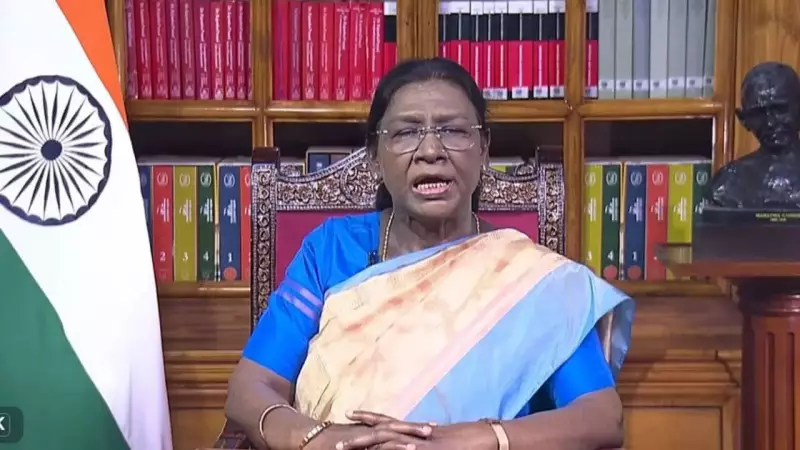
President Droupadi Murmu delivered a comprehensive address to the nation on the eve of the 77th Republic Day, focusing on the foundational pillars of India's democracy, the enduring legacy of national icons, and the collective efforts of citizens in building a stronger and more prosperous nation. Her speech highlighted the constitutional ideals that guide the republic and celebrated the diverse contributions of various segments of society.
Constitutional Ideals and National Unity
In her address, President Murmu underscored the significance of the Constitution's core principles. The ideals of justice, liberty, equality, and fraternity enshrined in our Constitution define our republic, she stated. She praised the framers of the Constitution for establishing a robust foundation that fosters nationalism and unity across the country through well-crafted constitutional provisions.
Cultural and Patriotic Significance of Vande Mataram
The president elaborated on the cultural and patriotic resonance of Vande Mataram, describing it as India's lyrical national prayer. She noted that the great nationalist poet Subramanya Bharati composed the song "Vande Mataram Yenbom" in Tamil, which translates to "Let us chant Vande Mataram", thereby connecting the masses on an even larger scale with the spirit of Vande Mataram. Translations of this song in other Indian languages gained popularity, and Sri Aurobindo translated it into English, further amplifying its reach and impact.

Inspiration from Netaji Subhas Chandra Bose
President Murmu paid tribute to Netaji Subhas Chandra Bose, whose birth anniversary was observed on January 23. Since 2021, Netaji's Jayanti has been celebrated as 'Parakram Diwas' to inspire the youth with his indomitable patriotism. She highlighted that Netaji's slogan 'Jai Hind' stands as a powerful declaration of national pride, motivating citizens to uphold the values of courage and dedication.
Achievements and Contributions Across Sectors
The address celebrated the remarkable achievements of women, who are breaking traditional stereotypes and forging ahead in various fields. More than ten crore women associated with self-help groups are redefining the process of development, she emphasized. Women are making significant strides in agriculture, space exploration, self-employment, and the armed forces. In sports, Indian daughters have set new global benchmarks, including winning the ICC Women's Cricket World Cup and the Blind Women's T20 World Cup in November, and having two Indian women compete in the final match of the Chess World Cup.
Collective Efforts of Citizens
President Murmu acknowledged the collective contributions of diverse groups in advancing the nation's progress:
- Brave soldiers of the armed forces vigilantly protect the motherland.
- Dedicated policemen and Central Armed Police Forces ensure internal security.
- Farmers, as food providers, produce nutritious food and have made India self-reliant in food grains.
- Hardworking women set new standards in multiple domains.
- Doctors, nurses, and health workers care for public health.
- Sanitation workers play a key role in keeping the country clean.
- Enlightened teachers shape future generations.
- World-class scientists and engineers guide the country's development.
- Promising youth and children strengthen faith in a bright future through their talent and contributions.
Tribal Empowerment Initiatives
The president highlighted efforts to empower tribal communities, including the 'National Sickle Cell Anaemia Elimination Mission', which has conducted over 6 crore screenings. Nearly one lakh forty thousand students are receiving education in Eklavya Model Residential Schools, with many excelling in competitive examinations. Campaigns in health and education aim to harmonize traditions with modern development among tribal communities. The 'Dharti Aaba Janajatiya Gram Utkarsh Abhiyan' and the 'PM-JANMAN Yojana' have empowered all tribal communities, including PVTG communities.

Support for Farmers
President Murmu described farmers as the backbone of society and economy, noting that generations of hardworking farmers have achieved self-reliance in food grains and enabled agricultural exports. Priority is being given to ensuring farmers receive fair prices, access to loans at lower interest rates, effective insurance coverage, quality seeds, irrigation facilities, fertilizers, modern agricultural practices, and encouragement for organic farming. The 'PM Kisan Samman Nidhi' honors farmers' contributions and strengthens their efforts.
Economic Growth and Reforms
India is recognized as the world's fastest-growing major economy, recording continuous growth despite global uncertainties. The nation is moving towards becoming the world's third-largest economy in the near future. Investments in world-class infrastructure are rebuilding economic strength on a larger scale, with Atma-nirbharata and Swadeshi serving as guiding principles. The implementation of GST has established a system of 'One Nation, One Market', and recent decisions to enhance the GST system will further strengthen the economy. Four Labour Codes in the field of labour reforms will benefit workers and accelerate enterprise development.
National Voters' Day and Digital India
On National Voters' Day, celebrated on January 25, President Murmu emphasized the importance of voting as a means of political education, echoing Babasaheb Dr Bhimrao Ambedkar's vision. The increasing participation of women in voting is a powerful dimension of the republic, crucial for the country's development. National efforts in health, education, safety, and economic empowerment have boosted women's participation across sectors.
Under the Digital India initiative, beneficiaries are directly connected to facilities through technology, emphasizing 'Ease of Living' to improve everyday life. Public participation has transformed important national campaigns into mass movements, with local institutions in villages and cities driving progressive change. Building Viksit Bharat is a shared responsibility, and society's active support has led to revolutionary changes, such as the massive adoption of digital payment systems. Today, more than half of the world's digital transactions occur in India, setting an impressive example for the global community. President Murmu expressed hope that citizens will similarly participate in achieving other national goals.