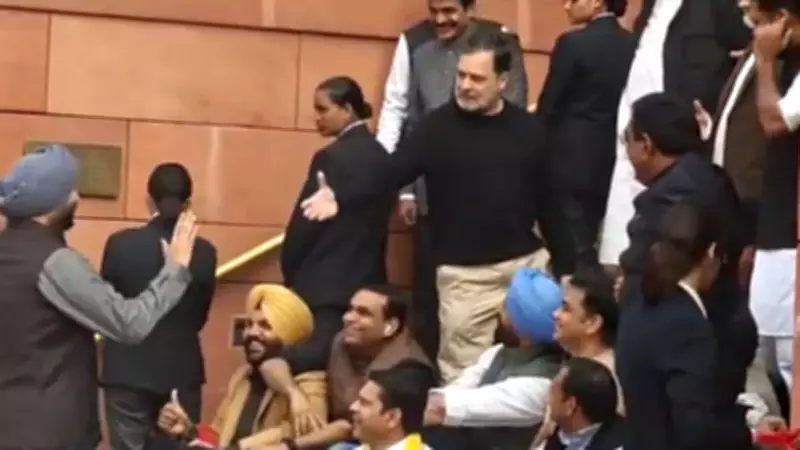
In a dramatic confrontation outside the Lok Sabha, Leader of Opposition Rahul Gandhi and BJP MP Ravneet Singh Bittu engaged in a sharp verbal exchange, with Gandhi labeling Bittu as a "traitor" during a Congress protest against the recent India-US trade agreement.
Heated Exchange at Parliament's Makar Dwar
The incident occurred on Wednesday when Congress MPs were staging a demonstration at the Makar Dwar of Parliament. As Union Minister of State Ravneet Singh Bittu walked past the protesting group, Rahul Gandhi pointed towards him and remarked, "Here is a traitor walking right by. Look at the face..." This comment elicited laughter and slogans of "Narendra surrender" from the Congress MPs.
Handshake Offer and Counter-Insults
Gandhi then extended his hand for a handshake, addressing Bittu as "Hello brother! My traitor friend. Don't worry, you will come back [to Congress]." In response, Bittu refused the handshake and retorted by calling Gandhi "Desh ke dushman" (enemy of the nation). Despite the harsh words, both leaders were observed smiling throughout the interaction, adding a layer of political theater to the exchange.

Context of the Protest
The Congress protest was centered on the India-US trade deal signed late on Monday. The opposition party has alleged that Prime Minister Narendra Modi was compromised and forced to accept an agreement imposing an 18% tariff on Indian exports to the United States. This trade deal has sparked significant controversy, with Congress accusing the government of undermining national interests.
Political Implications
This verbal clash highlights the ongoing tensions between the Congress and BJP, particularly in the context of economic policies and international agreements. The use of terms like "traitor" and "desh ke dushman" underscores the deep political divisions and the personal nature of some parliamentary confrontations.
The incident has drawn attention to the broader debate over the India-US trade deal, with both parties using such exchanges to rally their bases and influence public opinion. As political rhetoric intensifies, such episodes are likely to become more frequent in the lead-up to future elections.