

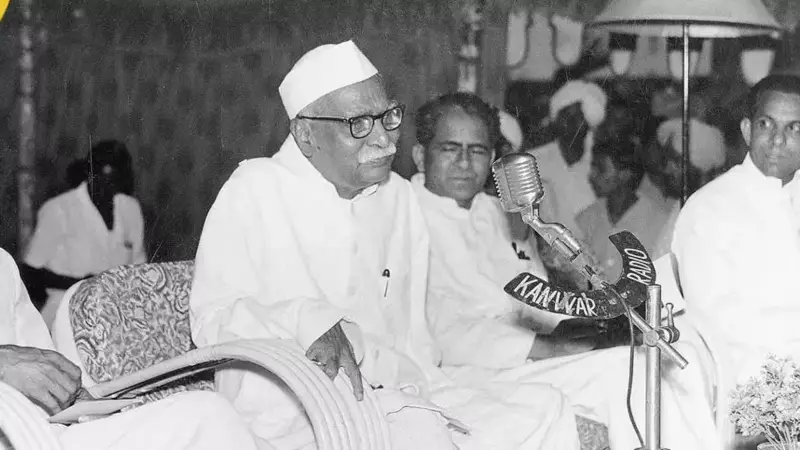
Rajendra Prasad's Historic Address on the Eve of India's First Republic Day
On January 24, 1950, just two days before India's inaugural Republic Day, the Constituent Assembly convened for its final session in a momentous gathering that would shape the nation's future. This historic meeting marked the election of Dr. Rajendra Prasad as the first President of India, a role he assumed with humility and profound wisdom, setting a precedent for leadership in the newly independent republic.
The Election and Immediate Proceedings
The session began with Secretary H V R Iyengar announcing that Rajendra Prasad was the sole nominee for the presidency, proposed by Prime Minister Jawaharlal Nehru and seconded by Home Minister Sardar Vallabhbhai Patel. With no opposition, Prasad was declared duly elected, prompting heartfelt congratulations from Nehru, who praised his leadership during the tumultuous years of constitution-making. Sardar Patel echoed these sentiments, noting Prasad's recovery from health issues and his unwavering dedication.
Following the election, Assembly member B Das raised concerns about the representation of women, highlighting that provinces like the United Provinces had sent only two female members to replace three vacated seats, while Orissa had sent none. Prasad responded by emphasizing that, according to the House's rules, there were no reserved seats for women, and the electorate had the freedom to choose their representatives, underscoring the democratic principles enshrined in the new Constitution.

Prasad's Humble Response and Mahabharat Analogy
As members began to shower praise on the newly elected President, Prasad urged them to refrain, expressing embarrassment and a belief that he was undeserving of such accolades. He famously stated that the time for congratulation should be upon retirement, not appointment, and invoked a story from the Mahabharat to illustrate his point. He recounted how Arjuna, after failing to fulfill a vow, was advised by Shri Krishna that listening to one's own praise was equivalent to committing suicide, thus allowing Arjuna to satisfy his vow without physical harm.
Prasad applied this analogy to his own situation, suggesting that he listened to praise in the same spirit, viewing it as a form of self-sacrifice rather than an honor. He emphasized that the country faced numerous challenges requiring greater devotion, care, application, and sacrifice, and expressed hope that India would produce capable men and women to shoulder these burdens and fulfill the people's aspirations.
Key Announcements and Constitutional Signing
In his address, Prasad made two critical announcements that would resonate through Indian history. He declared that Jana Gana Mana would be the national anthem, subject to future governmental alterations, and that Vande Mataram, as a historic inspiration during the freedom struggle, would hold equal status. This decision balanced tradition with modernity, honoring both the artistic composition and the revolutionary spirit.
The session culminated in all members signing the English and Hindi versions of the Constitution, a symbolic act of unity and commitment. Following this, the Assembly collectively sang the national anthem, with Prasad leading a recitation of Vande Mataram before adjourning the body sine die. This adjournment marked the transition of the Constituent Assembly into the Parliament of India, a seamless shift from constitution-drafting to governance.
Historical Context and Legacy
This meeting occurred two months after the Constitution was adopted on November 26, 1949, and set the stage for Republic Day on January 26, 1950, which commemorated the establishment of the Constitution. The date was chosen in homage to the Indian National Congress's declaration of January 26, 1930, as Independence Day or Purna Swaraj Day, linking the new republic to the freedom struggle's legacy.
In the days that followed, Nehru reflected on the first Republic Day parade in New Delhi, noting its precision and the presence of dignitaries like Indonesia's President Soekarno. In a speech at Ramlila Maidan on January 30, 1950, Nehru highlighted the national enthusiasm and the fulfillment of the pledge taken two decades prior, emphasizing the day's special significance in India's history.

Rajendra Prasad's invocation of the Mahabharat not only showcased his modesty but also rooted India's republican values in ancient wisdom, blending cultural heritage with contemporary governance. This moment remains a testament to the thoughtful leadership that guided India's early steps as a sovereign nation.





