The Day Politics Overshadowed Planning: A Historic Confrontation
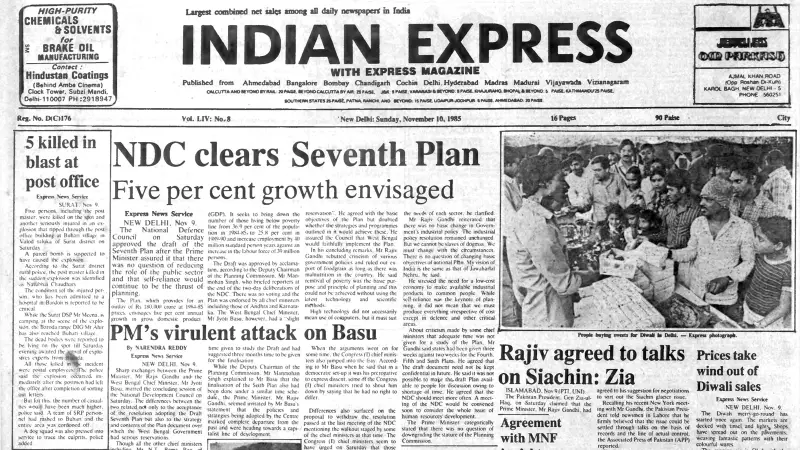
On November 10, 1985, the concluding session of the National Development Council witnessed an unprecedented political drama that threatened to derail the country's economic planning. What was supposed to be a routine approval of the Seventh Five-Year Plan turned into a heated confrontation between two political heavyweights: Prime Minister Rajiv Gandhi and West Bengal Chief Minister Jyoti Basu.
The Seventh Plan Approval Amidst Tensions
The National Development Council gave its formal approval to the draft Seventh Five-Year Plan, but not before Prime Minister Rajiv Gandhi made significant assurances. The Plan, which provided for an massive outlay of Rs 1,80,000 crore at 1984-85 prices, envisioned an ambitious five percent annual growth in GDP. Gandhi firmly assured the council that there was no question of reducing the role of the public sector and that self-reliance would continue to be the central thrust of India's planning process.
The Gandhi-Basu Confrontation
The approval process was marred by sharp exchanges between Prime Minister Rajiv Gandhi and West Bengal Chief Minister Jyoti Basu. The differences between the two leaders extended beyond mere acceptance of the resolution adopting the Draft Seventh Plan. Jyoti Basu's government had serious reservations about both the strategy and contents of the Plan document, creating a significant rift at the highest levels of governance.

What made the situation particularly dramatic was the united front presented by other chief ministers. Prominent leaders including N T Rama Rao of Andhra Pradesh and Ramakrishna Hegde of Karnataka urged Basu to facilitate a unanimous approval of the Draft Plan. However, the sharpness of Prime Minister Gandhi's attack surprised everyone present at the conference, revealing the depth of the political divide.
International and Domestic Developments
While the political drama unfolded in the National Development Council, other significant events were shaping India's landscape. On the international front, Pakistan President Ziaul Haq claimed that PM Rajiv Gandhi had agreed to negotiations regarding the Siachen glacier issue. Recalling their recent meeting in New York, Zia told journalists in Lahore that he firmly believed the contentious issue could be settled through diplomatic talks.
Domestically, a shocking incident developed near Palam where some policemen in plain clothes from the Delhi cantonment police station allegedly forced their entry into the house of an Army jawan and attempted to rape his wife. The woman's alarms woke her relatives and villagers, eventually involving the assistant commissioner of police of the area, Lala Ram. The dramatic incident started just before midnight and continued until the early hours of dawn, highlighting the law and order challenges of the time.
Legacy of the Confrontation
The November 10, 1985 confrontation between Rajiv Gandhi and Jyoti Basu represented more than just a political disagreement. It symbolized the ongoing tension between the central government and states with different political ideologies. Despite the sharp exchanges, the Seventh Five-Year Plan was approved, setting the course for India's economic development with its emphasis on self-reliance and significant public sector involvement.
This historic episode remains significant in understanding the complex dynamics of Indian federalism and the challenges of consensus-building in a diverse democracy. The clash between two powerful leaders over economic planning strategy continues to inform contemporary discussions about center-state relations and economic policy-making in India.