

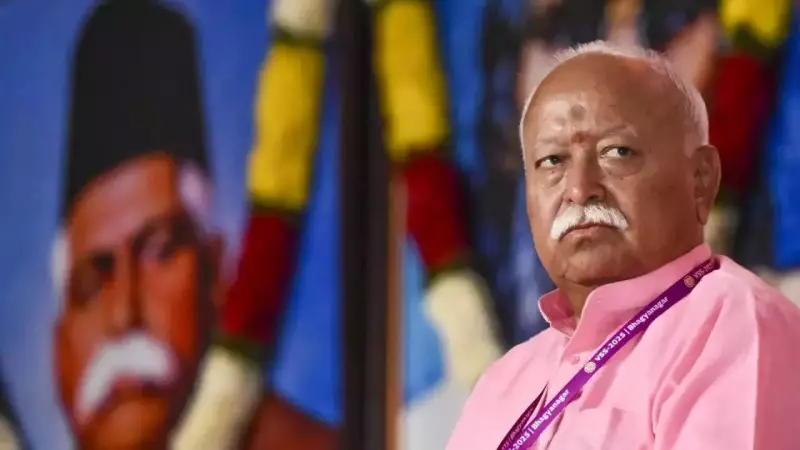
Rashtriya Swayamsevak Sangh (RSS) chief Mohan Bhagwat, on Friday, delivered a significant clarification regarding the nature of the organisation, firmly stating that it is not a paramilitary body. He addressed common perceptions stemming from its structured drills and uniform, emphasising its core purpose is character-building and national service.
Uniform and Drill Do Not Define a Paramilitary Force
Speaking publicly, Bhagwat acknowledged that the RSS's external activities might lead to misconceptions. "We wear a uniform, take out marches, and do stick exercise. (But) If someone thinks it is a paramilitary organisation, it will be a mistake," he asserted. He explained that these practices are designed to instil discipline, unity, and essential virtues among its volunteers, known as swayamsevaks.
The ultimate goal of this training, according to the RSS chief, is to forge a resilient national character. He stated the organisation aims to imbue qualities that would ensure India never again falls into the clutches of a foreign power. Bhagwat provided a historical perspective, noting that small groups of invaders from distant lands, whom he described as neither wealthier nor more virtuous than Indians, had repeatedly defeated the country. He cited the British rule as the eighth such instance in India's long history.

Context on the 'Three-Day Army' Remark
Bhagwat's latest comments also bring to the fore his controversial statement from 2018, which had sparked a major political row. Speaking in Bihar that year, he had claimed that the RSS had the capability to prepare military personnel within three days, a task that would take the Indian Army six to seven months.
He had added that swayamsevaks would be ready to take on the front if the country faced such a situation and the Constitution permitted it. The remark had triggered strong criticism from opposition parties, who saw it as a disrespect to the armed forces.
Congress leader Rahul Gandhi had then said, "The RSS chief's speech is an insult to every Indian, because it disrespects those who have died for our nation. It is an insult to our flag because it insults every soldier who ever saluted it." The opposition had demanded an apology from Bhagwat for comparing the RSS with the professional army.
RSS and BJP: Clarifying the Relationship
In his address, Bhagwat also took time to delineate the RSS's identity from its political progeny, the Bharatiya Janata Party (BJP). He reiterated that it would be a mistake to try to understand the Sangh solely through the prism of the BJP.
"There is a common feeling that the Sangh was born as a reaction or opposition (to the prevailing forces). This is not the case. The Sangh is not a reaction or opposition to anything. The Sangh is not competing with anyone as well," the RSS chief clarified.
While acknowledging the ideological and organisational links, he stressed the RSS's independent identity and purpose. Historically, the BJP's roots lie in the Bharatiya Jana Sangh, founded in 1951 by RSS leader Syama Prasad Mukherjee. The BJP and its predecessor have consistently drawn from the Sangh's ideological worldview, with many of their leaders emerging from the RSS's extensive ecosystem.
Bhagwat's comprehensive remarks serve to address long-standing perceptions about the RSS's structure, its past contentious statements regarding national defence, and its nuanced relationship with the ruling political party at the centre.






