

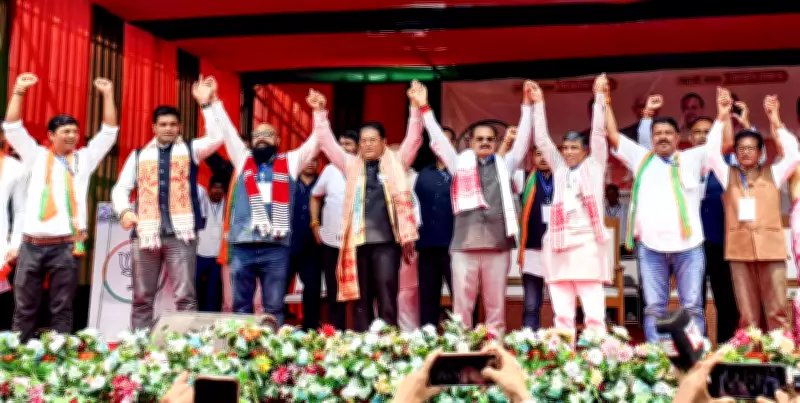
Union Minister Sarbananda Sonowal Unveils BJP's Three-Pillar Strategy to Combat Infiltration in Assam
In a significant announcement, Union Minister Sarbananda Sonowal declared on Sunday that the Bharatiya Janata Party's approach to addressing the issue of infiltration in Assam for the upcoming five years will be built upon three fundamental pillars. The strategy aims to render infiltrators landless, stateless, and jobless, as part of a broader effort to protect the state's identity and culture from external threats.
Clear Vision for the Next Five Years
Sonowal emphasized that the BJP's plan is designed to decisively tackle what he described as Assam's most pressing problem. "In the next five years, our approach will be clear — make them landless, stateless, and jobless, and prevent them from threatening our identity and culture," he stated. He further clarified that this fight is targeted solely against illegal migrants, not against the Assamese Muslim community, whom he reaffirmed as bona fide citizens of India and integral to Assamese society.
Historical Context and Political Significance
Infiltration has been a dominant issue in Assam's political landscape since 1983, frequently highlighted during election campaigns by key figures such as Prime Minister Narendra Modi, Home Minister Amit Shah, and Chief Minister Himanta Biswa Sarma. Sonowal, speaking to The Times of India, labeled infiltration as a "very serious human problem" and criticized the Congress party for historically settling migrants across various districts. "Now, it is our duty to drive them out," he asserted, linking past policies to current challenges.

Breaking Down the Three-Pillar Approach
The minister detailed each component of the strategy:
- Making Infiltrators Landless: Sonowal pointed to ongoing eviction drives that have already displaced Bangladesh-origin Muslim migrants from over 1.5 lakh bighas of illegally occupied forest and government lands. He vowed that more evictions would occur in the next five years, viewing this as an effective method to compel their departure.
- Rendering Them Stateless: The second pillar involves removing the names of illegal migrants from the National Register of Citizens (NRC). Sonowal explained that affidavits have been filed in the Supreme Court, seeking stricter monitoring through re-verification processes—20% in border districts and 10% in interior districts—to ensure the NRC's integrity as a constitutional document.
- Making Them Jobless: The final pillar focuses on depriving infiltrators of employment opportunities. Sonowal argued that this would force them to leave Assam, as they pose a threat to local identity and culture through their presence and activities.
Sonowal's Legacy and Legal Battles
Widely recognized as a key architect in Assam's legal and political struggle against infiltration, Sonowal's efforts predate the BJP's rise in the state. He single-handedly challenged the Illegal Migrants (Determination by Tribunals) Act (IMDT), leading to its repeal by the Supreme Court in 2005. The court noted that the IMDT Act, introduced by the Indira Gandhi government in 1983 during the Assam Movement, inadvertently protected illegal migrants rather than facilitating their identification and deportation. This repeal marked a pivotal moment in Assam's history, elevating Sonowal to national prominence.
Criticism of Congress and Border Security Measures
Sonowal accused the Congress party of ignoring the Supreme Court's judgment post-IMDT repeal, alleging that they systematically settled migrants, transferred land and resources to them, and illegally included their names in electoral rolls. "This created problems in many ways, leading indigenous people to feel disturbed and distressed, ultimately sparking the six-year Assam Movement," he said. Despite the Assam Accord's promises, he claimed nothing was implemented in practice.

In contrast, Sonowal highlighted the BJP government's achievements in sealing the Bangladesh border with modern scientific devices, making it impermeable to infiltrators. Additionally, he noted initiatives to support indigenous communities, such as distributing over eight lakh land pattas to Assamese families across two terms and promoting cultural elements like Assamese classical language status and UNESCO recognition for Moidams in Sivasagar.
This comprehensive strategy underscores the BJP's commitment to addressing long-standing infiltration issues while balancing the rights of legitimate citizens in Assam.





